

In this article
- Chicken eggs fiber in every carton on the shelf
- What one large chicken egg supplies
- How chicken egg sizes are set
- What grades AA, A and B mean
- Brown, white and colored shells
- Chicken eggs compared with other poultry eggs
- What a dozen large eggs adds up to
- How many chicken eggs fit a healthy week
- Turning an egg meal into a fiber meal
- A carton checklist for your next shop
- Chicken eggs and fiber: what shoppers ask
- Sources
You’re standing at the egg case, choosing between brown and white, large and jumbo, grade A and grade AA. None of those choices touches the fiber number, because chicken eggs fiber content is 0 grams in every option on the shelf.
USDA FoodData Central lists zero fiber for a raw whole chicken egg, and that holds for every size it tracks. The labels on the carton still tell you something useful, though, and this guide decodes each one.
Chicken eggs fiber in every carton on the shelf
Fiber comes from plants. Mayo Clinic defines it as the parts of plant foods your body can’t digest or absorb, and a chicken egg is formed entirely inside a hen from animal proteins and fats.
That’s why the fiber line stays at zero no matter how the egg is sorted or sold:
- Size: peewee through jumbo, 0 g
- Grade: AA, A or B, 0 g
- Shell color: white or brown, 0 g
- Yolk color: pale yellow to deep orange, 0 g
A full dozen large eggs, about 600 grams of edible egg, still adds up to 0 grams of fiber. It does bring roughly 76 grams of protein.
What one large chicken egg supplies
USDA measures a large egg at 50 grams once it’s out of the shell. Here’s what that edible portion holds, with percent Daily Value based on the FDA’s label targets:
| Nutrient | Large egg (50 g) | Medium egg (44 g) | % DV, large egg |
|---|---|---|---|
| Calories | 72 | 63 | n/a |
| Protein | 6.3 g | 5.5 g | 13% |
| Fat | 4.8 g | 4.2 g | 6% |
| Saturated fat | 1.6 g | 1.4 g | 8% |
| Fiber | 0 g | 0 g | 0% |
| Cholesterol | 186 mg | 164 mg | n/a |
| Choline | 147 mg | 129 mg | 27% |
| Selenium | 15.4 mcg | 13.5 mcg | 28% |
| Riboflavin | 0.23 mg | 0.20 mg | 18% |
| Vitamin B12 | 0.45 mcg | 0.39 mcg | 19% |
| Vitamin A | 80 mcg | 70 mcg | 9% |
| Vitamin D | 1.0 mcg | 0.9 mcg | 5% |
Choline and selenium stand out. A single large egg covers more than a quarter of the Daily Value for each, for about 72 calories.
The egg also carries about 252 micrograms of lutein and zeaxanthin, two yellow pigments that sit in the yolk. Harvard’s Nutrition Source lists them among the nutrients eggs supply.
Not sure how many grams of fiber should sit beside your eggs each day? Our fiber calculator works out a personal target for you.
How chicken egg sizes are set
Egg sizes in the United States aren’t a guess. The USDA Egg Grading Manual assigns each size class a minimum net weight per dozen, measured in the shell:
| Size class | Minimum per dozen | Average per egg, in shell |
|---|---|---|
| Jumbo | 30 oz | 2.5 oz |
| Extra large | 27 oz | 2.25 oz |
| Large | 24 oz | 2.0 oz |
| Medium | 21 oz | 1.75 oz |
| Small | 18 oz | 1.5 oz |
| Peewee | 15 oz | 1.25 oz |
The class is set by the weight of the whole dozen, so individual eggs in one carton can vary a little. The manual allows single eggs slightly under the dozen rate, such as 23 ounces per dozen for an egg in a large carton.
Bigger eggs bring proportionally more protein, fat and vitamins, since the composition per gram stays about the same. Fiber is the one line that never scales, because zero times any weight is still zero.
What grades AA, A and B mean
Grade is about interior quality and shell condition, not nutrition. The USDA manual describes how a broken out egg looks at each level:
- Grade AA: a firm, tall yolk and thick white that spreads very little
- Grade A: a round, upstanding yolk with a slightly less firm white
- Grade B: a flatter yolk and a thinner white that spreads wider
Graders inspect eggs by candling, which means shining a light through the shell to see the air cell, yolk and any defects. Small blood spots push an egg into grade B, and larger ones remove it from sale.
FoodData Central doesn’t separate eggs by grade, so the protein and choline numbers above apply to all three.
Brown, white and colored shells
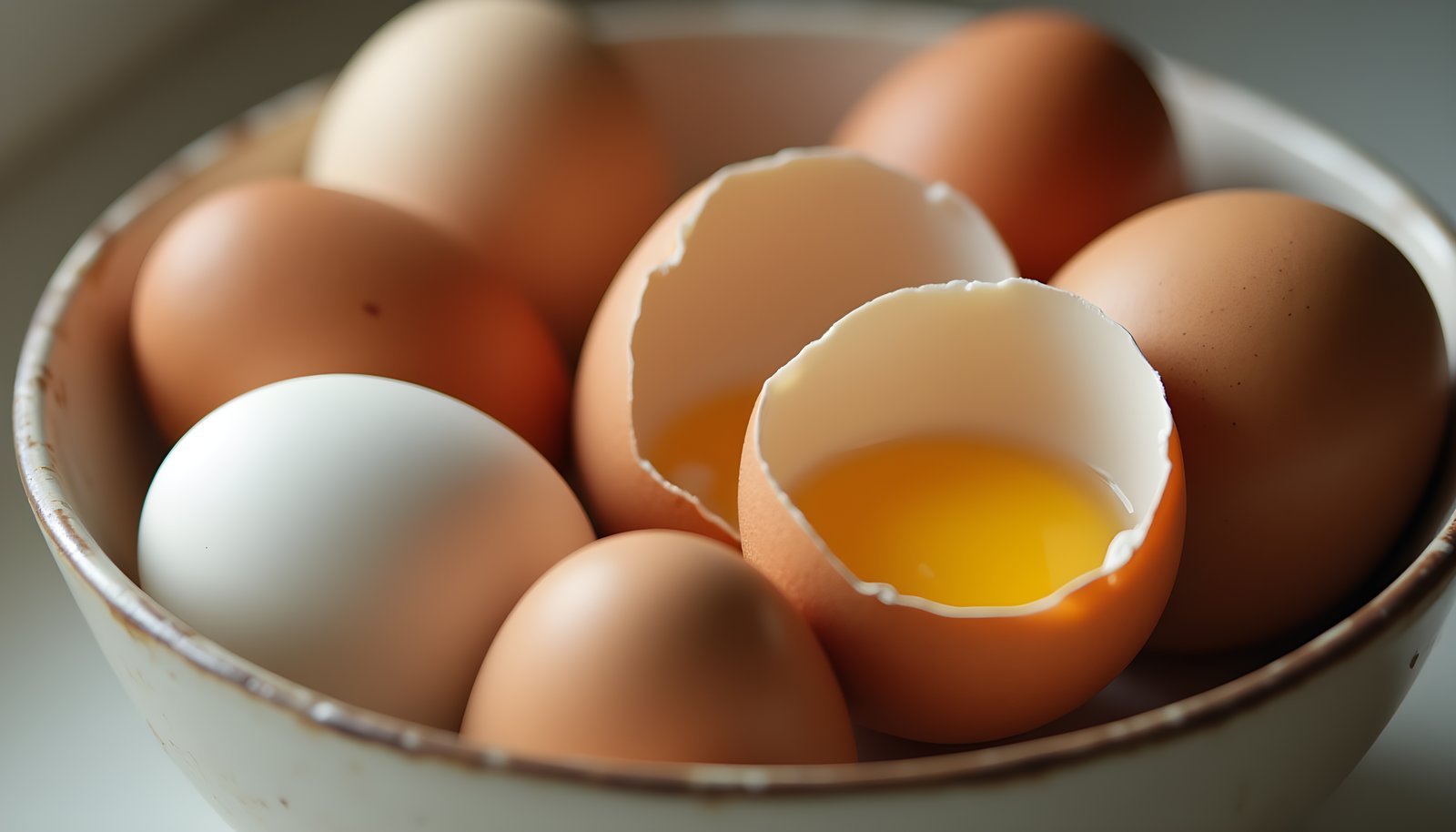
Shell color depends on the hen’s breed. The USDA manual states plainly that shell color doesn’t affect the quality of the egg and isn’t a factor in U.S. grades.
Harvard’s Nutrition Source agrees on nutrition: brown and white eggs are nutritionally similar. Picking brown over white adds no fiber, protein or vitamins.
Yolk color works differently. The grading manual notes that hens fed yellow grains and green feed lay darker yellow to orange yolks, so color reflects diet rather than a fixed nutrition upgrade.
Chicken eggs compared with other poultry eggs
Chicken eggs are the standard in most kitchens, but duck, quail and goose eggs show up at farmers markets and specialty stores. Per 100 grams of edible egg, FoodData Central reports:
| Per 100 g | Chicken | Duck | Quail | Goose |
|---|---|---|---|---|
| Calories | 143 | 185 | 158 | 185 |
| Protein | 12.6 g | 12.8 g | 13.1 g | 13.9 g |
| Cholesterol | 372 mg | 884 mg | 844 mg | 852 mg |
| Fiber | 0 g | 0 g | 0 g | 0 g |
All four tie at zero fiber. Chicken eggs carry the least cholesterol per gram in this group, while the other three are richer and higher in calories.
A duck egg weighs about 70 grams, so one replaces roughly one and a half large chicken eggs. A quail egg weighs about 9 grams, so you’d need five or six to match a single large chicken egg.
What a dozen large eggs adds up to
Buying by the dozen makes it easy to see an egg’s place in your week. Twelve large eggs, about 600 grams once cracked, deliver these totals:
| Per dozen large eggs | Amount | Share of one day’s DV |
|---|---|---|
| Protein | about 76 g | 151% |
| Choline | about 1,760 mg | 320% |
| Calories | about 860 | n/a |
| Fiber | 0 g | 0% |
Spread over a week, that’s a little under two eggs a day and a strong share of your choline. Meanwhile, the fiber you need over those same seven days, 175 grams at 25 a day, still has to come entirely from other foods.
If you eat two eggs every morning, a dozen lasts six days. That’s six breakfasts where the side dish decides whether you start the day with zero grams of fiber or ten.
How many chicken eggs fit a healthy week
A large egg holds about 186 milligrams of cholesterol, all of it in the yolk. Harvard notes that the 2015 Dietary Guidelines dropped the old 300 milligram daily cholesterol limit.
Large studies tracking about 40,000 men and more than 80,000 women found that up to one egg a day didn’t raise heart disease risk in healthy people, according to Harvard. People with diabetes are the exception, and Harvard suggests they keep yolks to about three a week.
What surrounds the eggs matters too. Bacon, sausage and buttered white toast add saturated fat and sodium, while vegetables, beans and whole grains add the fiber eggs lack.
Turning an egg meal into a fiber meal
Since eggs bring protein and no fiber, every gram has to come from what you cook with them. These FoodData Central values show how fast that adds up:
| Add to your eggs | Amount | Fiber |
|---|---|---|
| Raspberries, on the side | 1 cup | 8.0 g |
| Chickpeas, simmered in sauce | 1/2 cup | 6.3 g |
| Broccoli, cooked | 1 cup | 5.2 g |
| Avocado, cubed | 1/2 cup | 5.0 g |
| Spinach, cooked | 1 cup | 4.3 g |
| Mushrooms, cooked | 1 cup | 3.4 g |
| Almonds | 1 oz | 3.5 g |
| Red bell pepper, raw | 1 cup | 3.1 g |
| Whole wheat tortilla | 1 oz | 2.8 g |
Three plates built around two large eggs
- Vegetable omelet: 1 cup cooked spinach, 1 cup cooked mushrooms and 1/2 cup red bell pepper, about 9.3 g fiber
- Chickpea skillet: eggs poached in tomato sauce with 1/2 cup chickpeas and a 1 oz whole wheat tortilla, about 9.1 g
- Grab and go: 2 hard boiled eggs with 1 cup raspberries and 1 oz almonds, about 11.5 g
Each plate gives you about 12.6 grams of protein from the eggs and roughly 35 to 45 percent of Mayo Clinic’s 25 gram daily suggestion for women. Men under 50 aim for 38 grams, so the same plate covers about a quarter.
Want more ways to fold vegetables and beans into egg dishes? Our recipe eBooks have plenty of high fiber breakfasts and suppers.
A carton checklist for your next shop
Use this list to decide what’s worth paying for, and what to put in the cart next to the eggs:
- Pick the size your recipes call for, usually large
- Choose grade AA or A for frying and poaching, where a firm yolk shows
- Ignore shell color for nutrition, since brown and white are similar
- Check the date and keep eggs in the refrigerator
- Add one fiber food per egg meal: a vegetable, beans, fruit or a whole grain tortilla
Next time you buy a dozen, put a bag of frozen spinach or a can of chickpeas in the same basket. Tomorrow’s eggs then have a fiber partner waiting, and the plate goes from 0 grams to 6 or more.
Chicken eggs and fiber: what shoppers ask
Do chicken eggs have fiber?
No. USDA FoodData Central lists 0 grams of fiber in a whole chicken egg of any size. Fiber only comes from plant foods.
Do brown eggs have more fiber than white eggs?
No. Both have 0 grams of fiber, and Harvard notes that brown and white eggs are nutritionally similar. Shell color depends on the hen’s breed.
Does a jumbo egg have more fiber than a large egg?
No. A jumbo egg has more protein and fat simply because it weighs more, but fiber stays at 0 grams in every size.
How much protein is in a large chicken egg?
About 6.3 grams in a 50 gram large egg, or 13 percent of the Daily Value. A medium egg has about 5.5 grams.
What does grade AA mean on eggs?
It means the egg has a firm, tall yolk and a thick white that spreads very little. Grade describes quality, not nutrition, so it doesn’t change the fiber or protein.
How many chicken eggs can I eat a day?
Harvard reports that up to one egg a day is fine for most healthy people. Those with diabetes are advised to limit yolks to about three a week.
Which vegetables add the most fiber to an omelet?
Cooked broccoli adds about 5.2 grams per cup and cooked spinach about 4.3 grams. Cooked mushrooms add 3.4 grams per cup.
Sources
- U.S. Department of Agriculture, Agricultural Research Service. “FoodData Central” (egg, whole, raw, fresh 171287; egg, duck 172189; egg, quail 172191; egg, goose 172190; egg, whole, hard boiled 173424; raspberries; chickpeas; broccoli; avocado; spinach; mushrooms; almonds; red bell pepper; whole wheat tortilla). 2026. fdc.nal.usda.gov
- U.S. Department of Agriculture, Agricultural Marketing Service. “Egg-Grading Manual.” Agricultural Handbook Number 75. 2000. www.ams.usda.gov
- U.S. Food and Drug Administration. “Daily Value on the Nutrition and Supplement Facts Labels.” 2024. www.fda.gov
- Harvard T.H. Chan School of Public Health. “Eggs.” The Nutrition Source. 2024. nutritionsource.hsph.harvard.edu
- Mayo Clinic Staff. “Dietary fiber: Essential for a healthy diet.” Mayo Clinic. 2025. mayoclinic.org

