
In this article
- Mushrooms fiber by type and form
- What kind of fiber is in fungi?
- Mushroom nutrition: small on calories, big on minerals
- How mushrooms compare with vegetables
- Mushrooms in plant based eating
- A mushroom swap, counted
- A quick checklist for getting more from mushrooms
- Mushrooms fiber and your digestion
- What research still needs to show
- Common questions about mushrooms and fiber
- Sources
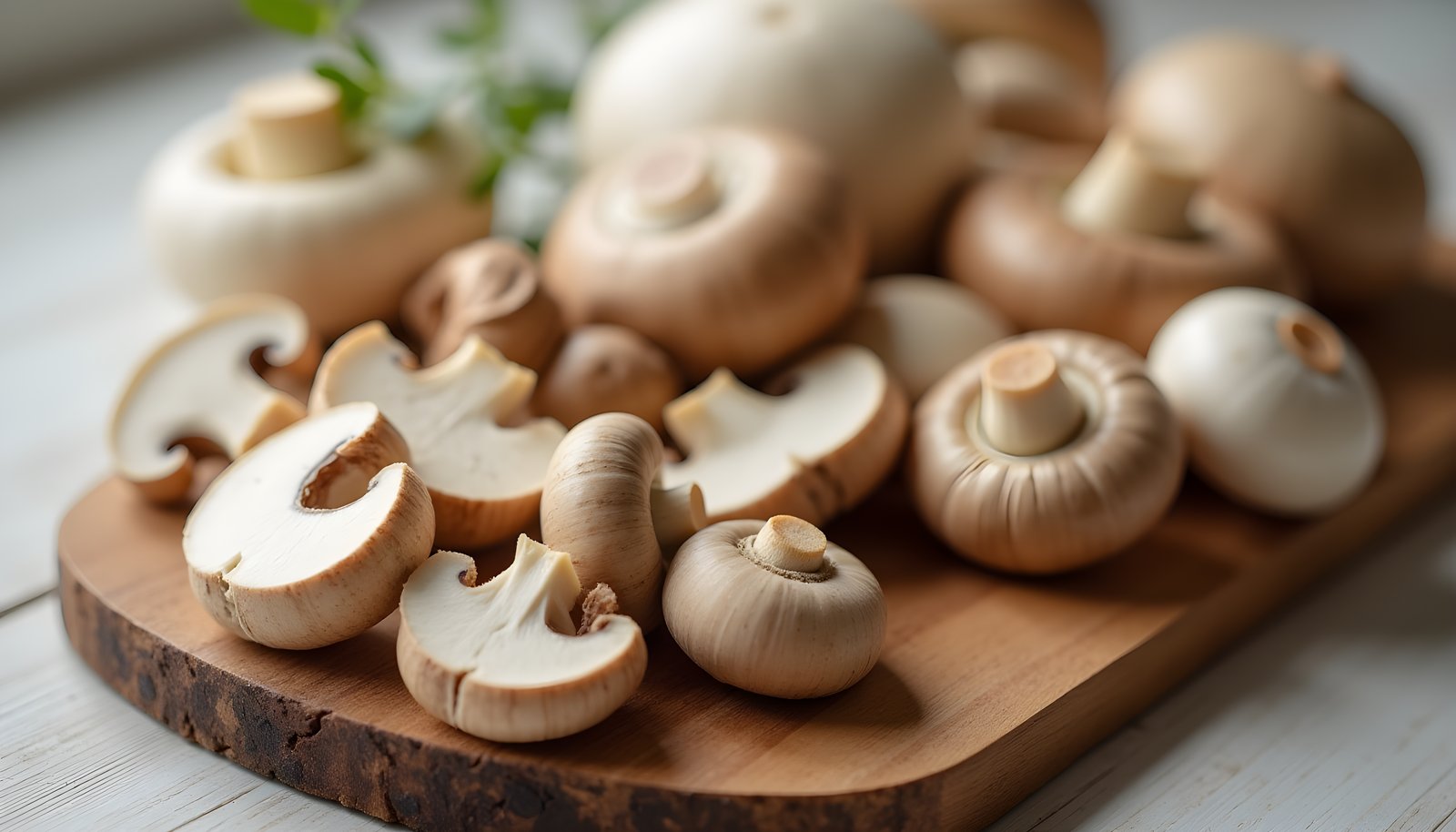
Yes, and cooking is the surprise. A cup of raw sliced or whole white mushrooms gives you only about 1 gram of fiber, but a cup of cooked mushrooms delivers about 3.4 grams, more than three times as much.
Nothing is added in the pan. Mushrooms are mostly water, and as they cook they shrink, so a measuring cup holds far more mushroom. That simple fact changes how much mushrooms fiber you actually get on your plate.
Mushrooms fiber by type and form
USDA FoodData Central lists raw white mushrooms at 1.0 gram of fiber per 100 grams and boiled white mushrooms at 2.2 grams. The same pattern holds for other common varieties.
| Mushroom | Serving | Fiber | % DV (28 g) | Calories |
|---|---|---|---|---|
| White, raw, whole | 1 cup (96 g) | 1.0 g | 4% | 21 |
| White, boiled | 1 cup pieces (156 g) | 3.4 g | 12% | 44 |
| Portabella, grilled | 1 cup sliced (121 g) | 2.7 g | 10% | 35 |
| Shiitake, cooked | 4 mushrooms (72 g) | 1.5 g | 5% | 40 |
| Shiitake, dried | 4 mushrooms (15 g) | 1.7 g | 6% | 45 |
The Dietary Guidelines’ Food Sources of Dietary Fiber list agrees with USDA, putting a cup of cooked mushrooms at 3.4 grams and 44 calories.
Dried shiitake are the most concentrated form. USDA lists them at 11.5 grams of fiber per 100 grams, because nearly all the water is gone. Once you soak them, they plump back up, but the fiber in each mushroom stays the same.
Among fresh mushrooms, the variety matters less than you might think. Boiled white mushrooms and grilled portabellas both list about 2.2 grams of fiber per 100 grams, and cooked shiitake about 2.1 grams. Pick whichever you enjoy most and cook plenty of it.
So if you want more fiber from mushrooms, cook them down. A big pan of sliced raw mushrooms becomes a modest pile, and that pile carries all the fiber you started with.
What kind of fiber is in fungi?
Mushrooms aren’t plants. They’re fungi, and the fiber in fungi is built differently from the fiber in vegetables or grains.
A 2023 review in the Journal of Fungi explains that mushroom dietary fiber is made up mainly of chitin, a tough structural carbohydrate, along with beta-glucans and hemicellulose. The authors call beta-glucan one of the most important components.
Like plant fiber, mushroom fiber comes in soluble and insoluble forms. The same review notes that beta-glucan shows up in both, with a larger share in the insoluble fraction.
Once it reaches your large intestine, this fiber becomes food for gut bacteria. The review describes how fermentation of mushroom fiber yields short-chain fatty acids such as acetate, propionate and butyrate, compounds your gut bacteria produce from fiber.
Most of that research comes from animal and lab studies, so it tells you what mushroom fiber can do rather than exactly what it does in people. Still, it’s a good reason to treat mushrooms as more than a garnish.
Mushroom nutrition: small on calories, big on minerals
Mushroom nutrition stands out for a group of nutrients that most vegetables don’t supply in large amounts. Based on USDA’s record for boiled white mushrooms, one cooked cup (156 g) provides about:
- Copper: 0.8 mg, about 87% of the Daily Value
- Niacin (vitamin B3): 7.0 mg, about 43% DV
- Riboflavin (vitamin B2): 0.5 mg, about 36% DV
- Selenium: 19 mcg, about 34% DV
- Iron: 2.7 mg, about 15% DV
- Potassium: 560 mg, about 12% DV
- Protein: about 3.4 grams
That’s an unusual mix for a food this light. Selenium and copper are trace minerals, and a side of cooked mushrooms covers a third or more of the Daily Value for both.
Portabellas are even stronger on selenium. A cup of grilled portabella slices brings about 26 mcg, close to half the Daily Value, along with about 530 mg of potassium.
Shiitake are the copper champions of the group. Four cooked shiitake caps provide about 72% of the Daily Value for copper, and four dried ones about 86%.
Curious how much fiber you should be aiming for each day? Our fiber calculator gives you a personal target in seconds.
How mushrooms compare with vegetables
Cooked mushrooms hold their own next to many everyday vegetables. Here’s how they line up using the Dietary Guidelines’ figures for one cup.
| Food (1 cup) | Fiber | Calories |
|---|---|---|
| Brussels sprouts, cooked | 6.4 g | 65 |
| Broccoli, cooked | 5.2 g | 54 |
| Green beans, cooked | 4.0 g | 44 |
| Mushrooms, cooked | 3.4 g | 44 |
| Red bell pepper, raw | 3.1 g | 39 |
| Asparagus, cooked | 2.9 g | 32 |
| Cabbage, cooked | 2.8 g | 34 |
Mushrooms match green beans on calories and come within a gram of their fiber. They also edge past asparagus, cabbage and raw red bell pepper.
Raw mushrooms are another matter. At about 1 gram per cup, a few slices on a salad add flavor but very little fiber.
Mayo Clinic suggests about 21 to 25 grams of fiber a day for women and 30 to 38 grams for men. A cup of cooked mushrooms covers roughly 14 to 16% of a woman’s target.
Mushrooms in plant based eating
Mushrooms show up constantly in plant based foods as a stand-in for meat, thanks to their savory flavor and chewy texture. That swap has a fiber upside.
Meat contains no fiber at all, so replacing some of the ground beef in tacos, chili or pasta sauce with chopped cooked mushrooms adds fiber that wasn’t there before. Every cup of cooked mushrooms you mix in brings about 3.4 grams.
A grilled portabella cap makes a natural burger patty, and sliced shiitake add depth to stir fries and grain bowls. Pair mushrooms with beans or lentils for a plant based meal that’s genuinely high in fiber. Half a cup of lentils alone adds about 7.8 grams, according to the Dietary Guidelines.
Want more ideas for meatless meals built around ingredients like these? Our recipe eBooks are full of easy, high fiber options.
A mushroom swap, counted
Say you make a pot of chili for four with a pound of ground beef. The beef contributes no fiber, so every gram in the pot comes from the beans, tomatoes and other vegetables.
Now swap half the beef for two cups of finely chopped mushrooms, cooked until they brown. Those two cooked cups add roughly 6.8 grams of fiber to the pot, about 1.7 grams per bowl, and they bring along copper, selenium and B vitamins too.
The texture stays hearty, because browned mushrooms have a meaty chew that blends into the sauce. That makes the swap an easy one to try on a weeknight.
Add a can of beans to the same pot and each bowl climbs much higher. Half a cup of navy beans carries about 9.6 grams of fiber, according to the Dietary Guidelines, so mushrooms and beans together turn a classic chili into one of the most fiber rich meals of the week.
The same trick works in pasta sauce, meatballs, burgers and taco filling. Start with a quarter of the meat replaced, then go further if you like the result.
A quick checklist for getting more from mushrooms
- Cook them down: sauté, roast or grill so the cup fills with mushroom, not water
- Use the whole package rather than a handful, since it shrinks a lot in the pan
- Keep dried shiitake in the pantry for soups, broths and stir fries
- Save the soaking liquid from dried mushrooms as a flavorful broth
- Blend chopped mushrooms into ground meat dishes or veggie burgers
- Pair them with a higher fiber food such as beans, barley or brown rice
The biggest jump comes from the first item. Switching from a handful of raw slices to a cup of sautéed mushrooms more than triples the fiber.
Mushrooms fiber and your digestion
Whatever its source, fiber helps your gut in similar ways. Mayo Clinic explains that fiber increases stool weight and size and softens it, which makes it easier to pass and helps prevent constipation.
Mayo Clinic also notes that fiber rich foods tend to be more filling. With only about 44 calories per cooked cup, mushrooms add volume and savoriness to a meal without adding much energy.
If you’re adding more fiber overall, Mayo Clinic recommends doing it gradually over a few weeks and drinking plenty of water.
If your digestion tends to complain when you change your diet, our gut health guides walk you through a gentler approach.
What research still needs to show
Scientists are increasingly interested in mushroom fiber as a food for gut bacteria. The 2023 Journal of Fungi review gathered studies showing that mushroom fiber can shift gut microbes and boost short-chain fatty acid production.
Most of that evidence comes from mice, rats and lab fermentation tests, and the authors themselves call for more human clinical trials. Over the next few years, expect clearer answers on whether chitin and mushroom beta-glucans do anything special in people beyond what fiber in general already does. Until then, the safest bet is simple: cook your mushrooms, eat them often and count them toward your daily fiber.
Common questions about mushrooms and fiber
Are mushrooms high in fiber?
Cooked mushrooms are a moderate source, with about 3.4 grams per cup. Raw mushrooms are low, at about 1 gram per cup, because they’re mostly water.
Which mushroom has the most fiber?
Dried shiitake have the most by weight, at 11.5 grams per 100 grams. Among fresh, cooked white mushrooms and grilled portabellas both have about 2.2 grams per 100 grams.
Do cooked mushrooms have more fiber than raw?
Per cup, yes. Cooking shrinks mushrooms, so a cup of boiled white mushrooms holds about 3.4 grams of fiber compared with about 1 gram in a raw cup.
What type of fiber is in mushrooms?
Mostly chitin, along with beta-glucans and hemicellulose, according to a 2023 review in the Journal of Fungi. Mushroom fiber includes both soluble and insoluble forms.
Are mushrooms good for gut health?
They can help. Mushroom fiber is fermented by gut bacteria into short-chain fatty acids, though most of the research so far comes from animal and lab studies.
How many calories are in a cup of mushrooms?
About 21 calories raw and about 44 calories cooked, according to USDA. That makes them an easy way to add volume to a meal.
Are mushrooms a vegetable?
They’re fungi, not plants, but they’re usually cooked and eaten like vegetables and fit easily into plant based eating.
Sources
- USDA Agricultural Research Service. FoodData Central: SR Legacy Mushrooms, white, raw (169251); white, cooked, boiled, drained, without salt (169252); portabella, grilled (169243); shiitake, cooked, without salt (168437); shiitake, dried (168436). 2019. fdc.nal.usda.gov
- U.S. Department of Agriculture and U.S. Department of Health and Human Services. “Food Sources of Dietary Fiber.” Dietary Guidelines for Americans, 2020 to 2025. dietaryguidelines.gov
- U.S. Food and Drug Administration. “Daily Value on the Nutrition and Supplement Facts Labels.” 2024. fda.gov
- Yu C, Dong Q, Chen M, et al. “The Effect of Mushroom Dietary Fiber on the Gut Microbiota and Related Health Benefits: A Review.” Journal of Fungi. 2023. pmc.ncbi.nlm.nih.gov
- Mayo Clinic Staff. “Dietary fiber: Essential for a healthy diet.” Mayo Clinic. 2025. mayoclinic.org