
In this article
- Eggplant fiber by serving
- Eggplant nutrition at a glance
- How eggplant compares with other fiber rich vegetables
- A Mediterranean plate, counted
- Eggplant myths vs facts
- The oil question: does eggplant soak it all up?
- Eggplant in Mediterranean cooking
- What eggplant fiber does for digestion
- Try this tonight
- Eggplant questions people ask
- Sources
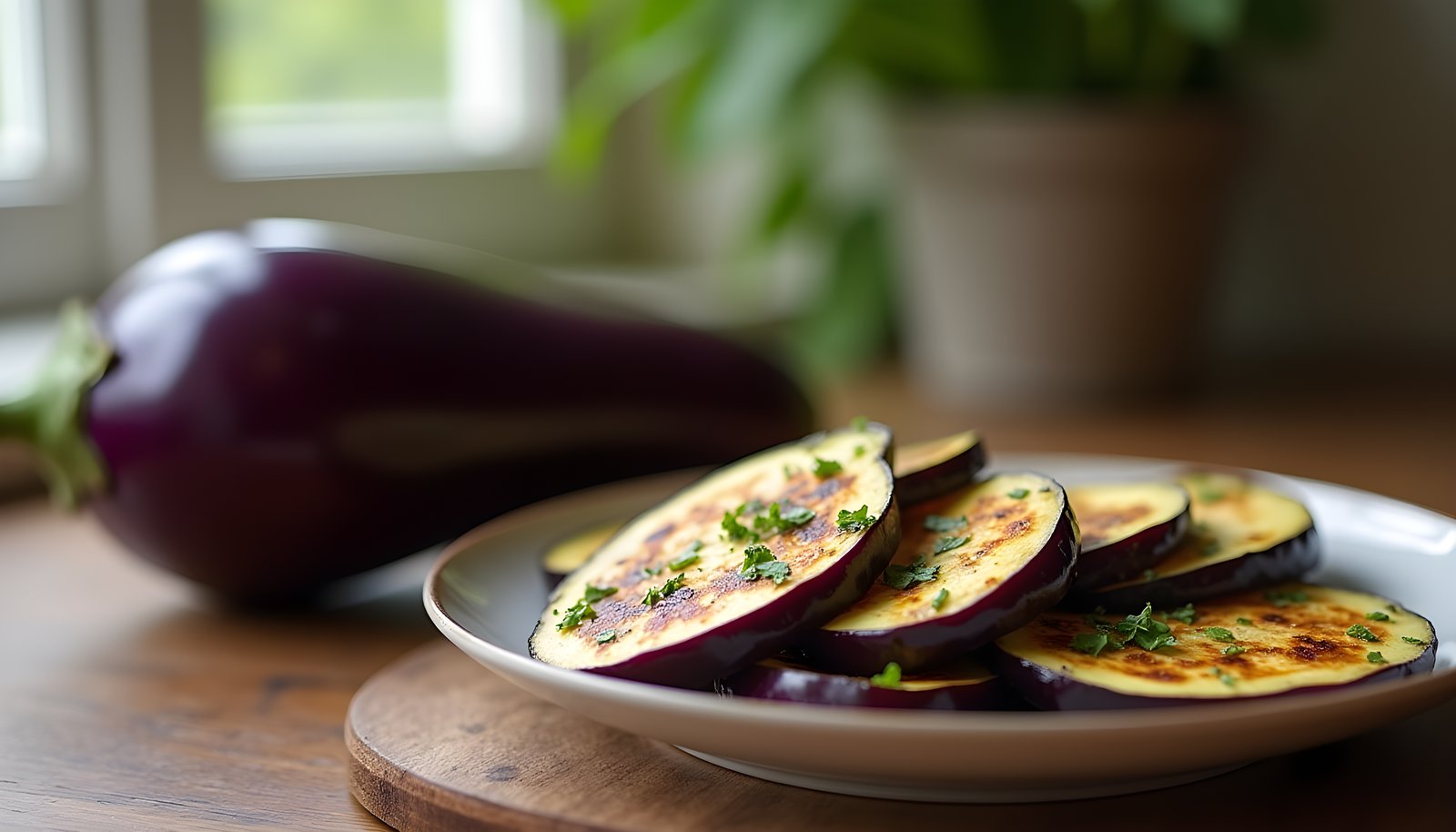
Eggplant has a reputation as a spongy, watery vegetable that mostly soaks up oil. The numbers tell a different story: a cup of cooked eggplant gives you about 2.5 grams of fiber for 35 calories, and a whole medium eggplant holds roughly 16 grams.
Per calorie, that’s a strong showing. Eggplant fiber won’t top a list of the highest fiber vegetables, but it delivers steady fiber in a food that makes up the bulk of many Mediterranean dishes.
Eggplant fiber by serving
USDA FoodData Central lists raw eggplant at 3.0 grams of fiber per 100 grams and boiled eggplant at 2.5 grams. Cooking concentrates eggplant into a smaller volume, so a cup of cooked cubes ends up with about the same fiber as a cup of raw cubes.
| Eggplant form | Serving | Fiber | % DV (28 g) | Calories |
|---|---|---|---|---|
| Raw, cubed | 1 cup (82 g) | 2.5 g | 9% | 20 |
| Boiled, cubed | 1 cup (99 g) | 2.5 g | 9% | 35 |
| Raw, whole medium | 1 eggplant (548 g) | 16.4 g | 59% | 137 |
| Raw | 100 g | 3.0 g | 11% | 25 |
| Cooked with added fat | 100 g | about 2.5 g | 9% | 51 |
That whole eggplant figure surprises a lot of people. A single 1.25 pound eggplant, the size you’d use for a tray of roasted slices or a pan of eggplant parmesan, carries more than half of the 28 gram Daily Value.
Cup for cup, raw and boiled eggplant come out even on fiber. The calories rise a little after boiling because the cooked cubes pack more eggplant into the same cup, not because anything is added.
Of course, you’ll usually share it. Split four ways, each portion still brings about 4 grams of fiber from the eggplant alone.
Eggplant nutrition at a glance
Eggplant is a light vegetable in most nutrients other than fiber, which is part of why it works so well as a base. Based on USDA’s raw eggplant record, 100 grams provides about:
- Calories: 25
- Carbohydrate: 5.9 g, with 3.0 g of it fiber
- Natural sugar: 3.5 g
- Fat: 0.2 g
- Protein: 1 g
- Potassium: 229 mg, about 5% DV
- Manganese: 0.23 mg, about 10% DV
The fiber to carbohydrate ratio stands out. About half the carbs in raw eggplant are fiber, which leaves roughly 2.9 grams of net carbs per 100 grams, the part your body actually digests.
Boiling pulls some minerals into the water. USDA lists potassium at 123 mg per 100 grams after boiling and manganese at 0.11 mg, roughly half the raw amounts. Roasting or grilling, with no cooking water to pour away, is a reasonable way to hold on to more.
In a typical cup of raw cubes (82 g), that works out to about 2.5 grams of fiber, 188 mg of potassium and only 20 calories. Even a generous two cup portion stays around 40 calories before any oil goes in.
Eggplant is low in vitamins compared with leafy greens. Its strength lies in volume, texture and fiber, so pair it with colorful vegetables to round out the plate.
How eggplant compares with other fiber rich vegetables
Here’s where a cup of eggplant sits next to other common vegetables from the Dietary Guidelines’ Food Sources of Dietary Fiber list.
| Vegetable (1 cup) | Fiber | Calories |
|---|---|---|
| Cauliflower, cooked | 4.9 g | 34 |
| Green beans, cooked | 4.0 g | 44 |
| Okra, cooked | 4.0 g | 36 |
| Mushrooms, cooked | 3.4 g | 44 |
| Red bell pepper, raw | 3.1 g | 39 |
| Asparagus, cooked | 2.9 g | 32 |
| Eggplant, cooked | 2.5 g | 35 |
Eggplant lands toward the middle of the low calorie group. It trails green beans and okra by about 1.5 grams per cup, and it’s close to asparagus and cooked cabbage.
Where eggplant wins is portion size. People rarely eat a single cup of asparagus, but a serving of ratatouille or baba ghanoush can easily include two cups of eggplant, which puts you at about 5 grams of fiber.
Mayo Clinic recommends about 21 to 25 grams of fiber a day for women and 30 to 38 grams for men. Two cups of cooked eggplant covers about a fifth of a woman’s target.
Want a quick read on your own daily target? Our fiber calculator works it out in seconds.
A Mediterranean plate, counted
Picture a simple dinner built the Mediterranean way. You roast two cups of eggplant cubes, stir them into a pan of tomatoes and garlic with half a cup of chickpeas, and spoon it over a cup of cooked brown rice.
The eggplant brings about 5 grams of fiber. The chickpeas add about 6.3 grams and the brown rice about 3.5 grams, based on the Dietary Guidelines’ figures, for a total near 15 grams before you count the tomatoes.
That’s well over half of a 21 to 25 gram target for women in a single bowl. The eggplant itself is the lightest part of the meal, at roughly 70 calories for those two cups, yet it makes up most of the volume.
Swap the chickpeas for lentils and the total climbs a little more, since half a cup of lentils carries about 7.8 grams. Either way, the eggplant does the job of stretching the bowl without stretching the calories.
Eggplant myths vs facts
Myth: eggplant is mostly water with nothing to offer
It’s light, but not empty. USDA lists 3.0 grams of fiber per 100 grams of raw eggplant, more than many people expect, and about half of its carbohydrate is fiber.
Myth: eggplant is always a high calorie food
Plain eggplant is very low in calories, at about 20 per raw cup. The high calorie reputation comes from frying and heavy oil, not the vegetable.
The oil question: does eggplant soak it all up?
This is the one real catch with eggplant, and USDA’s records show it clearly. Raw eggplant has just 0.2 grams of fat per 100 grams, but USDA’s record for eggplant cooked with added fat lists 2.9 grams of fat and 51 calories.
That’s about 15 times the fat of plain eggplant, while the fiber stays the same.
You don’t need to avoid oil, which carries flavor and helps eggplant brown. You just need a few techniques that use less of it:
- Brush oil onto slices rather than pouring it into the pan
- Roast cubes on a sheet pan at high heat instead of shallow frying
- Use a pastry brush or spray bottle so a little oil covers more surface
- Grill thick slices, which need only a light coat
- Measure oil with a spoon instead of pouring straight from the bottle
Pickled eggplant is another way to enjoy it, but USDA lists it at 49 calories per 100 grams, about double raw eggplant, so treat it more like a condiment.
Eggplant in Mediterranean cooking
Mediterranean cooking leans on eggplant in a big way, and many of its classic dishes are naturally fiber rich because they pair eggplant with beans, tomatoes and whole grains.
Baba ghanoush
Roasted eggplant blended with tahini, lemon and garlic. Serve it with raw vegetables or whole wheat pita instead of white pita chips for a higher fiber snack.
Ratatouille
A stew of eggplant, zucchini, peppers, onions and tomatoes. Every ingredient adds fiber, and two cups of eggplant alone bring about 5 grams before you count the rest.
Caponata and imam bayildi
Caponata is a Sicilian sweet and sour eggplant relish, while imam bayildi is a Turkish dish of eggplant stuffed with onions and tomatoes. Recipes for both often call for a fair amount of oil, so measuring it helps if you’re watching calories.
Eggplant and chickpea stews
Many Middle Eastern recipes simmer eggplant with chickpeas. Half a cup of chickpeas adds about 6.3 grams of fiber, according to the Dietary Guidelines, turning a vegetable dish into a filling main.
Looking for more ways to cook eggplant beyond the usual parmesan? Our recipe eBooks are full of easy, high fiber meals.
What eggplant fiber does for digestion
Eggplant’s fiber works the same way fiber from other vegetables does. Mayo Clinic explains that fiber adds weight and size to stool and softens it, which makes it easier to pass and helps prevent constipation.
Because eggplant is so low in calories, it also adds a lot of volume to a meal. Mayo Clinic notes that high fiber foods tend to be more filling, so you may eat less while staying satisfied longer.
As with any fiber increase, Mayo Clinic suggests going gradually and drinking plenty of water. That helps your digestive system adjust without gas or bloating.
If your digestion needs a gentler path to more fiber, our gut health guides walk you through it step by step.
Try this tonight
Cut one medium eggplant into cubes, toss them with a tablespoon of olive oil, salt and pepper, and roast at high heat until golden. You’ll have a tray with about 16 grams of fiber to share across the week.
Stir a scoop into pasta sauce, pile some onto a grain bowl or blend the rest into a quick baba ghanoush. One vegetable, a few meals, and much less oil than frying would use.
Eggplant questions people ask
Is eggplant high in fiber?
It’s a moderate source. A cup of raw or cooked eggplant has about 2.5 grams of fiber, around 9% of the Daily Value, and a whole medium eggplant has about 16 grams.
Is eggplant good for weight loss?
It can help. A cup of cooked eggplant has about 35 calories and 2.5 grams of fiber, and Mayo Clinic notes that high fiber foods tend to keep you full longer.
Does cooking eggplant reduce its fiber?
Only slightly per gram. USDA lists 3.0 grams per 100 grams raw and 2.5 grams boiled, and a cup of either has about 2.5 grams.
Why is cooked eggplant often high in calories?
It readily takes up oil during cooking. USDA lists eggplant cooked with added fat at 51 calories per 100 grams, double plain raw eggplant.
Is eggplant good for a low carb diet?
Yes. Raw eggplant has about 5.9 grams of carbohydrate per 100 grams, and about half of that is fiber.
How much fiber is in baba ghanoush?
It depends on the recipe, but the eggplant base provides about 2.5 to 3 grams of fiber per 100 grams before tahini is added.
How many calories are in a cup of eggplant?
About 20 calories raw and 35 calories boiled, according to USDA. Oil is what changes the number most, not the eggplant itself.
Sources
- USDA Agricultural Research Service. FoodData Central: SR Legacy Eggplant, raw (169228); Eggplant, cooked, boiled, drained, without salt (169229); Eggplant, pickled (169892); Eggplant, cooked, fat added. 2019. fdc.nal.usda.gov
- U.S. Department of Agriculture and U.S. Department of Health and Human Services. “Food Sources of Dietary Fiber.” Dietary Guidelines for Americans, 2020 to 2025. dietaryguidelines.gov
- U.S. Food and Drug Administration. “Daily Value on the Nutrition and Supplement Facts Labels.” 2024. fda.gov
- Mayo Clinic Staff. “Dietary fiber: Essential for a healthy diet.” Mayo Clinic. 2025. mayoclinic.org