
In this article
- Mung beans fiber, form by form
- Why mung beans rank so high per calorie
- Mung beans next to other beans, cup for cup
- Folate and the rest of the package
- Sprouted mung beans fiber and food safety
- Where bean sprouts sit among vegetables
- Asian legumes nutrition: mung beans on the menu
- A bowl of moong dal, counted
- Mung beans and your gut
- Cooking mung beans from dry
- Which mung bean form to choose
- Mung bean fiber questions
- Sources
Myth: a handful of bean sprouts counts as a serving of beans. Fact: a cup of raw mung bean sprouts has under 2 grams of fiber, while a cup of the cooked beans has about 15 grams, according to USDA FoodData Central.
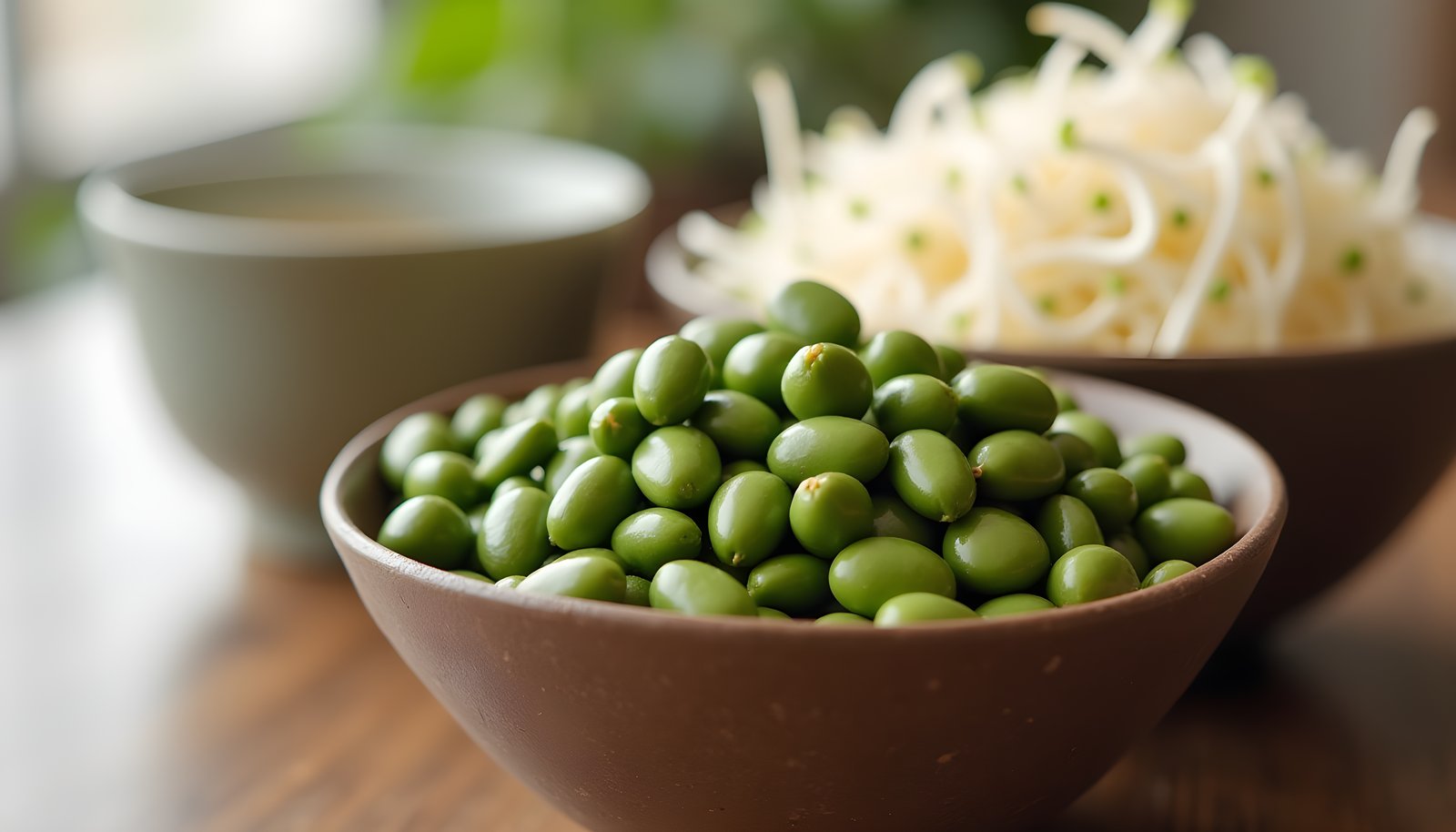
Same plant, very different food. This guide covers mung beans fiber in every common form, why the small green bean ranks near the top of the legume list per calorie, and how it fits into Asian dishes you may already love.
Mung beans fiber, form by form
Mung beans show up as whole dried beans, split and hulled yellow moong dal, and fresh sprouts. The numbers below compare the whole bean and the sprout:
| Mung beans | Serving | Fiber | Calories | Protein |
|---|---|---|---|---|
| Whole, cooked from dry | 1/2 cup | 7.7 g | 106 | about 7 g |
| Whole, cooked from dry | 1 cup (202 g) | 15.4 g | 212 | 14.2 g |
| Whole, cooked from dry | 100 grams | 7.6 g | 105 | 7.0 g |
| Sprouts, raw | 1 cup (104 g) | 1.9 g | 31 | 3.2 g |
| Sprouts, raw | 100 grams | 1.8 g | 30 | 3.0 g |
Half cup values come from the Dietary Guidelines for Americans fiber table, and the rest from USDA FoodData Central. Gram for gram, cooked mung beans have about four times the fiber of the sprouts.
Sprouts are mostly water, which is why they’re so light. They’re a crunchy vegetable, not a bean serving.
Why mung beans rank so high per calorie
On a straight fiber per half cup list, mung beans land in the middle of the pack. Once you divide by calories, they jump to near the top.
| Legume, 1/2 cup cooked | Fiber | Calories | Fiber per 100 calories |
|---|---|---|---|
| Navy beans | 9.6 g | 128 | 7.5 g |
| Mung beans | 7.7 g | 106 | 7.3 g |
| Split peas | 8.2 g | 116 | 7.1 g |
| Lentils | 7.8 g | 115 | 6.8 g |
| Black beans | 7.5 g | 114 | 6.6 g |
| Pinto beans | 7.7 g | 123 | 6.3 g |
| Chickpeas | 6.3 g | 135 | 4.7 g |
Among the beans in this Dietary Guidelines table, only navy beans deliver more fiber for each calorie. Mung beans edge out split peas and lentils, and they beat chickpeas by a wide margin.
That makes them a smart pick if you’re trying to raise fiber without adding many calories. A full cup covers more than half of the 28 gram Daily Value for around 210 calories.
Want to see how far one cup moves you toward your own number? Our fiber calculator works out a personal target in seconds.
Mung beans next to other beans, cup for cup
Per full cooked cup, USDA values put mung beans in close company with the best known high fiber legumes:
- Split peas: 16.3 g fiber, 16.3 g protein
- Lentils: 15.6 g fiber, 17.9 g protein
- Mung beans: 15.4 g fiber, 14.2 g protein
- Black beans: 15.0 g fiber, 15.2 g protein
- Chickpeas: 12.5 g fiber, 14.5 g protein
Mung beans give up a few grams of protein to lentils and split peas, but match them on fiber within a gram. They also beat chickpeas on fiber by nearly 3 grams per cup.
If you already rotate lentils and black beans, mung beans slot right in without lowering your fiber at all. They simply add a new flavor and texture to the mix.
Folate and the rest of the package
Mung beans are a folate powerhouse. A cooked cup has about 321 micrograms, roughly 80% of the Daily Value, by USDA values.
They also bring around 14 grams of protein per cup, with very little fat. Harvard’s Nutrition Source notes that legumes in general supply protein, folate, iron and phosphorus along with both soluble and insoluble fiber.
Sprouts offer a different set of strengths. A cup of raw sprouts has about 13.7 milligrams of vitamin C and 34 micrograms of vitamin K, all for only about 31 calories.
Sprouted mung beans fiber and food safety
If you love bean sprouts in pho, stir fries or spring rolls, you don’t need to give them up. Just know that sprouted mung beans fiber is modest, at about 1.9 grams per cup, so count them as a vegetable add on.
Raw sprouts also carry a food safety caveat. Penn State Extension explains that seeds can carry bacteria like Salmonella and E. coli O157:H7, and the warm, moist sprouting process lets them multiply, even in clean conditions and at home.
Penn State advises young children, older adults and anyone with a weakened immune system to avoid raw sprouts. Cooking sprouts significantly reduces the risk, so a quick toss in a hot wok or a simmer in soup is the safer way to eat them.
Where bean sprouts sit among vegetables
Since sprouts behave like a vegetable, it’s fairer to compare them with other vegetables than with beans. These cooked or raw cup portions come from the Dietary Guidelines fiber table:
| Vegetable, 1 cup | Fiber | Calories |
|---|---|---|
| Broccoli, cooked | 5.2 g | 54 |
| Cauliflower, cooked | 4.9 g | 34 |
| Carrots, cooked | 4.8 g | 54 |
| Kale, cooked | 4.7 g | 43 |
| Mushrooms, cooked | 3.4 g | 44 |
| Red bell pepper, raw | 3.1 g | 39 |
| Mung bean sprouts, raw (USDA) | 1.9 g | 31 |
Sprouts trail every vegetable on this list for fiber. Their strengths are crunch, freshness and very few calories, not bulk fiber.
So if a stir fry is your main vegetable for the night, pair the sprouts with broccoli or peppers. That simple mix can easily triple the fiber of a sprouts only topping.
Asian legumes nutrition: mung beans on the menu
Mung beans are a staple in kitchens across South, East and Southeast Asia. They show up in savory and sweet dishes alike:
- Moong dal: split, hulled mung beans simmered into a soft, spiced Indian dal
- Mung bean soup: a simple sweet soup eaten in China, often served chilled in summer
- Bindaetteok: crisp Korean pancakes made from ground soaked mung beans
- Sprouts: tossed into pho, pad thai, bibimbap and spring rolls
- Glass noodles: made from mung bean starch rather than the whole bean
The whole bean dishes carry the fiber. Glass noodles are made from the starch, not the whole bean, so don’t count them toward your bean servings.
Hungry for more ways to cook with mung beans? Our recipe eBooks are packed with easy, high-fiber dishes from around the world.
A bowl of moong dal, counted
Picture a weeknight bowl: one cup of cooked mung beans simmered with turmeric, cumin, ginger and tomato, spooned over half a cup of cooked brown rice.
The dal brings about 15 grams of fiber on its own. Mayo Clinic lists a full cup of cooked brown rice at 3.5 grams, so half a cup adds roughly 1.8, for a bowl near 17 grams.
That’s about 60% of the Daily Value in one meal. Add a handful of spinach to the pot and the bowl climbs a little higher.
Mung beans and your gut
Mung beans are often described as one of the easier beans to digest, and the Monash University FODMAP team backs part of that up. Monash lists a quarter cup, or 53 grams, of boiled and drained mung beans as a low FODMAP serve.
Monash explains that the carbohydrates in legumes that cause gas are water soluble, so boiling and draining helps lower them. Soaking dried mung beans before cooking, which Harvard recommends for at least three hours, works on the same principle.
Add fiber gradually and drink plenty of water as you go. Starting with a quarter cup and building up over a couple of weeks gives your gut bacteria time to adjust.
If your digestion needs a gentler on ramp, our gut health guides walk you through it step by step.
Cooking mung beans from dry
Whole mung beans are small, so they cook faster than most dried beans. Split, hulled moong dal is quicker still and usually breaks down into a soft, creamy texture.
Rinse the beans, soak them if you have time, then simmer in plenty of water until tender. Season after cooking, and use the cooked beans in dal, soups, salads or blended into a savory pancake batter.
The Dietary Guidelines recommend about 3 cups of legumes a week, Harvard’s Nutrition Source notes. Two or three bowls of moong dal would cover most of that on their own.
If all 3 cups came from mung beans, that would add roughly 46 grams of fiber to your week, more than a day and a half of the Daily Value. Even swapping one rice or pasta side a week for a cup of mung beans makes a visible dent.
Which mung bean form to choose
Use this quick rule when you’re shopping or cooking:
- If fiber is the goal: choose whole or split mung beans, cooked, at about 15 grams per cup
- If you want crunch and vitamin C: add sprouts, cooked if you’re in a higher risk group
- If your gut is sensitive: start with a quarter cup of boiled, drained mung beans
- If you’re counting glass noodles: treat them as a starch, not a legume
Pick the cooked bean whenever you can, and let the sprouts be the garnish.
Mung bean fiber questions
How much fiber is in a cup of cooked mung beans?
About 15.4 grams, according to USDA FoodData Central. That’s more than half of the 28 gram Daily Value, for around 212 calories.
Do mung bean sprouts have fiber?
Yes, but not much. A cup of raw mung bean sprouts has about 1.9 grams of fiber, compared with about 15 grams in a cup of cooked beans.
Is moong dal high in fiber?
Yes. Moong dal is made from split mung beans, and cooked mung beans have about 7.7 grams of fiber per half cup.
Are mung beans easy to digest?
For many people, yes. Monash University lists a quarter cup of boiled, drained mung beans as a low FODMAP serve.
Are mung beans high in protein?
Yes. A cup of cooked mung beans has about 14 grams of protein, plus about 80% of the Daily Value for folate.
Are raw bean sprouts safe to eat?
They carry some risk. Penn State Extension advises young children, older adults and people with weakened immune systems to avoid raw sprouts, and cooking lowers the risk.
Do glass noodles count as mung beans?
No. Glass noodles are made from mung bean starch, not the whole bean, so treat them as a starch rather than a bean serving.
Sources
- U.S. Department of Agriculture, Agricultural Research Service. “FoodData Central.” 2026. fdc.nal.usda.gov
- U.S. Department of Agriculture and U.S. Department of Health and Human Services. “Food Sources of Dietary Fiber.” Dietary Guidelines for Americans, 2020 to 2025. 2020. dietaryguidelines.gov
- LaBorde L. “What You Should Know About Sprouts.” Penn State Extension. 2005. extension.psu.edu
- Collins L. “Including legumes on a low FODMAP diet.” Monash University FODMAP blog. 2016. monashfodmap.com
- Harvard T.H. Chan School of Public Health. “Legumes and Pulses.” The Nutrition Source. 2024. nutritionsource.hsph.harvard.edu
- Mayo Clinic Staff. “Chart of high-fiber foods.” Mayo Clinic. 2025. mayoclinic.org