
In this article
- Bean sprouts fiber, raw, boiled and stir fried
- Sprout nutrition beyond the fiber
- Mung, soy and alfalfa: not all sprouts are alike
- A sprout myth worth clearing up
- Bean sprouts among other low calorie vegetables
- Building more fiber around bean sprouts
- Bean sprouts and your daily fiber goal
- Bean sprouts and your gut
- Getting the best out of bean sprouts
- Which sprout to reach for
- What people ask about bean sprouts fiber
- Sources
You top a noodle bowl with a big tangle of bean sprouts and figure you’ve just added a solid dose of vegetables. You have added something, but a cup of raw mung bean sprouts brings only about 1.9 grams of fiber, roughly 7% of the Daily Value.
What you get in exchange is volume, crunch and very few calories, just 31 in that cup. Bean sprouts fiber also shifts more than you might expect depending on which sprout you buy and what happens to it in the pan.
Bean sprouts fiber, raw, boiled and stir fried
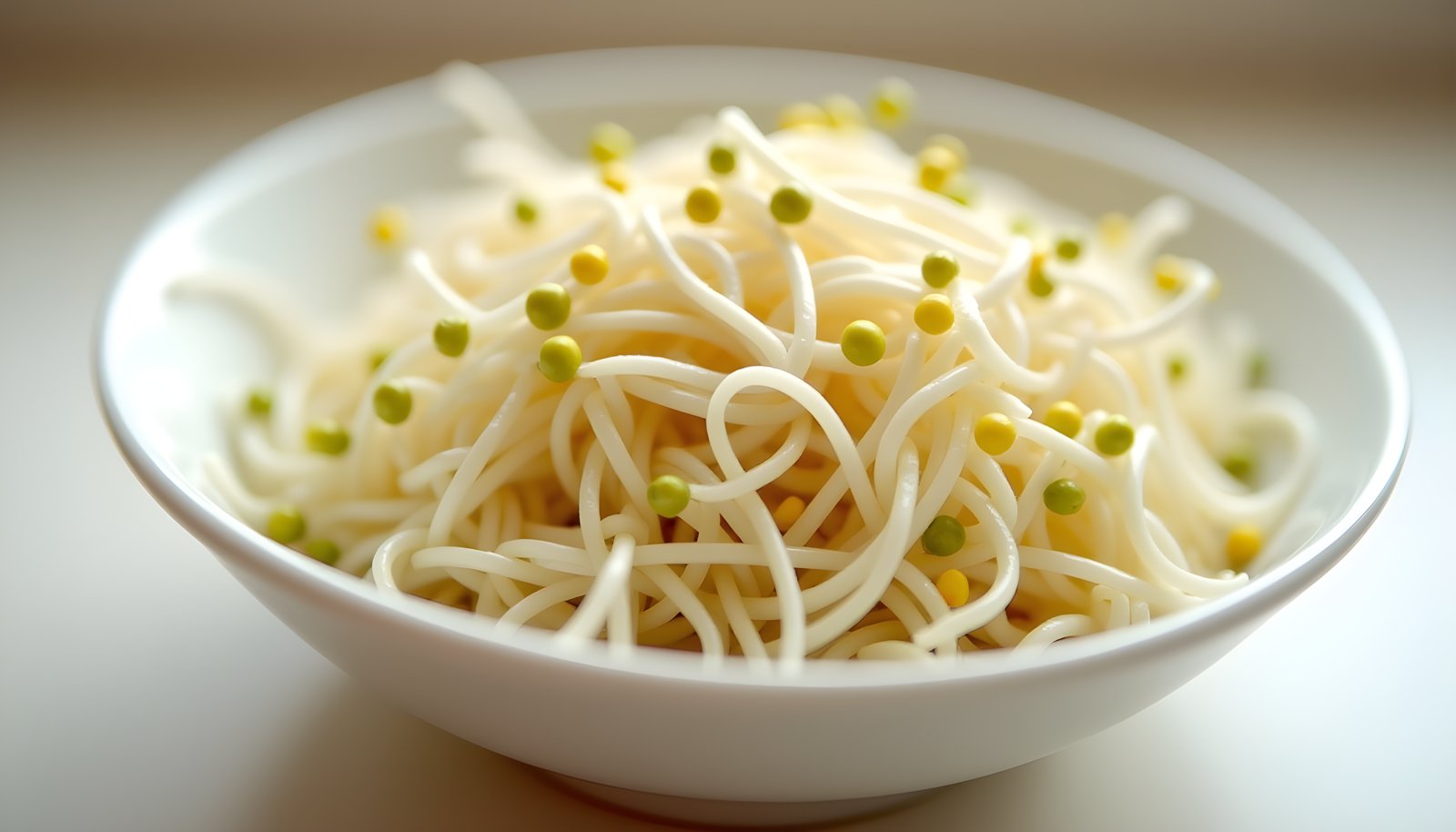
In most stores, “bean sprouts” means sprouted mung beans, the pale, crisp shoots with a small yellow head. USDA FoodData Central lists them in three forms.
| Mung bean sprouts | Serving | Fiber | % DV (28 g) | Calories |
|---|---|---|---|---|
| Raw | 1 cup (104 g) | 1.9 g | 7% | 31 |
| Raw | 100 g | 1.8 g | 6% | 30 |
| Boiled, drained | 1 cup (124 g) | 1.0 g | 4% | 25 |
| Boiled, drained | 100 g | 0.8 g | 3% | 21 |
| Stir fried | 1 cup (124 g) | 2.4 g | 8% | 62 |
| Stir fried | 100 g | 1.9 g | 7% | 50 |
Stir fried sprouts come out on top, at about 2.4 grams per cup. They also double the calories of raw sprouts, since the pan adds oil and the sprouts shrink so more of them fit in a cup.
Boiled sprouts look the weakest on paper, at roughly 1 gram per cup and 0.8 grams per 100 grams. USDA’s records don’t explain the gap, so read it as a measured difference between entries rather than proof that water strips the fiber away.
Whichever form you eat, the totals stay small. Even the best case sits under 10% of the Daily Value per cup.
Sprout nutrition beyond the fiber
Bean sprouts make up for their modest fiber with a few useful vitamins. Here’s a raw cup of mung bean sprouts (104 g), measured against the FDA Daily Values.
| Nutrient | Raw mung bean sprouts, 1 cup | % Daily Value |
|---|---|---|
| Vitamin K | 34 mcg | 28% |
| Copper | 0.17 mg | 19% |
| Folate | 63 mcg | 16% |
| Vitamin C | 14 mg | 15% |
| Fiber | 1.9 g | 7% |
| Calories | 31 | n/a |
Vitamin K leads, covering more than a quarter of the 120 mcg Daily Value. Copper and folate follow, each landing in the mid to high teens.
For 31 calories, that’s a decent spread, and it’s the main reason sprouts deserve a place in your cooking even though their fiber is modest. You’re mostly buying water and crunch, with a small but real share of vitamins along for the ride.
Mung, soy and alfalfa: not all sprouts are alike
The sprout aisle often holds more than one kind, and they’re far from interchangeable. USDA data shows big differences in calories and protein.
| Sprout | Serving | Fiber | Calories | Fiber per 100 g |
|---|---|---|---|---|
| Mung bean, raw | 1 cup (104 g) | 1.9 g | 31 | 1.8 g |
| Alfalfa, raw | 1 cup (33 g) | 0.6 g | 8 | 1.9 g |
| Soybean, raw | 1/2 cup (35 g) | 0.4 g | 45 | 1.1 g |
Alfalfa sprouts are so light that a full cup weighs only 33 grams. Gram for gram they match mung sprouts on fiber, but a typical sandwich layer adds well under a gram.
Soybean sprouts are a different food entirely. At 122 calories and 13.1 grams of protein per 100 grams, they behave more like a legume than a garnish, yet they carry the least fiber of the three per 100 grams.
Portion size matters as much as the type. A cup of mung sprouts is a generous handful, while a cup of alfalfa sprouts is a fluffy pile that few sandwiches hold. Most people use far less, so the fiber from a sandwich layer of alfalfa is closer to a few tenths of a gram.
Lentil sprouts show up in some stores too, but their USDA record doesn’t report fiber, so there’s no reliable number to compare.
A sprout myth worth clearing up
Myth: Sprouting a bean concentrates its fiber, so sprouts must be a fiber shortcut.
Fact: Dry mung beans have about 16.3 grams of fiber per 100 grams. Raw mung sprouts have 1.8 grams per 100 grams. Much of a sprout’s weight is water, which is also why 100 grams of them holds just 30 calories.
Sprouting turns a dense, dry seed into a crisp, watery vegetable. That’s great for texture and calories, but it means sprouts count toward your vegetables, not as a stand in for a serving of cooked beans.
Bean sprouts among other low calorie vegetables
Bean sprouts get picked for their light, fresh bite, so it’s fair to compare them with other vegetables in the same calorie range. These figures come from the Dietary Guidelines for Americans, per cup.
| Vegetable, 1 cup | Fiber | Calories | Fiber per 100 calories |
|---|---|---|---|
| Savoy cabbage, cooked | 4.1 g | 35 | 11.7 g |
| Okra, cooked | 4.0 g | 36 | 11.1 g |
| Swiss chard, cooked | 3.7 g | 35 | 10.6 g |
| Turnip, cooked | 3.1 g | 34 | 9.1 g |
| Cabbage, cooked | 2.8 g | 34 | 8.2 g |
| Bean sprouts, raw | 1.9 g | 31 | 6.1 g |
Every vegetable on this list lands between 30 and 40 calories a cup, and bean sprouts finish last on fiber. Savoy cabbage and okra carry about twice as much.
Put another way, reaching the full 28 gram Daily Value from raw bean sprouts alone would take nearly 15 cups. No one eats that many, which is the clearest sign that sprouts are a supporting player.
That makes sprouts a good partner rather than a fiber anchor. A cup of cooked savoy cabbage served with your sprouts brings more than double their fiber for about the same calories.
Building more fiber around bean sprouts
Because sprouts add so few calories, they pair well with foods that carry more fiber. Here’s one quick bowl, using USDA, Dietary Guidelines and Mayo Clinic figures.
| Bowl ingredient | Fiber |
|---|---|
| 1 cup raw bean sprouts | 1.9 g |
| 1/2 cup shelled edamame | 4.1 g |
| 1 cup cooked savoy cabbage | 4.1 g |
| 1 cup cooked brown rice | 3.5 g |
| Total | 13.6 g |
That bowl reaches about 13.6 grams of fiber, close to half the Daily Value. The sprouts give crunch and freshness while the edamame, cabbage and rice do most of the fiber work.
Looking for more bowls, wraps and stir fries built this way? Our recipe eBooks are full of easy, high fiber meals.
Bean sprouts and your daily fiber goal
Mayo Clinic suggests 21 to 25 grams of fiber a day for women and 30 to 38 grams for men. A cup of raw sprouts covers about 8 to 9% of a woman’s target and 5 to 6% of a man’s.
That’s why sprouts work best as one of several vegetables in a meal. Mayo notes that high fiber foods tend to be more filling and can help with cholesterol, blood sugar and weight, and you’ll get more of that from meals that combine sprouts with beans, whole grains and denser vegetables.
Want to see your own daily number? Our fiber calculator gives you a personal target in seconds.
Bean sprouts and your gut
Mayo Clinic describes two broad types of fiber. Soluble fiber dissolves into a gel like material, while insoluble fiber helps material move through the digestive system and adds bulk to stool.
USDA records list only total fiber for bean sprouts, so there’s no measured split for them. With less than 2 grams per cup, sprouts are a gentle addition for anyone easing into more fiber, which Mayo recommends doing gradually with plenty of water.
If you’re building up your fiber slowly, our guides walk you through each step.
Getting the best out of bean sprouts
Fresh bean sprouts should look white and crisp, with firm stems and no slimy or brown patches. They spoil quickly, so buy them close to when you plan to use them.
For stir fries, add them in the last minute so they warm through but keep their snap. For soups and noodle bowls, place them on top just before serving and let the hot broth soften them a little.
Rinse sprouts just before using them and drain them well. Wet sprouts turn soft and watery in the fridge, and a soggy handful adds nothing but mush to a stir fry.
Raw sprouts are popular in spring rolls, sandwiches and slaws. Mixing them with shredded cabbage or carrots adds color and lifts the fiber in the same bite.
Which sprout to reach for
Each sprout earns its place for a different reason, so the best pick depends on what you want from the meal. Use this quick rule when you’re standing at the sprout shelf.
- If you want the most fiber per cup, pick mung bean sprouts and stir fry them, for about 2.4 grams.
- If you want protein, choose soybean sprouts, with 13.1 grams of protein per 100 grams.
- If you want the lightest topping, go for alfalfa sprouts at 8 calories a cup.
- If fiber is the real goal of the meal, treat any sprout as a garnish and add beans, whole grains or cabbage alongside.
What people ask about bean sprouts fiber
How much fiber is in a cup of bean sprouts?
A cup of raw mung bean sprouts (104 g) has about 1.9 grams of fiber, around 7% of the Daily Value. Stir fried sprouts reach about 2.4 grams per cup.
Are bean sprouts a good source of fiber?
Not really on their own. With under 2 grams per raw cup they’re a light source, but they add vitamin K, folate and vitamin C for only 31 calories.
Do cooked bean sprouts have less fiber?
Boiled mung sprouts list about 1 gram per cup in USDA data, compared with 1.9 grams raw. Stir fried sprouts list more, about 2.4 grams per cup.
Do bean sprouts have more fiber than alfalfa sprouts?
Per cup, yes, because a cup of mung sprouts weighs about three times as much. Gram for gram they’re nearly equal, at about 1.8 to 1.9 grams per 100 grams.
Are bean sprouts low calorie?
Yes. A cup of raw mung bean sprouts has about 31 calories, and a cup of alfalfa sprouts has only about 8.
Do soybean sprouts have more protein than mung sprouts?
Yes, by a wide margin. Soybean sprouts have about 13.1 grams of protein per 100 grams, though they’re lower in fiber, at 1.1 grams.
Can bean sprouts replace beans for fiber?
No. Dry mung beans have about 16.3 grams of fiber per 100 grams, while raw sprouts have 1.8 grams, so sprouts count as a vegetable rather than a bean serving.
Sources
- USDA FoodData Central. “Mung beans, mature seeds, sprouted, raw” (FDC 169957), “boiled, drained, without salt” (FDC 169137), “stir-fried” (FDC 169138); “Soybeans, mature seeds, sprouted, raw” (FDC 169284); “Alfalfa seeds, sprouted, raw” (FDC 168384); “Mung beans, mature seeds, raw” (FDC 174256). SR Legacy, 2019. fdc.nal.usda.gov
- Dietary Guidelines for Americans. “Food Sources of Dietary Fiber.” 2020. dietaryguidelines.gov
- U.S. Food and Drug Administration. “Daily Value on the Nutrition and Supplement Facts Labels.” 2024. fda.gov
- Mayo Clinic Staff. “Dietary fiber: Essential for a healthy diet.” Mayo Clinic, 2024. mayoclinic.org