
In this article
- What makes a grain rich in soluble fiber
- Soluble fiber grains ranked by serving
- Barley vs wheat in the lab
- Oat flakes and barley flakes, side by side
- Grains that lean insoluble
- What oat and barley fiber does for blood sugar and your gut
- Wheat bran: great fiber, wrong kind
- Soluble fiber grains and cholesterol
- How grains compare with beans, fruit and psyllium
- Easy kitchen swaps for more oats and barley
- A day that leans on oats and barley
- Something to cook tonight
- Soluble fiber in grains: your questions
- Sources
Oats get the credit, but barley quietly matches them. The top soluble fiber grains are oats, oat bran and barley, each with about 1 gram of soluble fiber per half cup cooked in the National Heart, Lung, and Blood Institute’s cholesterol guide.
Wheat, the grain most people eat most, barely registers. In one lab study, barley carried about 19 times the soluble beta-glucan of wheat, and Harvard groups whole wheat, brown rice and quinoa with the insoluble fiber foods.
What makes a grain rich in soluble fiber
Soluble fiber dissolves in water and forms a gel during digestion. In grains, most of it comes from beta-glucan, a type of fiber packed into the cell walls of oats and barley.
Harvard’s Nutrition Source describes beta-glucan as a soluble, highly fermentable fiber that may help normalize blood sugar and cholesterol levels. Cleveland Clinic lists both oats and barley among its main soluble fiber foods.
Most other grains carry far less beta-glucan, so more of their fiber is the insoluble kind. That’s why two grains can carry similar total fiber yet behave very differently once you eat them.
Soluble fiber grains ranked by serving
The NHLBI guide lists soluble and total fiber for the grains that matter most here:
| Grain, cooked (1/2 cup) | Soluble fiber | Total fiber | Soluble share |
|---|---|---|---|
| Oat bran | 1 g | 3 g | about 33% |
| Oatmeal | 1 g | 2 g | about 50% |
| Barley | 1 g | 4 g | about 25% |
All three land at about a gram per half cup. Oatmeal has the highest soluble share, while barley brings the most total fiber alongside it.
Oat bran is the outer layer of the oat kernel, sold on its own as a hot cereal or a baking add in. Because it’s concentrated, a spoonful or two stirred into other foods adds fiber without changing the dish much.
Harvard Health gives a slightly more generous figure for a bowl of oatmeal, at 1 to 2 grams of soluble fiber. Adding a banana or some strawberries adds roughly another half gram.
Barley vs wheat in the lab
A 2017 study by Messia and colleagues in the Italian Journal of Food Science measured beta-glucan in five barley varieties and five wheat varieties. The gap was striking.
| Grain | Soluble beta-glucan per 100 g (dry) | Total beta-glucan per 100 g (dry) |
|---|---|---|
| Waxy barley (USA 2) | 6.08 g | 9.49 g |
| Barley, average of 5 varieties | 3.28 g | 5.33 g |
| Barley, lowest variety (Braemar) | 1.97 g | 3.89 g |
| Wheat, average of 5 varieties | 0.17 g | 0.57 g |
Even the lowest barley carried more than ten times the soluble beta-glucan of the average wheat. The waxy barley stood out with nearly double the barley average.
Variety matters within barley too. If you find a barley labeled as high beta-glucan or waxy, it’s likely a step up for soluble fiber.
Want more ways to cook barley beyond soup? Our recipe eBooks are full of easy, high fiber grain bowls and sides.
Oat flakes and barley flakes, side by side
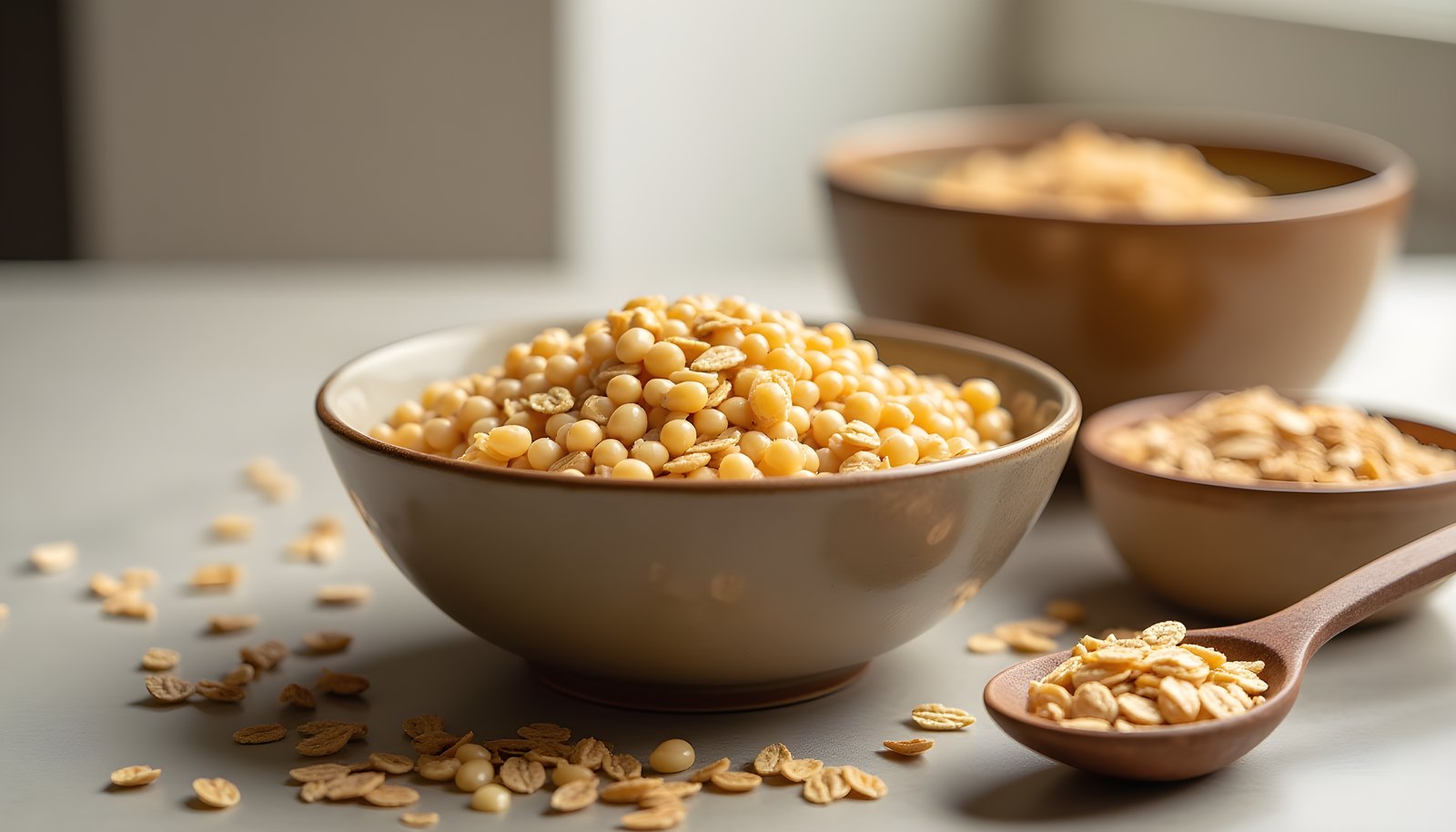
A 2013 study by Dodevska and colleagues in Food Chemistry measured fiber components in cereals eaten in Serbia. Per serving, oat flakes held about 1.39 grams of beta-glucan and barley flakes about 1.30 grams.
That’s close to a tie. If you like the chewier texture of barley flakes, you can swap them into your morning bowl without losing soluble fiber.
The same study found cooked wheat was rich in a different fiber, arabinoxylan, at about 3.2 grams per serving. Arabinoxylan is a major fiber in wheat, but wheat is not counted among the beta-glucan grains.
Grains that lean insoluble
Plenty of healthy grains simply aren’t soluble fiber grains. Harvard’s Nutrition Source lists whole wheat, wheat bran, brown rice and quinoa as sources of insoluble fiber.
- Whole wheat and wheat bran: excellent for regularity, but mostly insoluble.
- Brown rice: listed by Harvard with the insoluble fiber sources.
- Quinoa: also grouped with the insoluble sources.
- Oats and barley: the two grains that bring meaningful soluble fiber.
You don’t need to drop the others. Insoluble fiber adds bulk and keeps things moving, so a mix of grains covers both jobs.
What oat and barley fiber does for blood sugar and your gut
Cleveland Clinic notes that soluble fiber lowers blood sugar levels as well as cholesterol. Harvard’s Nutrition Source says beta-glucan in particular may help normalize blood glucose.
Beta-glucan is also a prebiotic, meaning it feeds the bacteria in your large intestine. Harvard explains that gut bacteria ferment prebiotics into short chain fatty acids, compounds that help nourish the cells lining the colon.
So a bowl of oats or barley does two jobs at once. It works on cholesterol and blood sugar higher up in the gut, then feeds your microbes further down.
Wheat bran: great fiber, wrong kind
Wheat bran often shows up on high fiber lists, so it’s easy to assume it helps with cholesterol the way oat bran does. Both Harvard and Cleveland Clinic list wheat bran as an insoluble fiber food instead.
That makes wheat bran a strong choice for regularity and stool bulk. If soluble fiber is your goal, oat bran is the bran to reach for.
Soluble fiber grains and cholesterol
Harvard Health notes that barley and other whole grains can help lower the risk of heart disease, mainly through the soluble fiber they deliver. Soluble fiber binds cholesterol in the digestive system and carries it out of the body.
The NHLBI guide reports that adding 5 to 10 grams of soluble fiber a day lowered LDL cholesterol by about 5%. Harvard Health suggests 20 to 35 grams of fiber daily, with at least 5 to 10 grams from soluble fiber.
At about a gram per half cup, grains alone won’t fill that target. They’re a steady base that other foods build on.
Not sure how much total fiber you need? Our fiber calculator gives you a personal daily target in seconds.
How grains compare with beans, fruit and psyllium
Grains are a modest source of soluble fiber next to some other foods. Here’s how a half cup of cooked barley or oatmeal compares with other items in the NHLBI guide:
| Food and serving | Soluble fiber | Total fiber |
|---|---|---|
| Psyllium seeds, 1 Tbsp | 5 g | 6 g |
| Brussels sprouts, 1/2 cup cooked | 3 g | 4.5 g |
| Pear, medium | 2 g | 4 g |
| Orange or other citrus | 2 g | 2 to 3 g |
| Barley, 1/2 cup cooked | 1 g | 4 g |
| Oatmeal, 1/2 cup cooked | 1 g | 2 g |
Harvard Health adds that two teaspoons of psyllium give about 4 grams of soluble fiber, though it calls supplements the least appealing way to get it. Whole grains come with other nutrients and are easy to eat daily.
Easy kitchen swaps for more oats and barley
- Use barley in place of rice in pilaf, risotto style dishes or stuffed peppers.
- Add a handful of barley to soups and stews for the last 40 minutes of cooking.
- Stir a spoonful of oat bran into your usual oatmeal or yogurt.
- Try barley flakes as a porridge, alone or mixed half and half with oats.
- Bind meatballs or veggie burgers with rolled oats instead of breadcrumbs.
- Bake with oat flour for part of the wheat flour in muffins and pancakes.
None of these change how a meal looks much. They just move a little more beta-glucan onto your plate every day.
Go gradually if you’re adding a lot at once. Cleveland Clinic warns that too much fiber too soon can lead to gas and bloating, so build up over a week or two.
A day that leans on oats and barley
Say you want to reach the low end of the soluble fiber range mostly from grains and a little fruit. Here’s one way it adds up with the NHLBI and Harvard figures.
Breakfast is oatmeal topped with strawberries, for about 1.5 to 2.5 grams. Lunch is a vegetable soup with a half cup of barley, adding 1 gram.
An afternoon pear brings 2 grams, and dinner includes a half cup of Brussels sprouts for 3 grams. That’s about 7.5 to 8.5 grams, comfortably inside the 5 to 10 gram range.
Notice that the grains supply about a third of it. The rest comes from fruit and vegetables, which is exactly how a balanced plan works.
If your digestion needs time to adjust to more fiber, our guides walk you through building it up gently.
Something to cook tonight
Make a pot of barley tonight. Use some as a side or in soup, and keep the rest in the fridge to stir into salads and breakfast bowls over the next few days.
Cooked barley keeps well in the fridge for a few days, so one pot can cover several meals. Reheat it with a splash of water, or eat it cold in a grain salad with chopped vegetables and a squeeze of lemon.
Pair it with your usual oatmeal in the morning and you’ll have both soluble fiber grains working for you every day this week.
Soluble fiber in grains: your questions
Which grain has the most soluble fiber?
Oats, oat bran and barley lead, each with about 1 gram of soluble fiber per half cup cooked in NIH data. Harvard Health puts a bowl of oatmeal at 1 to 2 grams.
Is barley better than oats for soluble fiber?
They’re very close. Barley and oats have similar soluble fiber per half cup cooked, and in one study barley flakes and oat flakes had nearly identical beta-glucan per serving.
Does brown rice have soluble fiber?
Not much. Harvard lists brown rice with insoluble fiber sources, so it does more for regularity than for cholesterol.
Is wheat a soluble fiber grain?
Not really. In one lab study, wheat averaged about 0.17 grams of soluble beta-glucan per 100 grams dry, compared with about 3.3 grams in barley.
Is quinoa high in soluble fiber?
Not especially. Harvard groups quinoa with insoluble fiber foods, so oats and barley are better picks for soluble fiber.
How much soluble fiber is in oatmeal?
About 1 gram per half cup cooked in the NHLBI guide, or 1 to 2 grams per bowl according to Harvard Health.
Is oat bran higher in soluble fiber than oatmeal?
Per half cup cooked, both have about 1 gram of soluble fiber in the NHLBI guide. Oat bran has more total fiber, at about 3 grams versus 2.
Sources
- National Heart, Lung, and Blood Institute. “Your Guide to Lowering Your Cholesterol with TLC.” NIH, 2005. nhlbi.nih.gov
- LeWine HE. “11 foods that lower cholesterol.” Harvard Health Publishing, 2024. health.harvard.edu
- Harvard T.H. Chan School of Public Health. “Fiber.” The Nutrition Source, 2022. nutritionsource.hsph.harvard.edu
- Cleveland Clinic. “What’s the Difference Between Soluble and Insoluble Fiber?” Health Essentials, 2021. health.clevelandclinic.org
- Messia MC, Candigliota T, De Arcangelis E, Marconi E. “Arabinoxylans and β-glucans assessment in cereals.” Italian Journal of Food Science, 2017. distantreader.org
- Dodevska MS, Djordjevic BI, Sobajic SS, et al. “Characterisation of dietary fibre components in cereals and legumes used in Serbian diet.” Food Chemistry, 2013. agris.fao.org