
In this article
- What makes a vegetable prebiotic
- Prebiotic vegetables ranked by fructan content
- Salsify, artichokes and Jerusalem artichokes
- Onions, leeks and the allium family
- Myth vs fact: asparagus is a prebiotic powerhouse
- Other vegetables on the inulin list
- Why a vegetable can be low in fiber but high in prebiotics
- Cooked and cooled potatoes: the starchy prebiotic
- Cooking doesn’t wipe out fructans
- How prebiotic vegetables compare with other prebiotic foods
- What prebiotic fiber may do for you
- A prebiotic vegetable checklist
- What researchers still need to measure
- Prebiotic vegetables: common questions
- Sources
15.6 grams. That’s roughly how much fructan, a prebiotic fiber, sits in 100 grams of raw salsify, based on a 2017 lab study of 29 vegetables. Artichokes followed at about 13.1 grams and Jerusalem artichokes at 11.6 grams.
Those three, plus onions at about 4.5 grams, are the top prebiotic vegetables by a wide margin. Most other vegetables in the study, from broccoli to Brussels sprouts, held less than half a gram.
What makes a vegetable prebiotic
A prebiotic is a fiber that feeds the bacteria in your gut. Harvard’s Nutrition Source explains that gut bacteria ferment these fibers into short chain fatty acids, a process that also draws water into the intestines for softer, easier to pass stools.
In vegetables, the main prebiotic fibers are fructans, chains of fructose sugar that your own enzymes can’t break down. Inulin and fructooligosaccharides are the best known types, and Harvard names onions, chicory root, asparagus and Jerusalem artichokes as sources.
Some vegetables add a second prebiotic, resistant starch. Harvard lists cooked and cooled potatoes among its resistant starch foods.
Prebiotic vegetables ranked by fructan content
Kalala and colleagues measured fructans in 29 vegetables, raw and steamed, and reported them per 100 grams of dry matter. This table converts the raw values to fresh weight using each vegetable’s measured dry matter:
| Vegetable, raw | Fructans per 100 g fresh | Fructans per 100 g dry |
|---|---|---|
| Salsify | 15.6 g | 69.5 g |
| Artichoke | 13.1 g | 62.0 g |
| Jerusalem artichoke | 11.6 g | 62.8 g |
| Onion | 4.5 g | 32.6 g |
| Cardoon | 0.3 g | 4.0 g |
| Parsnip | 0.3 g | 1.3 g |
| Carrot | 0.3 g | 2.0 g |
| Leek | 0.3 g | 3.0 g |
| Endive | 0.1 g | 1.6 g |
| Brussels sprouts | 0.1 g | 0.9 g |
| Asparagus | under 0.1 g | 0.4 g |
| Broccoli | under 0.1 g | 0.2 g |
The drop after onion is steep. Four vegetables hold almost all of the fructans in the study, and the rest are bit players.
The researchers cite 10 to 14 grams of fructans a day as a health promoting intake and note that only a few vegetables could supply that. By these figures, 100 grams of raw salsify or artichoke would cover it on its own.
Salsify, artichokes and Jerusalem artichokes
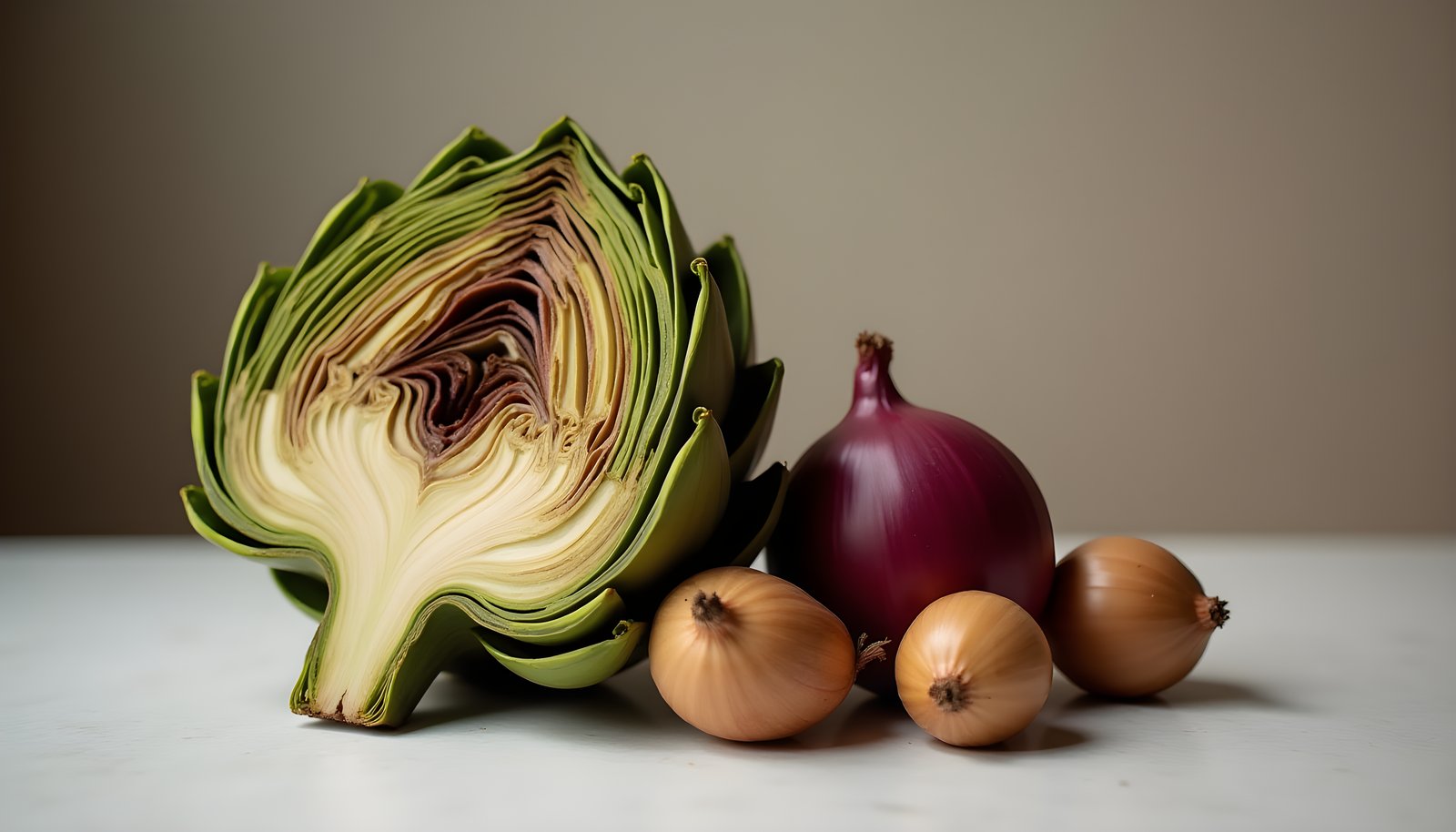
Salsify is a long, thin root with a mild, slightly nutty flavor, sometimes sold as oyster plant. It’s less common in stores, but it topped the study at nearly 70% fructans by dry weight.
Globe artichokes are easier to find, fresh, frozen or jarred. The Dietary Guidelines list a cup of cooked artichoke at 9.6 grams of total fiber for 89 calories, one of the highest fiber vegetables on the list.
Jerusalem artichokes, also called sunchokes, are knobby tubers that aren’t true artichokes at all. Cleveland Clinic names them specifically as an inulin food, and Harvard lists them too.
Want ideas for cooking artichokes, sunchokes and salsify? Our recipe eBooks are full of easy, high fiber vegetable dishes.
Onions, leeks and the allium family
Onions are the everyday prebiotic vegetable. At about 4.5 grams of fructans per 100 grams raw, they’re far ahead of most vegetables and easy to add to almost any savory dish.
Because onions show up in so many recipes, they’re the easiest way to eat prebiotic fiber every day without changing your menu. Dice one into soups, sauces, stir fries, omelets and grain dishes, or slice it thin and raw into salads and salsas.
Leeks showed much lower and more variable values in the study, at about 3 grams per 100 grams of dry matter with a wide spread between samples. Cleveland Clinic still lists leeks and garlic among inulin foods.
Garlic wasn’t part of the Kalala study, so there’s no number here. Cleveland Clinic includes it on its inulin list, and people tend to eat it in small amounts.
Myth vs fact: asparagus is a prebiotic powerhouse
Myth: Asparagus is one of the best prebiotic vegetables you can eat.
Fact: Asparagus does appear on prebiotic lists from Harvard and Cleveland Clinic. In the Kalala study, though, it held only about 0.4 grams of fructans per 100 grams of dry matter, a tiny fraction of the levels in onions or artichokes.
Asparagus is still a healthy, fiber containing vegetable. It just isn’t in the same league as the top four for fructans, and measured amounts can vary between samples and studies.
Other vegetables on the inulin list
Cleveland Clinic’s inulin list reaches beyond the top four. It also names burdock, chicory root, garlic, leeks, soybeans and wild yams, along with non vegetable sources like bananas, oats and wheat.
Burdock and chicory root are roots you’re more likely to meet in Asian cooking or as a coffee substitute than in a typical salad. If you see them, they’re worth a try.
The Kalala study didn’t measure these, so there are no gram figures for them here. Treat them as useful extras rather than replacements for onions and artichokes.
Why a vegetable can be low in fiber but high in prebiotics
Onions don’t look like a fiber star on a nutrition label. The Dietary Guidelines list a cup of cooked onions at just 2.9 grams of total fiber, less than half of what a cup of Brussels sprouts carries.
Yet onions held about 30 times more fructans than Brussels sprouts in the Kalala study. Total fiber and prebiotic fiber simply measure different things, so a vegetable that ranks low on one list can rank near the top of another.
Artichokes are the rare vegetable that does both. They’re near the top for total fiber and for fructans.
Cooked and cooled potatoes: the starchy prebiotic
Potatoes have almost no fructans, but they can supply a different prebiotic. Cleveland Clinic explains that cooking starchy foods like potatoes and then cooling them forms type 3 resistant starch, which feeds gut bacteria in a similar way.
Harvard also lists cooked and cooled potatoes as a resistant starch source. Potato salad made the day before or chilled roasted potatoes in a grain bowl are easy ways to use this.
Cooking doesn’t wipe out fructans
The study steamed each vegetable for 20 to 30 minutes until fully cooked. Fructan levels in the top vegetables held steady or even rose slightly:
| Vegetable | Raw (per 100 g dry) | Steamed (per 100 g dry) |
|---|---|---|
| Salsify | 69.5 g | 71.9 g |
| Jerusalem artichoke | 62.8 g | 68.3 g |
| Artichoke | 62.0 g | 63.8 g |
| Onion | 32.6 g | 32.7 g |
Jerusalem artichoke and salsify even edged upward after steaming. The researchers flagged that rise but also noted that earlier studies on cooking and fiber haven’t always agreed.
So you don’t need to eat these vegetables raw to get their prebiotic fiber. Steamed artichokes, sunchokes and onions all kept theirs, though roasting and frying weren’t tested.
The authors also reported that steaming didn’t change the average chain length of the fructans, so the fiber itself stays much the same.
How prebiotic vegetables compare with other prebiotic foods
Vegetables aren’t the only prebiotic foods. Harvard groups prebiotic fibers into a few families, each found in different places:
| Prebiotic fiber | Main food sources (Harvard) |
|---|---|
| Inulin and fructooligosaccharides | Onions, chicory root, asparagus, Jerusalem artichokes |
| Beta-glucan | Oats and barley |
| Resistant starch | Legumes, unripe bananas, cooked and cooled pasta and potatoes |
Eating from more than one family gives your gut bacteria a wider menu. Onions in a lentil soup with barley, for example, covers all three.
Not sure how much fiber your day should include overall? Our fiber calculator gives you a personal target in seconds.
What prebiotic fiber may do for you
Cleveland Clinic says inulin can stimulate bowel movements, help prevent constipation and even firm up loose stools. It may also slow stomach emptying, which can help you feel full longer.
The Kalala team notes that fructans may help suppress harmful bacteria in the colon and support the gut lining. Cleveland Clinic adds that inulin may help lower cholesterol and increase the variety of beneficial gut bacteria.
A prebiotic vegetable checklist
- Start most savory meals with a chopped onion.
- Keep frozen or jarred artichoke hearts for salads, pasta and pizza.
- Try roasted sunchokes in place of potatoes once a week.
- Look for salsify at farmers markets or specialty grocers.
- Add leeks and garlic to soups and stews.
- Cook potatoes ahead and chill them for a resistant starch bonus.
Go slowly with the top four. Harvard warns that people with irritable bowel syndrome may be sensitive to inulin type fibers, and Cleveland Clinic notes that too much can cause gas, bloating or cramping.
If your gut is sensitive, our guides walk you through adding prebiotic foods one step at a time.
What researchers still need to measure
Fructan data for vegetables is still patchy. The Kalala paper itself reports different numbers in its text and tables for Jerusalem artichoke and leek, and leek samples varied widely.
The authors also point out that research on how cooking affects soluble fiber is inconsistent, and they call for studies of methods beyond steaming. Expect future numbers for roasting, frying and pickling to sharpen this list.
Prebiotic vegetables: common questions
Which vegetable has the most prebiotic fiber?
Salsify, artichokes and Jerusalem artichokes lead. In one study, raw salsify held about 15.6 grams of fructans per 100 grams, with artichokes at 13.1 grams and Jerusalem artichokes at 11.6 grams.
Are onions prebiotic?
Yes. Raw onions held about 4.5 grams of fructans per 100 grams in lab testing, far more than most vegetables, and Harvard lists onions as an inulin source.
Is asparagus a good prebiotic?
It’s listed as one, but its measured fructan level was low in one study, at about 0.4 grams per 100 grams of dry matter. Onions and artichokes carry much more.
Does cooking destroy prebiotics in vegetables?
No. Steaming for 20 to 30 minutes left fructan levels in salsify, artichokes, Jerusalem artichokes and onions the same or slightly higher.
Is garlic a prebiotic vegetable?
Yes. Cleveland Clinic lists garlic among inulin foods, though people usually eat it in small amounts.
How much prebiotic fiber do you need a day?
Researchers have cited 10 to 14 grams of fructans a day as health promoting. About 100 grams of raw artichoke or salsify could supply that.
Can prebiotic vegetables cause gas?
Yes, in some people. Harvard notes that people with IBS may be sensitive to inulin type fibers, and too much can cause bloating or cramping.
Sources
- Kalala G, Kambashi B, Everaert N, et al. “Characterization of fructans and dietary fibre profiles in raw and steamed vegetables.” International Journal of Food Sciences and Nutrition, 2017. sites.uclouvain.be
- Harvard T.H. Chan School of Public Health. “Fiber.” The Nutrition Source, 2022. nutritionsource.hsph.harvard.edu
- Cleveland Clinic. “Does Inulin Help Improve Gut Health?” Health Essentials, 2022. health.clevelandclinic.org
- Cleveland Clinic. “Are Foods With Resistant Starch Good for You?” Health Essentials, 2025. health.clevelandclinic.org
- Dietary Guidelines for Americans. “Food Sources of Dietary Fiber.” 2020. dietaryguidelines.gov