

In this article
- Black eyed peas fiber by the serving
- Myth vs fact: are black-eyed peas really peas?
- Southern beans nutrition: the folate standout
- Black-eyed peas vs other fiber rich legumes
- What a small trial found, and didn’t
- Black-eyed peas, heart health and blood sugar
- Black-eyed peas and your digestion
- A Hoppin’ John plate, counted
- More ways to use black-eyed peas
- Buying and storing black-eyed peas
- How black-eyed peas fit your daily target
- Your next step
- Questions about black-eyed peas and fiber
- Sources
Ninety-nine calories. That’s what a half cup of cooked black-eyed peas costs you, the lowest of any bean or pea in the Dietary Guidelines for Americans’ fiber table apart from fava beans and edamame, and it still delivers 5.6 grams of black eyed peas fiber.
Black-eyed peas, also called cowpeas, are a staple of Southern cooking and of cuisines across West Africa, India and Brazil. Here’s how their fiber stacks up, what else they bring, and why one small study found them harder to judge than expected.
Black eyed peas fiber by the serving
USDA FoodData Central lists these values for black-eyed peas boiled from dry without salt:
| Black-eyed peas, boiled | Fiber | Calories | Protein |
|---|---|---|---|
| 1/2 cup | 5.6 g | 99 | 6.6 g |
| 1 cup (172 g) | 11.2 g | 200 | 13.3 g |
| 100 grams | 6.5 g | 116 | 7.7 g |
A cup covers about 40% of the 28 gram Daily Value. That’s a little less than black beans or lentils, but black-eyed peas make up for it with fewer calories and a quick cooking time.
Per 100 calories, they supply about 5.7 grams of fiber, ahead of kidney beans at about 5.0 and chickpeas at about 4.7.
Myth vs fact: are black-eyed peas really peas?
Myth: Black-eyed peas are a type of garden pea.
Fact: They’re cowpeas, a different legume from the green peas in your freezer. They’re eaten as dried seeds, like beans, which is why their nutrition looks much more like a bean’s than a green pea’s.
Whatever the name says, cowpeas fiber and protein numbers belong firmly in the dried bean family.
Southern beans nutrition: the folate standout
Black-eyed peas carry one of the highest folate counts in the legume aisle. A cooked cup provides about 358 micrograms, close to 90% of the Daily Value, by USDA values.
The NIH Office of Dietary Supplements lists boiled black-eyed peas among its top food sources of folate, alongside spinach and asparagus. Folate helps the body make DNA and form new cells, which is why it matters so much before and during pregnancy.
Per cup, black-eyed peas also bring about 13 grams of protein. Harvard’s Nutrition Source notes that legumes like these are rich in protein, iron and phosphorus, contain both soluble and insoluble fiber, and are naturally low in saturated fat and sodium.
Curious how a cup fits into your own daily fiber needs? Our fiber calculator gives you a personal target in a few seconds.
Black-eyed peas vs other fiber rich legumes
From the Dietary Guidelines for Americans’ table of fiber sources, per half cup cooked:
| Legume, 1/2 cup cooked | Fiber | Calories |
|---|---|---|
| Navy beans | 9.6 g | 128 |
| Split peas | 8.2 g | 116 |
| Lentils | 7.8 g | 115 |
| Black beans | 7.5 g | 114 |
| Kidney beans | 5.7 g | 113 |
| Black-eyed peas | 5.6 g | 99 |
| Fava beans | 4.6 g | 94 |
Black-eyed peas fall in the middle of the pack on fiber but come in among the lowest on calories. If you’re trying to add fiber without many extra calories, they’re a solid choice.
They also cook faster than most dried beans. Many cooks skip a long soak entirely, though a short soak of a few hours, which Harvard recommends for dried beans, helps them cook evenly.
Protein and calories per cooked cup
Black-eyed peas also hold their own on protein. Per cooked cup, using USDA values:
| Legume, 1 cup cooked | Protein | Fiber | Calories |
|---|---|---|---|
| Chickpeas | 14.5 g | 12.5 g | 269 |
| Black-eyed peas | 13.3 g | 11.2 g | 200 |
| Fava beans | 12.9 g | 9.2 g | 187 |
| Pigeon peas | 11.4 g | 11.3 g | 203 |
Chickpeas edge ahead on both protein and fiber, but they cost about 70 more calories per cup. Black-eyed peas give you nearly as much of each for noticeably less, which makes them one of the more efficient picks among Southern and tropical legumes.
Pigeon peas, another warm-climate legume often cooked with rice, land very close on fiber but carry less protein.
What a small trial found, and didn’t
In a study at Arizona State University, 17 adults with higher cholesterol or early insulin resistance ate a half cup a day of pinto beans, black-eyed peas or carrots, each for eight weeks. The carrots served as the comparison food.
Pinto beans lowered total and LDL cholesterol by more than 8% on average. Black-eyed peas showed little effect at first, but the researchers found that some participants hadn’t eaten them as consistently as the other foods.
That means the trial couldn’t say much either way about black-eyed peas, and the team planned to test them again. It’s a good reminder that one small study rarely settles a question, and that eating the food regularly is what any benefit depends on.
Black-eyed peas, heart health and blood sugar
Most research on legumes looks at beans and peas as a group rather than black-eyed peas alone. Harvard’s Nutrition Source cites a review of 11 clinical trials in which eating legumes lowered total cholesterol by about 7% and LDL cholesterol by about 6%.
Legumes also have a low glycemic index, meaning they raise blood sugar slowly. Harvard notes that a study of 64,277 women in Shanghai linked higher legume intake to a 38% lower risk of type 2 diabetes, though a large study of older US women found no clear link.
For black-eyed peas specifically, the evidence is thin. What’s clear is that their fiber, protein and low calorie count make them a sensible fit in a heart and blood sugar friendly diet.
Black-eyed peas and your digestion
Like other legumes, black-eyed peas contain oligosaccharides, carbohydrates that pass undigested into the colon and feed gut bacteria. Harvard’s Nutrition Source explains that this fermentation supports beneficial microbes but can also produce gas.
Soaking dried peas and discarding the water helps reduce those carbohydrates. Mayo Clinic adds that increasing fiber slowly and drinking plenty of water gives your digestive system time to adjust.
If gas and bloating keep you away from legumes, our gut health guides map out an easy, gradual way to bring them back.
A Hoppin’ John plate, counted
Hoppin’ John, the Southern dish of black-eyed peas and rice traditionally served on New Year’s Day, makes a natural test case. Picture a plate with a cup of black-eyed peas over a half cup of brown rice, with a side of cooked collard greens.
The peas bring about 11 grams of fiber, and a cup of cooked collards adds 4.8 grams, using Dietary Guidelines values. That puts the plate at about 16 grams before the brown rice adds its own small share.
That’s well over half the Daily Value in one meal, with collards and peas doing nearly all of the work. Swap in white rice and the total barely moves.
Want more Southern-inspired meals that put legumes front and center? Our recipe eBooks are full of easy, high-fiber dishes to try.
More ways to use black-eyed peas
Black-eyed peas have an earthy flavor and creamy texture that works in all kinds of dishes:
- Texas caviar: a cold salad of peas, peppers, onion and a tangy dressing
- Akara, West African fritters made from soaked, blended peas
- Lobia masala, an Indian curry with tomato and spices
- Soups and stews with smoked paprika, kale and carrots
- Mashed into a spread for toast or wraps
Leftovers are an advantage here. Black-eyed peas soak up dressings and spices as they sit, so a salad or stew often tastes better the next day than it did fresh from the pot.
Canned black-eyed peas work in all of these. Drain and rinse them to cut some of the sodium.
Buying and storing black-eyed peas
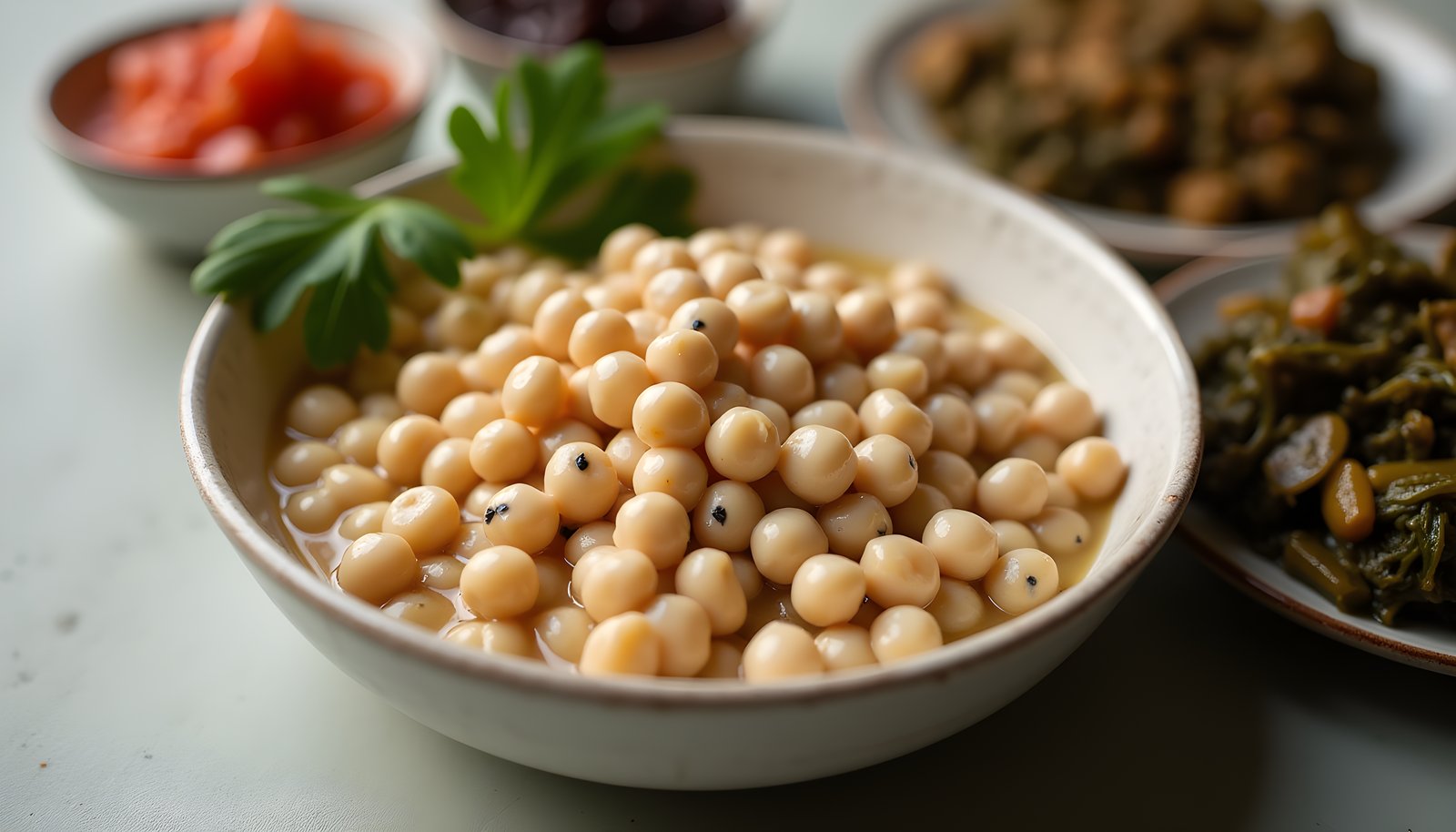
Dried black-eyed peas should look smooth and evenly colored, with the signature black spot clear on each one. Skip bags with lots of broken or shriveled peas, which can cook unevenly.
Store dried peas in an airtight container in a cool, dark cupboard. Cooked peas keep for a few days in the fridge and freeze well in portions, so a single pot can cover several meals.
Dried peas keep for months, though older ones may take longer to soften. If a batch stays firm after an hour of simmering, give it more time rather than more heat.
Canned peas are the quickest route. Look for low sodium or no salt added versions, and rinse them before using.
How black-eyed peas fit your daily target
Mayo Clinic suggests about 25 grams of fiber a day for women and 38 grams for men. A cup of black-eyed peas covers about 45% of the women’s target and nearly 30% of the men’s.
The Dietary Guidelines for Americans suggest about 3 cups of legumes a week, according to Harvard’s Nutrition Source. Black-eyed peas, with their low calorie count, are an easy way to fill some of those cups.
Your next step
You don’t need to wait for New Year’s Day. Cook a pot of black-eyed peas this week, or open a can, and build two meals around them: a Hoppin’ John style plate one night and a Texas caviar salad for lunch the next day. Together they’ll add more than 20 grams of fiber to your week.
Questions about black-eyed peas and fiber
How much fiber is in a cup of black-eyed peas?
About 11.2 grams in a cup of black-eyed peas boiled from dry, according to USDA FoodData Central. That’s about 40% of the 28 gram Daily Value.
Are black-eyed peas beans or peas?
They’re cowpeas, a type of legume eaten as a dried seed like beans. Their nutrition looks much more like a bean’s than a green pea’s.
Are black-eyed peas low in calories?
Yes, for a legume. A half cup has about 99 calories, among the lowest of the beans and peas in the Dietary Guidelines fiber table.
Do black-eyed peas have a lot of folate?
Yes. A cooked cup has about 358 micrograms, close to 90% of the Daily Value, making them one of the richest food sources.
Do black-eyed peas need to be soaked?
Not necessarily. They cook faster than most dried beans, though a short soak helps them cook evenly and may make them easier to digest.
Do canned black-eyed peas have fiber?
Yes. Canned black-eyed peas keep most of their fiber. Drain and rinse them to reduce the sodium.
Are black-eyed peas good protein?
Yes. A cooked cup has about 13 grams of protein along with 11 grams of fiber.
Sources
- Arizona State University. “ASU researchers find pinto beans may lower cholesterol more than oatmeal.” ASU News. 2007. news.asu.edu
- U.S. Department of Agriculture, Agricultural Research Service. “FoodData Central.” 2026. fdc.nal.usda.gov
- U.S. Department of Agriculture and U.S. Department of Health and Human Services. “Food Sources of Dietary Fiber.” Dietary Guidelines for Americans, 2020 to 2025. 2020. dietaryguidelines.gov
- NIH Office of Dietary Supplements. “Folate: Fact Sheet for Health Professionals.” 2018. ods.od.nih.gov
- Harvard T.H. Chan School of Public Health. “Legumes and Pulses.” The Nutrition Source. 2024. nutritionsource.hsph.harvard.edu
- Mayo Clinic Staff. “Dietary fiber: Essential for a healthy diet.” Mayo Clinic. 2024. mayoclinic.org

