
In this article
- Chili pepper fiber, fresh to ground
- Myth vs fact: what chili peppers really bring
- Chili nutrition: where the real value sits
- Hot peppers and sweet peppers compared
- Capsaicin foods and where the heat lives
- A pot of chili: where the fiber really adds up
- Pairing chilies with fiber rich staples
- How chilies fit your fiber target
- What chili fiber does in your body
- Fresh, dried or powder: a quick rule
- The edge case: chili powder and sodium
- Questions about chili peppers and fiber
- Sources
Fresh chili peppers have only a little fiber. One raw hot chili pepper (about 45 grams) has roughly 0.7 grams, according to USDA.
A lot of people assume a bowl of chili gets its fiber from the peppers. In practice, chili pepper fiber is a small player when the pods are fresh, and the beans in the pot do almost all the work.
Dried and ground chilies tell a different story, though. Once the water is gone, the same fiber is packed into a spoonful.
Chili pepper fiber, fresh to ground
USDA FoodData Central lists raw red and green hot chili peppers at the same 1.5 grams of fiber per 100 grams, with 40 calories. Dried spices made from chilies are far denser.
| Chili form | Serving | Fiber | % DV (28 g) | Calories |
|---|---|---|---|---|
| Hot chili, red or green, raw | 1 pepper (45 g) | 0.7 g | 3% | 18 |
| Hot chili, raw, chopped | 1/2 cup (75 g) | 1.1 g | 4% | 30 |
| Hot chili, raw | 100 g | 1.5 g | 5% | 40 |
| Chili powder | 1 teaspoon (2.7 g) | 0.9 g | 3% | 8 |
| Chili powder | 1 tablespoon (8 g) | 2.8 g | 10% | 23 |
| Cayenne pepper | 1 teaspoon (1.8 g) | 0.5 g | 2% | 6 |
| Cayenne pepper | 1 tablespoon (5.3 g) | 1.4 g | 5% | 17 |
Gram for gram, chili powder is about 35% fiber, at 34.8 grams per 100 grams. Ground cayenne is close behind at 27.2 grams.
That doesn’t make spice a fiber food, since nobody eats 100 grams of it. But a tablespoon of chili powder in a pot of stew brings as much fiber as four fresh chilies.
Myth vs fact: what chili peppers really bring
Myth: Chili gets its fiber from the chilies.
Fact: In a typical pot, the beans carry the load. The Dietary Guidelines list half a cup of cooked black beans at 7.5 grams of fiber, more than ten fresh chili peppers combined.
Myth: Hotter peppers are better for fiber.
Fact: Heat and fiber aren’t linked in USDA’s numbers. Raw jalapenos, a milder pepper, list 2.8 grams of fiber per 100 grams, nearly double the 1.5 grams in raw hot chilies.
Chili nutrition: where the real value sits
If fiber is modest, vitamin C is not. Here’s what one raw hot chili pepper (45 g) provides, by color.
| Nutrient | Red chili, 1 pepper | Green chili, 1 pepper |
|---|---|---|
| Vitamin C | 65 mg (72% DV) | 109 mg (121% DV) |
| Vitamin B6 | 0.23 mg (14% DV) | 0.13 mg (7% DV) |
| Potassium | 145 mg (3% DV) | 153 mg (3% DV) |
| Fiber | 0.7 g (3% DV) | 0.7 g (3% DV) |
| Calories | 18 | 18 |
A single green chili covers more than the full 90 mg Daily Value for vitamin C set by the FDA. Red chilies are lower in vitamin C but higher in vitamin B6.
Both colors carry the same fiber and calories. If you’re choosing between them for nutrition alone, green wins on vitamin C and red wins on B6.
Ground chilies shift the picture again. A tablespoon of chili powder brings about 119 mcg of vitamin A (13% DV) and 3.0 mg of vitamin E (20% DV), along with 1.4 mg of iron.
Hot peppers and sweet peppers compared
How does chili pepper fiber compare with the other peppers in the produce aisle? These figures come from USDA and the Dietary Guidelines for Americans.
| Pepper | Serving | Fiber | Calories |
|---|---|---|---|
| Red bell pepper, raw | 1 cup chopped | 3.1 g | 39 |
| Jalapeno, raw | 1 cup sliced (90 g) | 2.5 g | 26 |
| Hot chili, raw | 1/2 cup chopped (75 g) | 1.1 g | 30 |
| Hot chili, raw | 1 pepper (45 g) | 0.7 g | 18 |
| Jalapeno, raw | 1 pepper (14 g) | 0.4 g | 4 |
Sweet bell peppers lead because you can eat a full cup without a second thought. A cup of chopped red bell pepper gives you about four times the fiber of a single hot chili.
Red peppers also scored well in a 2014 CDC published ranking of nutrient dense produce, placing 17th of 41 powerhouse fruits and vegetables. Hot chilies weren’t scored separately in that study.
Capsaicin foods and where the heat lives
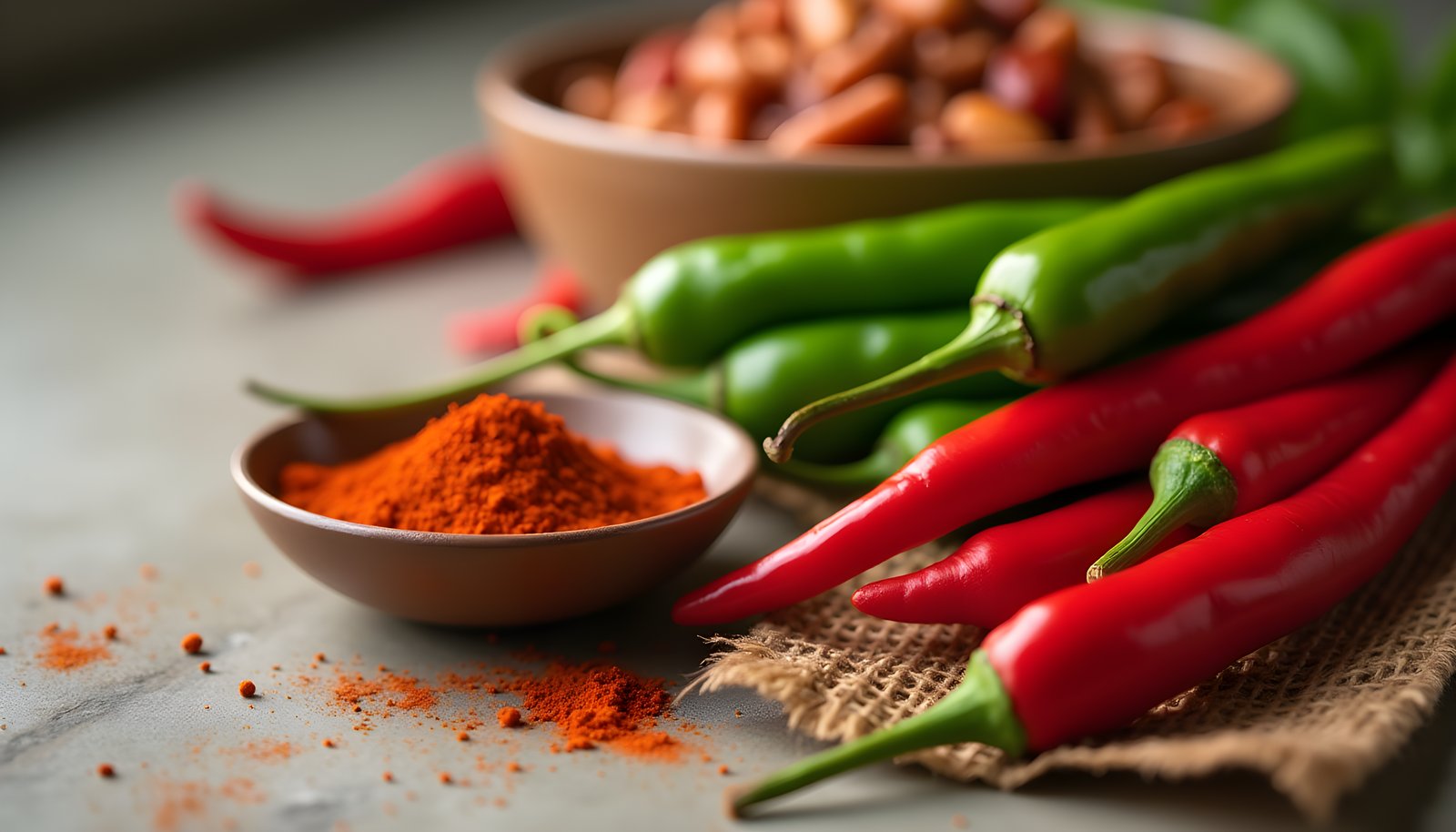
The burn in hot peppers comes from capsaicin, a compound found in chili peppers and the spices made from them. Common capsaicin foods include fresh chilies, dried chili flakes, cayenne, chili powder and hot sauce.
Capsaicin isn’t a fiber and adds essentially no calories. It’s the reason a few grams of pepper can flavor a whole pot, which is exactly why chilies pair so well with high fiber staples.
Many cooks scrape out the seeds and white ribs to tame the heat. Since fresh chilies carry so little fiber to begin with, that choice is about taste rather than nutrition.
A pot of chili: where the fiber really adds up
Picture a pot of vegetarian chili built for four. Fresh chilies and a spoonful of chili powder give it heat, but the fiber comes from what fills the bowl.
The Dietary Guidelines list half a cup of black beans at 7.5 grams and half a cup of pinto beans at 7.7 grams. A bowl with half a cup of each already holds about 15 grams of fiber before the onions, bell pepper and spice are counted.
Those extras add a little more. A cup of cooked onions has 2.9 grams, a cup of chopped red bell pepper 3.1 grams and a tablespoon of chili powder 2.8 grams, shared across the pot.
Mayo Clinic notes that soluble fiber, plentiful in beans, can help lower cholesterol and slow the absorption of sugar. Chilies make that kind of meal easier to look forward to.
Want more chili, curry and stew ideas built around beans? Our recipe eBooks are packed with easy, high fiber meals.
Pairing chilies with fiber rich staples
Chilies show up in cuisines all over the world, and many of their classic partners are fiber heavy. That makes them one of the easiest ways to make high fiber food taste exciting.
Red lentil dal with fresh green chili is one option, and the Dietary Guidelines list half a cup of cooked lentils at 7.8 grams of fiber. Split pea soup with a pinch of cayenne starts from 8.2 grams per half cup.
Chickpeas, at 6.3 grams per half cup, take well to a spicy tomato sauce. Bulgur, at 4.1 grams per half cup, makes a good base for a chili spiked grain salad with chopped peppers and herbs.
In each case, the chili supplies flavor and a good dose of vitamin C, while the legume or grain supplies the fiber. A teaspoon of chili powder stirred in adds close to another gram.
How chilies fit your fiber target
Mayo Clinic suggests 21 to 25 grams of fiber a day for women and 30 to 38 grams for men. At 0.7 grams per fresh chili, it would take about 30 peppers to reach the low end of a woman’s range.
So treat chilies as flavor, not as a fiber source. The real gains come from building meals around beans, lentils, whole grains and vegetables, then seasoning them well.
Curious what your own daily goal looks like? Our fiber calculator can give you a personal target in seconds.
What chili fiber does in your body
The fiber in chilies works like fiber from other vegetables. Mayo Clinic explains that insoluble fiber helps material move through your digestive system and adds bulk to stool, while soluble fiber dissolves to form a gel like material.
Mayo also notes that high fiber foods tend to be more filling. A bean chili with peppers is a good example: lots of volume, lots of fiber, and a satisfying amount of heat.
If you’re scaling up on beans and other fiber rich foods, Mayo recommends adding fiber gradually with plenty of water, since a quick jump can cause gas, bloating and cramping.
If your gut would like to take it slowly, our guides walk you through building fiber up one step at a time.
Fresh, dried or powder: a quick rule
If you want vitamin C, use fresh chilies, and pick green ones when you can. One green chili covers more than a day’s Daily Value.
If you want the most fiber from the pepper itself, use ground dried chilies like cayenne or chili powder. If you want fiber from the meal, season beans, lentils and vegetables with whichever chili form you enjoy most.
The edge case: chili powder and sodium
Chili powder is the one form where chili pepper fiber starts to count, but it comes with a catch. Store chili powder is often a blend, and USDA’s chili powder record lists 2,867 mg of sodium per 100 grams.
That works out to about 229 mg of sodium in a tablespoon, roughly 10% of the 2,300 mg Daily Value. Ground cayenne, by comparison, has only 30 mg per 100 grams.
If you’re watching salt, check the label or use plain ground chilies or cayenne, then add salt to taste. You keep most of the fiber and skip much of the sodium.
Questions about chili peppers and fiber
How much fiber is in a chili pepper?
About 0.7 grams in one raw hot chili pepper weighing 45 grams. USDA lists 1.5 grams of fiber per 100 grams for both red and green chilies.
Are chili peppers high in fiber?
No, not in fresh form. A whole pepper supplies about 3% of the 28 gram Daily Value, though dried chili powder is about 35% fiber by weight.
Does chili powder have fiber?
Yes. A tablespoon of chili powder has about 2.8 grams of fiber, and a teaspoon has about 0.9 grams.
Do red and green chilies have the same fiber?
Yes. USDA lists both at 1.5 grams per 100 grams, but green chilies have much more vitamin C, about 109 mg per pepper versus 65 mg.
Does cayenne pepper have fiber?
Yes. Ground cayenne has 27.2 grams of fiber per 100 grams, which works out to about 0.5 grams per teaspoon.
Is capsaicin a type of fiber?
No. Capsaicin is the compound that makes chili peppers hot, and it isn’t fiber.
How many calories are in a chili pepper?
About 18 calories in one raw hot chili pepper and 40 calories per 100 grams.
Sources
- USDA Agricultural Research Service. FoodData Central: SR Legacy Peppers, hot chili, red, raw (170106); Peppers, hot chili, green, raw (170497); Peppers, jalapeno, raw (168576); Spices, chili powder (171319); Spices, pepper, red or cayenne (170932). 2019. fdc.nal.usda.gov
- U.S. Department of Agriculture and U.S. Department of Health and Human Services. “Food Sources of Dietary Fiber.” Dietary Guidelines for Americans, 2020 to 2025. dietaryguidelines.gov
- U.S. Food and Drug Administration. “Daily Value on the Nutrition and Supplement Facts Labels.” 2024. fda.gov
- Di Noia J. “Defining Powerhouse Fruits and Vegetables: A Nutrient Density Approach.” Preventing Chronic Disease, CDC. 2014. cdc.gov
- Mayo Clinic Staff. “Dietary fiber: Essential for a healthy diet.” Mayo Clinic. 2025. mayoclinic.org