

In this article
- Chickpeas fiber by serving, plus garbanzo beans fiber explained
- The fibers in a chickpea and what they do
- Chickpeas and plant protein nutrition
- Four cans a week: what an Australian trial found
- Legume digestion: why chickpeas can cause gas
- Whole chickpeas vs hummus
- Chickpeas vs other high fiber foods
- Simple ways to work chickpeas into your week
- How chickpeas fit your daily fiber
- One thing to do this week
- Chickpea fiber questions, answered
- Sources
You toss a scoop of chickpeas onto a salad bar plate as the protein topping. That half cup is also quietly delivering about 6 grams of chickpeas fiber, more than most of the vegetables underneath it.
Chickpeas, also sold as garbanzo beans, are one of the easiest legumes to eat every day. Here’s how much fiber they bring in each form, how they stack up as a plant protein, and what happened when researchers asked adults to eat four cans of them a week.
Chickpeas fiber by serving, plus garbanzo beans fiber explained
Chickpeas and garbanzo beans are the same food, so the numbers apply to both names. USDA FoodData Central gives these values:
| Chickpeas | Fiber | Calories | Protein |
|---|---|---|---|
| 1/2 cup, boiled from dry | 6.3 g | 135 | 7.3 g |
| 1 cup (164 g), boiled from dry | 12.5 g | 269 | 14.5 g |
| 100 grams, boiled from dry | 7.6 g | 164 | 8.9 g |
A cup cooked from dry supplies about 45% of the 28 gram Daily Value. A cup of canned chickpeas, drained and rinsed, weighs about 152 grams and has 9.6 grams of fiber and 210 calories.
The canned cup weighs a little less and holds a little more water, which explains most of its lower number.
Starting from dry
Dry chickpeas have about 12.2 grams of fiber and 378 calories per 100 grams, according to USDA data. Cooking doesn’t remove that fiber, it just adds water, so the same beans weigh more and the per-gram figure drops to 7.6.
That’s worth knowing when you read a package label. A bag of dry chickpeas lists nutrition for the dry weight, which can look surprisingly high next to a can.
Either way, chickpeas sit comfortably in high fiber territory. Even a quarter cup on a grain bowl adds around 3 grams.
The fibers in a chickpea and what they do
Like other pulses, chickpeas carry several kinds of fiber. Monash University’s FODMAP team describes their jobs this way:
- Insoluble fiber adds bulk and helps stool move through the gut.
- Soluble fiber can help steady blood sugar and lower cholesterol.
- Prebiotic fiber feeds gut bacteria, which produce short chain fatty acids that support the bowel lining.
Chickpeas also contain resistant starch, starch that slips past digestion in the small intestine and gets fermented further down, much like fiber. Harvard’s Nutrition Source notes that legumes have a low glycemic index for this reason, raising blood sugar slowly.
Not sure how many grams your own day should hold? Our fiber calculator gives you a personal number in seconds.
Chickpeas and plant protein nutrition
Chickpeas are often eaten as a protein source, so it helps to see the fiber and protein together. Per standard serving, by USDA values:
| Food and serving | Protein | Fiber |
|---|---|---|
| Chickpeas, 1 cup cooked | 14.5 g | 12.5 g |
| Lentils, 1 cup cooked | 17.9 g | 15.6 g |
| Black beans, 1 cup cooked | 15.2 g | 15.0 g |
| Edamame, 1 cup | 18.4 g | 8.1 g |
| Firm tofu, 1/2 cup | 21.8 g | 2.9 g |
| Chicken breast, 3 oz | about 26 g | 0 g |
Chickpeas trail lentils and black beans slightly on both counts, but they’re far ahead of tofu on fiber and they bring something meat can’t. Harvard’s Nutrition Source also points out that legumes are low in saturated fat and, when unprocessed, low in sodium.
That makes chickpeas a strong swap in dishes where you’d usually add chicken, such as curries, wraps and salads. You keep a good share of the protein and pick up a dozen grams of fiber.
Four cans a week: what an Australian trial found
In a University of Tasmania study published in 2008, 45 adults added at least 728 grams of canned, drained chickpeas to their usual diet each week for 12 weeks. That’s about four 300 gram cans, or roughly a half cup a day.
They weren’t told to cut anything else. They simply worked the chickpeas into meals however they liked, then went back to their normal diet for four weeks.
The results
- Fiber intake rose by about 6.8 grams a day.
- Total cholesterol dropped by 7.7 mg/dL and LDL by 7.3 mg/dL during the chickpea phase.
- Fasting insulin and a measure of insulin resistance both fell slightly.
- The polyunsaturated to saturated fat ratio of their diets improved, from 0.39 to 0.47.
Of everything that changed in their diets, fiber had the biggest single link to lower cholesterol. The authors called the improvements small and said larger studies in people with higher cholesterol or blood sugar are needed.
The study’s most useful message may be its simplicity. A can of chickpeas a few times a week, eaten however you like, was enough to shift people’s diets in a measurable way.
Legume digestion: why chickpeas can cause gas
Chickpeas are high in galacto-oligosaccharides, or GOS, a type of FODMAP. Monash University explains that these short carbohydrates reach the colon undigested, where bacteria ferment them and produce gas.
Because GOS are water soluble, they leach out of the beans into the liquid. Canned chickpeas, drained and rinsed, are lower in GOS than many people expect, and Monash lists a quarter cup of canned chickpeas as a low FODMAP serve.
Mayo Clinic recommends adding fiber gradually over a few weeks and drinking plenty of water. Start with a few spoonfuls a day and build from there.
Myth vs fact
Myth: People with sensitive stomachs should avoid chickpeas entirely.
Fact: Monash suggests not cutting legumes out completely. Small portions of rinsed canned chickpeas are often well tolerated, even on a low FODMAP plan.
If bloating is holding you back from legumes, our gut health guides lay out a slow, steady plan to bring them back into your meals.
Whole chickpeas vs hummus
Hummus is the most popular way many people eat chickpeas, but blending in tahini and oil changes the math. USDA data for commercial hummus shows about 5.5 grams of fiber and 237 calories per 100 grams, compared with 7.6 grams and 164 calories for plain boiled chickpeas.
Per 100 calories, that’s about 4.6 grams of fiber from whole chickpeas and about 2.3 from hummus. A typical 2 tablespoon serving of hummus gives around 1.7 grams of fiber.
Hummus still counts, especially when it’s carrying raw vegetables to your mouth. For the biggest fiber return, though, keep whole chickpeas as the main event and hummus as the dip.
Chickpeas vs other high fiber foods
The Dietary Guidelines for Americans’ list of fiber sources puts chickpeas in good company. Per half cup cooked, chickpeas give 6.3 grams, compared with 7.8 grams for lentils, 7.5 for black beans and 4.1 for edamame.
That half cup of chickpeas also beats a medium apple with skin, at 4.8 grams, and a cup of cooked broccoli, at 5.2. Chickpeas carry more calories than most other legumes on the list, so they’re a better fit when you want a filling meal than a light snack.
Simple ways to work chickpeas into your week
Taking a cue from the Tasmanian study, aim for about four cans a week spread across meals:
- Monday: a chickpea and tomato curry over brown rice
- Tuesday: smashed chickpeas with lemon and herbs in a whole wheat wrap
- Wednesday: chickpeas tossed into a big green salad
- Thursday: a sheet pan of chickpeas roasted with vegetables
- Weekend: a pot of minestrone or chickpea soup to stretch into lunches
Each of those meals uses about a half to one cup, which brings 5 to 10 grams of fiber per serving from the chickpeas alone.
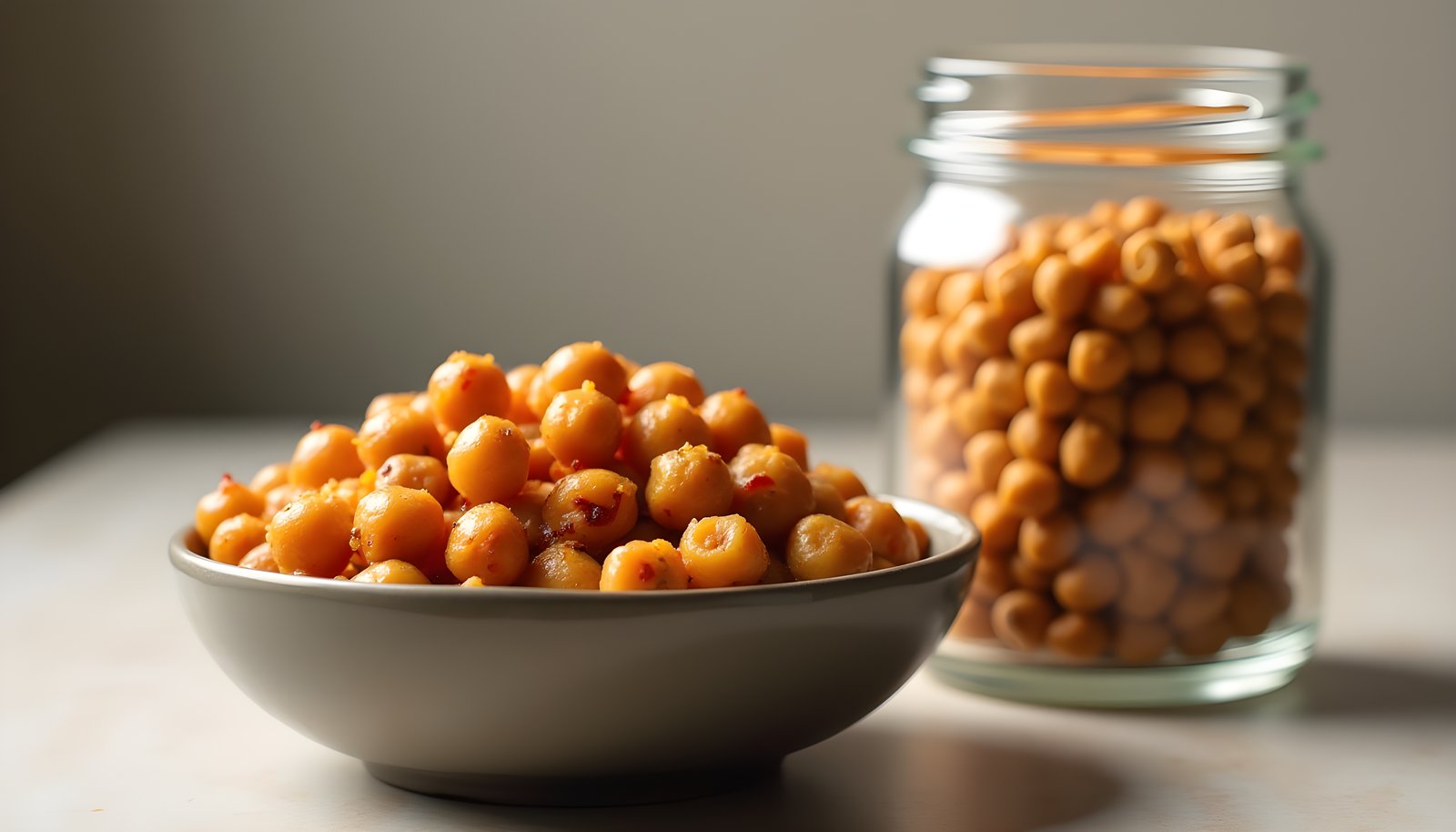
For snacks, roast rinsed chickpeas with a little oil and spice until crisp. Roasting drives off water, so a small handful packs more fiber per gram than the same weight straight from the can, and it travels better than a bag of chips.
Want more chickpea dinners to rotate through? Our recipe eBooks are full of easy, high-fiber meals built around beans and grains.
How chickpeas fit your daily fiber
Mayo Clinic suggests about 25 grams of fiber a day for women and 38 grams for men. A cup of chickpeas cooked from dry covers half the women’s goal on its own.
Picture a lunch wrap made with a cup of smashed chickpeas instead of 3 ounces of sliced chicken. You give up roughly 11 grams of protein but gain about 12.5 grams of fiber, and the chickpeas alone still supply 14.5 grams of protein.
Pair it with a medium apple and a cup of cooked broccoli at dinner, and those three foods alone bring you to about 22.5 grams for the day.
The Dietary Guidelines for Americans suggest about 3 cups of legumes a week, Harvard’s Nutrition Source notes. The four cans in the Tasmanian study came to well above that.
One thing to do this week
Pick up four cans of low sodium chickpeas on your next shopping trip and give each one a meal. Drain and rinse them, add them to dishes you already make, and you’ll add roughly 6 to 7 grams of fiber to your average day, about what the study participants gained.
Chickpea fiber questions, answered
How much fiber is in a can of chickpeas?
A standard can holds about one and a half cups drained, or roughly 14 grams of fiber, based on USDA values of 9.6 grams per rinsed cup.
Are garbanzo beans and chickpeas the same thing?
Yes. Garbanzo bean is another name for the chickpea, so the fiber and protein numbers are identical.
Is chickpea fiber soluble or insoluble?
Both. Chickpeas provide insoluble fiber for regularity, soluble fiber that can help with cholesterol, and prebiotic carbohydrates that feed gut bacteria.
Can chickpeas lower cholesterol?
They may help a little. In a 12 week Australian study, adults who ate about four cans a week lowered LDL cholesterol by about 7 mg/dL.
Are chickpeas good plant protein?
Yes. A cup cooked from dry has about 14.5 grams of protein and 12.5 grams of fiber, a pairing most protein foods can’t offer.
How can I make chickpeas easier to digest?
Use canned chickpeas, drain and rinse them, and start with about a quarter cup. Monash University lists that amount as a low FODMAP serve.
How many chickpeas should I eat a day?
There’s no set amount, but about a half cup a day matches the Tasmanian study and adds roughly 5 to 6 grams of fiber.
Sources
- Pittaway JK, Robertson IK, Ball MJ. “Chickpeas may influence fatty acid and fiber intake in an ad libitum diet, leading to small improvements in serum lipid profile and glycemic control.” Journal of the American Dietetic Association. 2008. doi.org
- U.S. Department of Agriculture, Agricultural Research Service. “FoodData Central.” 2026. fdc.nal.usda.gov
- U.S. Department of Agriculture and U.S. Department of Health and Human Services. “Food Sources of Dietary Fiber.” Dietary Guidelines for Americans, 2020 to 2025. 2020. dietaryguidelines.gov
- Harvard T.H. Chan School of Public Health. “Legumes and Pulses.” The Nutrition Source. 2024. nutritionsource.hsph.harvard.edu
- Collins L. “Including legumes on a low FODMAP diet.” Monash University FODMAP blog. 2016. monashfodmap.com
- Mayo Clinic Staff. “Dietary fiber: Essential for a healthy diet.” Mayo Clinic. 2024. mayoclinic.org

