
In this article
- Spinach fiber in a cooked cup versus a raw cup
- The benefits that travel with spinach fiber
- Spinach fiber and gut health
- Myth and fact: spinach wraps and pasta
- Spinach against other leafy greens
- Choosing spinach for the meal: a decision rule
- Spinach in a fiber rich day
- One spinach swap to make this week
- Spinach fiber and benefits: your questions
- Sources
You order the spinach wrap because it sounds like the greener choice. One spinach tortilla in USDA’s branded database lists spinach powder as its sixth ingredient, after salt, and gives you 2 grams of fiber for 150 calories.
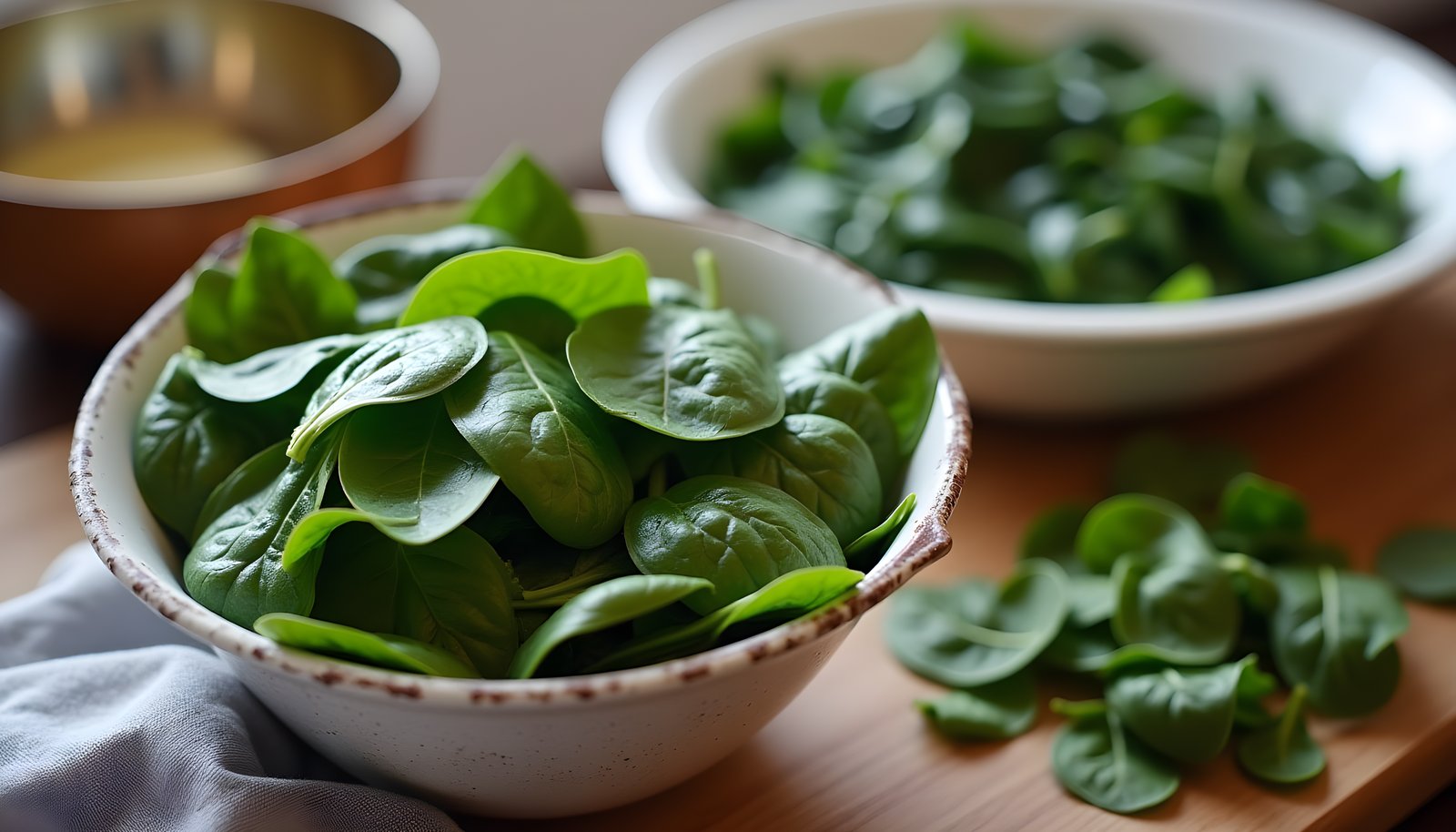
A cup of cooked spinach is a different story. It brings about 4.3 grams of spinach fiber for only 41 calories, plus a long list of vitamins and minerals that a green tinted wrap can’t match.
Here’s what spinach fiber does for your gut, which nutrients ride along with it, and how to tell real spinach from spinach flavored marketing.
Spinach fiber in a cooked cup versus a raw cup
By weight, raw and cooked spinach are close. USDA lists raw spinach at 2.2 grams of fiber per 100 grams and boiled, drained spinach at 2.4 grams.
The cup is where they split apart:
| Spinach serving (USDA) | Weight | Fiber | Calories |
|---|---|---|---|
| Raw spinach, 1 cup | 30 g | 0.7 g | 7 |
| Raw spinach, 100 g | 100 g | 2.2 g | 23 |
| Boiled spinach, 100 g | 100 g | 2.4 g | 23 |
| Boiled spinach, 1 cup | 180 g | 4.3 g | 41 |
A cooked cup weighs six times as much as a raw cup, because the leaves collapse as they wilt. So one cup of cooked spinach holds about the same leaves as six cups of fresh ones.
Raw spinach is about 91% water by weight, according to USDA. Heat collapses those watery leaves so they pack tightly into the cup, which is why the cooked cup weighs so much more.
That’s the main reason cooked spinach shows up in fiber plans and salad spinach mostly doesn’t. Raw leaves are light and airy, and you’d need a very large bowl to reach the fiber in a modest side of wilted greens.
The benefits that travel with spinach fiber
The NIH Office of Dietary Supplements points out that foods with dietary fiber generally provide magnesium, and it names green leafy vegetables such as spinach as good sources. Spinach is a clear example of both arriving together.
Here’s what USDA lists for one cup of boiled spinach, with the share of each FDA Daily Value:
| Nutrient, 1 cup boiled spinach (180 g) | Amount | % Daily Value |
|---|---|---|
| Fiber | 4.3 g | 15% |
| Magnesium | 157 mg | 37% |
| Potassium | 839 mg | 18% |
| Folate | 263 mcg DFE | 66% |
| Vitamin A | 943 mcg RAE | 105% |
| Vitamin K | 888 mcg | 740% |
| Protein | 5.4 g | 11% |
The ODS lists half a cup of boiled spinach at 78 milligrams of magnesium, or 19% of the Daily Value. Folate, one of the B vitamins, is another standout at about two thirds of a day’s worth per cooked cup.
Vitamin K is the number that jumps off the table. One cooked cup gives more than seven times the Daily Value of 120 micrograms, and vitamin A clears its 900 microgram mark too.
Potassium deserves a mention too. The FDA sets its Daily Value at 4,700 milligrams, and a cooked cup of spinach covers about 18% of it, a solid share for a side dish with only 41 calories.
Raw spinach is no slouch here either, with 558 milligrams of potassium per 100 grams. The catch is that 100 grams of raw leaves fills more than three cups, so cooked spinach is again the practical way to get there.
Protein is the quiet bonus. At 5.4 grams per cooked cup, spinach won’t replace beans or eggs, but it adds a little to every meal it joins.
Want to see how spinach fits next to your own daily fiber number? Our fiber calculator sets a personal target in a few quick steps.
Spinach fiber and gut health
Mayo Clinic lists vegetables among the main sources of insoluble fiber. It explains that insoluble fiber helps material move through your digestive system and increases stool bulk, which can help if you struggle with constipation or irregular stools.
Mayo also notes that fiber adds weight and size to stool and softens it, so it’s easier to pass. Over time, a high fiber diet is linked with a lower risk of hemorrhoids and small pouches in the colon known as diverticular disease.
Spinach makes an easy first step for a gut that isn’t used to much fiber. A cooked cup is gentle at 4.3 grams, and Mayo Clinic recommends adding fiber gradually over a few weeks with plenty of water.
If your gut is the reason you’re eating more greens, our gut health guides walk you through a steady plan, week by week.
Myth and fact: spinach wraps and pasta
Myth: A spinach wrap or spinach pasta counts as a serving of spinach.
Fact: Most of these products contain very little spinach. The Toufayan spinach wrap in USDA’s branded database lists enriched wheat flour first and spinach powder sixth, giving 2 grams of fiber, 150 calories and 280 milligrams of sodium per 52 gram wrap.
Calories tell the same story. That wrap has more than three times the calories of a cooked cup of spinach and less than half the fiber, so the leaves do more for you even before you add a filling.
Another product, a low carb spinach wrap from Fiesta Fit, lists no spinach at all in its submitted ingredients. Its 9 grams of fiber per wrap come from added fibers such as cellulose and oat fiber, along with whole wheat flour.
Spinach spaghetti is just as murky. USDA’s record for cooked spinach spaghetti lists 182 calories per cup and doesn’t report fiber, so the green color tells you nothing about what you’re getting.
| Spinach food (USDA) | Serving | Fiber | Calories | Spinach in it |
|---|---|---|---|---|
| Boiled spinach | 1 cup, 180 g | 4.3 g | 41 | All of it |
| Toufayan spinach wrap | 1 wrap, 52 g | 2 g | 150 | Powder, 6th ingredient |
| Fiesta Fit spinach low carb wrap | 1 wrap, 43 g | 9 g (added fibers) | 80 | None listed |
| Spinach spaghetti, cooked | 1 cup, 140 g | Not reported | 182 | Unclear |
Spinach against other leafy greens
Several leafy greens are sold under the spinach name. USDA lists them, along with romaine, per 100 grams raw:
| Leafy green, raw (USDA) | Fiber per 100 g | Calories per 100 g | Fiber per 100 calories |
|---|---|---|---|
| Mustard spinach (tendergreen) | 2.8 g | 22 | 12.7 g |
| Spinach | 2.2 g | 23 | 9.6 g |
| Romaine lettuce | 2.1 g | 17 | 12.4 g |
| New Zealand spinach | 1.5 g | 14 | 10.7 g |
Mustard spinach, also called tendergreen, edges ahead on fiber. It also carries 130 milligrams of vitamin C and 210 milligrams of calcium per 100 grams, far more vitamin C than the 28.1 milligrams in raw spinach.
Plain spinach is still the one most stores carry, and it cooks down further than you might expect. A wilted cup of it matches a heaped cup of raw chopped mustard spinach on fiber, at 4.3 versus 4.2 grams.
New Zealand spinach sits at the light end of the group. A cup of the chopped raw leaves weighs 56 grams and carries under 1 gram of fiber, so it works best cooked into a dish with other fiber foods.
Choosing spinach for the meal: a decision rule
- If fiber is the goal, cook it: a wilted cup gives about 4.3 grams versus 0.7 grams raw
- If you want a big salad, use raw spinach for volume and add beans or lentils for the fiber
- If you’re buying a spinach wrap or pasta, read the ingredient list and the fiber line before trusting the color
- If you want the most minerals per bite, try mustard spinach where you can find it
Spinach in a fiber rich day
Mayo Clinic recommends 25 grams of fiber a day for women and 38 grams for men up to age 50, then 21 and 30 grams after 50. Harvard’s Nutrition Source notes the average American eats only about 15 grams.
A cooked cup of spinach covers about 17% of a 25 gram goal and 11% of a 38 gram goal. That’s a solid contribution from a side dish with barely 40 calories.
Pairing makes the biggest difference. A bowl of half a cup of cooked lentils with a cup of wilted spinach stirred in comes to about 12.1 grams of fiber for roughly 156 calories, which is 43% of the Daily Value in one simple dish.
Spinach also mixes into dishes that already carry fiber. Stir a cooked cup into lentil soup, fold it into a bean burrito filling or layer it into a whole wheat lasagna and it adds fiber without crowding the plate.
Looking for soups, pastas and egg dishes that use a full cup of greens? Our recipe eBooks are packed with easy ideas.
One spinach swap to make this week
The next time you reach for a spinach wrap, flip the package over and find where spinach sits in the ingredient list. If it’s after salt, choose a whole wheat wrap and stuff it with a cup of cooked spinach instead.
That one change trades a green tint for about 4 grams of real spinach fiber, plus the magnesium, folate and vitamin K that come with the leaves. A bag of fresh spinach wilts into that filling in about the time it takes to warm the wrap.
Spinach fiber and benefits: your questions
Are spinach wraps a good source of fiber?
Not usually from the spinach. One spinach wrap lists spinach powder after salt and has 2 grams of fiber, while high fiber spinach wraps tend to get their fiber from added ingredients such as cellulose and oat fiber.
Is spinach good for gut health?
Yes. A cup of cooked spinach has about 4.3 grams of fiber, and Mayo Clinic says fiber from vegetables adds bulk to stool and helps material move through your digestive system.
How much magnesium is in spinach?
Half a cup of boiled spinach has about 78 milligrams, or 19% of the Daily Value, according to the NIH Office of Dietary Supplements. A full cooked cup gives about 157 milligrams.
Does spinach pasta have fiber?
It’s hard to say. USDA’s record for cooked spinach spaghetti doesn’t report fiber, so check the package label, and choose whole wheat or legume pasta if fiber is your goal.
How many cups of raw spinach equal a cup of cooked?
About six. A cup of raw spinach weighs 30 grams, while a cup of boiled spinach weighs about 180 grams, so the cooked cup holds far more leaves and fiber.
What is mustard spinach?
Mustard spinach, also called tendergreen, is a leafy green sold under the spinach name. USDA lists it at 2.8 grams of fiber and 210 milligrams of calcium per 100 grams raw.
Is spinach a superfood?
It earns the label for nutrient density. A cooked cup supplies more than a day’s vitamin A and vitamin K, two thirds of your folate and more than a third of your magnesium for about 41 calories.
Sources
- U.S. Department of Agriculture, Agricultural Research Service. “FoodData Central” (Spinach, raw 168462; Spinach, boiled, drained 168463; Mustard spinach, raw 168438; New Zealand spinach, raw 168440; Spaghetti, spinach, cooked 168912; Toufayan Savory Spinach Wraps 2109656; Fiesta Fit Spinach Low Carb Wraps 2554161; romaine lettuce). 2026. fdc.nal.usda.gov
- National Institutes of Health, Office of Dietary Supplements. “Magnesium: Fact Sheet for Health Professionals.” 2026. ods.od.nih.gov
- Mayo Clinic Staff. “Dietary fiber: Essential for a healthy diet.” Mayo Clinic. 2025. mayoclinic.org
- Harvard T.H. Chan School of Public Health. “Fiber.” The Nutrition Source. 2024. nutritionsource.hsph.harvard.edu
- U.S. Food and Drug Administration. “Daily Value on the Nutrition and Supplement Facts Labels.” 2024. fda.gov