
In this article
- Arugula fiber content, serving by serving
- Arugula nutrition beyond the fiber
- Arugula vs other leafy greens salad bases
- Arugula myths and facts
- Turning an arugula salad into a fiber meal
- Classic arugula pairings, counted
- What arugula fiber does in your gut
- Arugula on a low calorie or low carb plate
- One arugula habit to start today
- What people also ask about arugula
- Sources
Arugula is not high in fiber. A loosely packed cup weighs about 20 grams and gives you roughly 0.3 grams of fiber, around 1% of the Daily Value.
The twist is what happens when you weigh it instead of measuring by the cup. Gram for gram, arugula fiber beats iceberg lettuce, and the same 100 grams supplies more calcium than raw spinach and nearly a full day’s vitamin K.
So the useful question is less about whether arugula is a fiber food and more about what it adds to a plate that already has one.
Arugula fiber content, serving by serving
USDA FoodData Central lists raw arugula at 1.6 grams of fiber per 100 grams and 25 calories. Because the leaves are light and airy, the serving you pick changes the number a lot.
| Raw arugula | Weight | Fiber | % DV (28 g) | Calories |
|---|---|---|---|---|
| 1 leaf | 2 g | less than 0.1 g | 0% | under 1 |
| 1/2 cup | 10 g | 0.2 g | 1% | 3 |
| 1 cup | 20 g | 0.3 g | 1% | 5 |
| 2 cups | 40 g | 0.6 g | 2% | 10 |
| 100 g (about 5 cups) | 100 g | 1.6 g | 6% | 25 |
| 5 oz container | 142 g | 2.3 g | 8% | 36 |
Most side salads land between 1 and 3 cups, which means somewhere between 0.3 and 1 gram of fiber. Even finishing a whole 5 ounce container gets you only about 2.3 grams.
USDA’s newer Foundation record for baby arugula lists a bit more, about 2.3 grams per 100 grams. Baby leaves are not a weaker version of the plant, at least where fiber is concerned.
USDA has no cooked arugula entry, so every figure in this article is for raw leaves.
Arugula nutrition beyond the fiber
Where arugula earns its place is the micronutrients. Per 100 grams, USDA’s raw arugula record provides about:
- Vitamin K: 109 mcg, about 91% of the Daily Value
- Folate: 97 mcg DFE, about 24% DV
- Vitamin C: 15 mg, about 17% DV
- Manganese: 0.32 mg, about 14% DV
- Vitamin A: 119 mcg RAE, about 13% DV
- Calcium: 160 mg, about 12% DV
- Magnesium: 47 mg, about 11% DV
- Potassium: 369 mg, about 8% DV
- Iron: 1.5 mg, about 8% DV
A more typical 2 cup serving (40 g) still covers about 36% of the Daily Value for vitamin K and about 10% for folate, for 10 calories.
The NIH Office of Dietary Supplements explains that vitamin K helps your blood clot and supports healthy bones, and it lists green leafy vegetables among the best food sources.
Folate matters too. The NIH notes that your body needs folate to make DNA and other genetic material, and for cells to divide, and it names dark green leafy vegetables as a top source.
The calcium surprise
At 160 mg per 100 grams, arugula carries more calcium than raw spinach (99 mg) and almost five times as much as romaine (33 mg), based on USDA records. The amounts per cup are small, but they add up if arugula is your everyday salad base.
Arugula vs other leafy greens salad bases
Swapping one salad green for another changes fiber less than most people expect. Here are USDA’s raw figures side by side.
| Raw green | Fiber per 100 g | Calories per 100 g | Typical cup | Fiber per cup |
|---|---|---|---|---|
| Spinach | 2.2 g | 23 | 30 g | 0.7 g |
| Romaine | 2.1 g | 17 | 47 g (shredded) | 1.0 g |
| Arugula | 1.6 g | 25 | 20 g | 0.3 g |
| Iceberg | 1.2 g | 14 | 72 g (shredded) | 0.9 g |
| Watercress | 0.5 g | 11 | 34 g (chopped) | 0.2 g |
Per cup, romaine and iceberg look better than arugula only because their cups are heavier. Iceberg also carries only about a fifth of arugula’s vitamin K per 100 grams, according to USDA.
Looking at fiber per 100 calories tells a similar story. Arugula gives about 6.4 grams per 100 calories, while raw spinach gives about 9.6 grams and romaine about 12.4 grams, because those leaves are a little lower in calories and a little higher in fiber.
Arugula wins on other fronts instead. Its calcium per 100 grams sits well above spinach and romaine, and its vitamin K is about five times iceberg’s, so the green you pick depends on what you want the salad to deliver.
None of these raw greens is a serious fiber source. The leafy greens that really move the needle are cooked: the Dietary Guidelines list a cup of cooked spinach at 4.3 grams and cooked collards at 4.8 grams, because cooking packs far more leaf into the cup.
Mayo Clinic suggests 21 to 25 grams of fiber a day for women and 30 to 38 grams for men. Even a generous arugula salad covers only a few percent of that on its own.
Curious where your own number falls in that range? Our fiber calculator gives you a personal target in seconds.
Arugula myths and facts
Myth: Peppery greens are packed with fiber.
Fact: Arugula’s bold taste says nothing about its fiber. It has 1.6 grams per 100 grams, less than raw spinach or romaine.
Myth: A big salad is a high fiber meal.
Fact: A 3 cup arugula salad has about 1 gram of fiber. The toppings decide whether the bowl is high fiber.
Myth: Baby arugula is the lightweight version.
Fact: USDA’s baby arugula record shows about 2.3 grams of fiber per 100 grams, slightly more than the standard raw arugula entry.
Turning an arugula salad into a fiber meal
Picture a lunch bowl with 3 cups of arugula (60 g), half a cup of chickpeas and half a cup of cooked bulgur. The greens bring about 1.0 gram of fiber.
The Dietary Guidelines list half a cup of chickpeas at 6.3 grams and half a cup of cooked bulgur at 4.1 grams. Together the bowl reaches about 11.4 grams of fiber, roughly 40% of the Daily Value.
Without the chickpeas and grain, the same bowl stops at about 1 gram. The arugula supplies the flavor, the vitamin K and the folate, while the toppings carry the fiber load.
| Arugula salad add-in | Amount | Fiber (DGA) |
|---|---|---|
| Lentils, cooked | 1/2 cup | 7.8 g |
| Black beans | 1/2 cup | 7.5 g |
| Chickpeas | 1/2 cup | 6.3 g |
| Bulgur, cooked | 1/2 cup | 4.1 g |
| Pear, with skin | 1/2 medium | 2.8 g |
| Avocado | 1/4 cup | 2.5 g |
| Almonds | 1/2 ounce | 1.8 g |
| Barley, cooked | 1/2 cup | 3.0 g |
Want more salad bowls built this way? Our recipe eBooks are full of easy, high fiber meals.
Classic arugula pairings, counted
Arugula shows up in a few familiar combinations, and each one changes the fiber math in its own way. All of these use 2 cups of arugula (about 0.6 grams of fiber) as the base, with add-in values from the Dietary Guidelines.
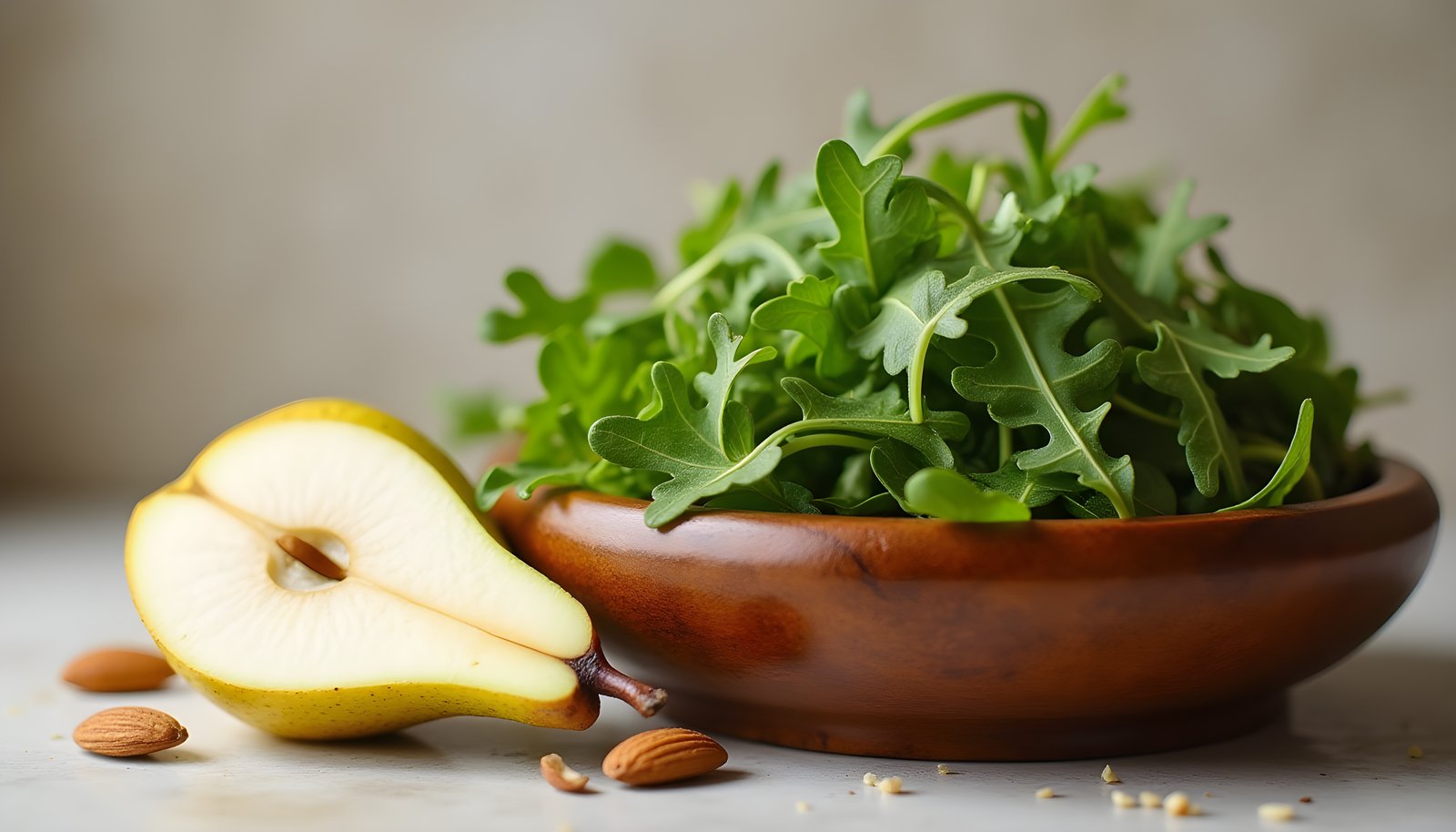
- Arugula, pear and almonds: half a medium pear (2.8 g) and half an ounce of almonds (1.8 g) bring the plate to about 5.2 grams
- Arugula and avocado: a quarter cup of avocado (2.5 g) lifts it to about 3.1 grams
- Arugula with raspberries: half a cup of raspberries (4.0 g) takes it to about 4.6 grams
- Arugula and white beans: half a cup of white beans (5.7 g) reaches about 6.3 grams
The pattern holds every time. The arugula contributes well under a gram, and the fruit, nuts or beans you add provide nearly all of the fiber content in the bowl.
That’s useful to know when you order a salad out, too. A plate of dressed arugula with shaved cheese is a fine side, but it isn’t doing much for your fiber total until something else joins it.
What arugula fiber does in your gut
The fiber in arugula behaves like fiber from other vegetables. Mayo Clinic explains that fiber adds weight and size to stool and softens it, which makes it easier to pass.
Mayo also describes two kinds of fiber. Soluble fiber dissolves in water to form a gel-like material, and insoluble fiber helps material move through your digestive system, with vegetables listed among its sources.
With only about 0.3 grams per cup, arugula is a gentle way to eat more greens if your gut is sensitive. Mayo Clinic notes that adding fiber too quickly can cause gas, bloating and cramping, and it recommends increasing intake gradually with plenty of water.
If you’re easing your gut into more fiber, our guides walk you through a slow, steady approach.
Arugula on a low calorie or low carb plate
A cup of arugula has about 5 calories and 0.7 grams of carbohydrate, of which 0.3 grams is fiber. That makes it easy to pile on volume without moving your calorie or carb totals.
Mayo Clinic notes that high fiber foods tend to be more filling than low fiber foods. Arugula alone won’t do much there, but pairing it with beans or whole grains gives you both the volume and the fiber.
One arugula habit to start today
Next time you make a salad, start with arugula and then add one half cup of beans, lentils or a whole grain before anything else. That single scoop moves the bowl from about 1 gram of fiber to somewhere between 4 and 9 grams.
Keep the arugula for what it does best: peppery flavor, vitamin K, folate and calcium. Let the scoop do the fiber work.
What people also ask about arugula
How much fiber is in a cup of arugula?
About 0.3 grams. A loosely packed cup of raw arugula weighs only around 20 grams and has about 5 calories.
Is arugula healthier than spinach?
It depends on the nutrient. Raw spinach has more fiber per 100 grams, 2.2 grams versus 1.6, while arugula has more calcium, about 160 mg versus 99 mg.
Does arugula have more fiber than iceberg lettuce?
Yes, by weight. Arugula has about 1.6 grams per 100 grams and iceberg about 1.2 grams, though a shredded cup of iceberg is heavier.
What vitamins are in arugula?
Arugula is rich in vitamin K and folate. 100 grams supplies about 91% of the Daily Value for vitamin K and 24% for folate, plus some vitamin C and A.
Is arugula good for digestion?
It helps a little. Arugula’s fiber adds bulk to stool, but at 0.3 grams per cup you’ll get more from adding beans or whole grains to your salad.
Is baby arugula as nutritious as regular arugula?
Yes, for fiber at least. USDA’s baby arugula record lists about 2.3 grams of fiber per 100 grams, slightly more than the standard raw entry.
How many calories are in arugula?
Very few. A cup of raw arugula has about 5 calories and 100 grams has about 25.
Sources
- USDA Agricultural Research Service. FoodData Central: SR Legacy Arugula, raw (169387); Foundation Arugula, baby, raw (2710822); Spinach, raw (168462); Lettuce, cos or romaine, raw (169247); Lettuce, iceberg, raw (169248); Watercress, raw (170068). 2019 to 2026. fdc.nal.usda.gov
- U.S. Department of Agriculture and U.S. Department of Health and Human Services. “Food Sources of Dietary Fiber.” Dietary Guidelines for Americans, 2020 to 2025. dietaryguidelines.gov
- U.S. Food and Drug Administration. “Daily Value on the Nutrition and Supplement Facts Labels.” 2024. fda.gov
- National Institutes of Health Office of Dietary Supplements. “Vitamin K: Fact Sheet for Consumers.” 2021. ods.od.nih.gov
- National Institutes of Health Office of Dietary Supplements. “Folate: Fact Sheet for Consumers.” 2022. ods.od.nih.gov
- Mayo Clinic Staff. “Dietary fiber: Essential for a healthy diet.” Mayo Clinic. 2025. mayoclinic.org