
In this article
- Chestnuts fiber by serving
- Myth: chestnuts are rich, fatty nuts like the rest
- Chestnut nutrition: the vitamin C surprise
- How chestnuts compare with other nuts
- Chestnuts as holiday nuts
- Roasting chestnuts at home
- Buying and storing fresh chestnuts
- Water chestnuts are a different food
- Getting more fiber from a chestnut dish
- Try one chestnut swap this week
- Chestnuts and fiber: what people ask
- Sources
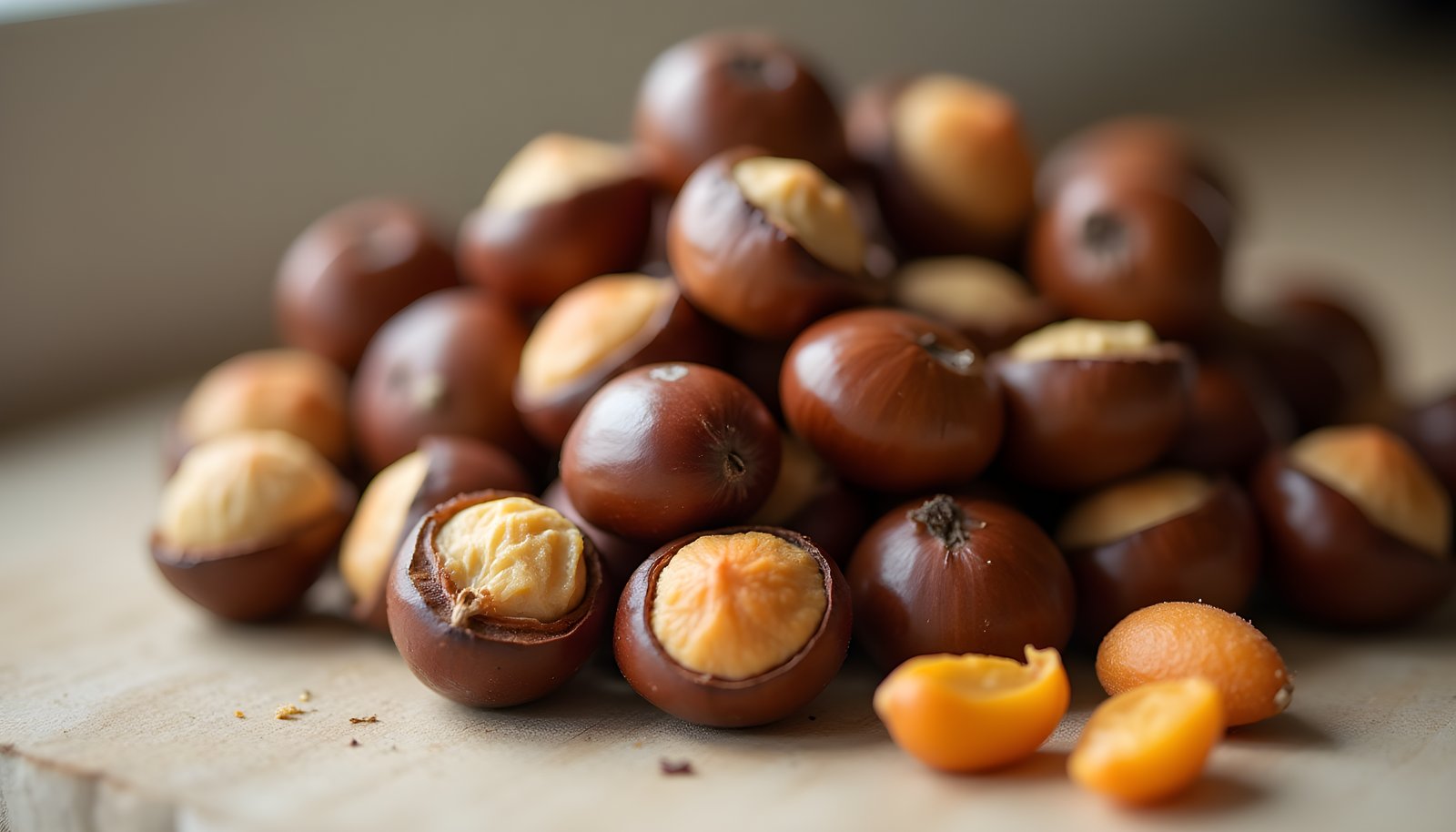
Chestnuts get filed with almonds and walnuts, but they barely act like nuts at all. A roasted chestnut is mostly starch and water, with less than a gram of fat per ounce, and its fiber story follows from that.
USDA lists roasted European chestnuts at 5.1 grams of fiber per 100 grams. Chestnuts fiber per ounce is modest, about 1.5 grams, but because they’re so low in calories you can eat a much bigger portion than you would of other nuts.
Chestnuts fiber by serving
Because chestnuts are so light on calories, portions look more like a side dish than a handful. The table scales the numbers for roasted chestnuts.
| Amount (roasted) | Fiber | % DV (28 g) | Calories | Carbs |
|---|---|---|---|---|
| 1 ounce (28 g) | 1.5 g | 5% | 70 | 15 g |
| 2 ounces (57 g) | 2.9 g | 10% | 140 | 30 g |
| 3 ounces (85 g) | 4.3 g | 15% | 208 | 45 g |
| 100 grams | 5.1 g | 18% | 245 | 53 g |
A 3 ounce serving, a generous side portion, gives you 4.3 grams of fiber for around 208 calories. That’s more fiber than an ounce of almonds, for a similar calorie cost.
Even a single ounce, about the size of a small handful of peeled kernels, gives you 1.5 grams of fiber for 70 calories. That makes chestnuts one of the few nut style snacks you can eat freely without the calorie math getting away from you.
The catch is carbohydrate. Those 3 ounces carry about 45 grams of carbs and 9 grams of natural sugar, closer to a serving of rice or potatoes than to any nut.
Myth: chestnuts are rich, fatty nuts like the rest
Myth: chestnuts are a high fat, high calorie nut, so they belong in the same small portions as pecans or macadamias.
Fact: roasted chestnuts have just 2.2 grams of fat per 100 grams, compared with roughly 50 to 76 grams in almonds, pecans, hazelnuts and macadamias. An ounce has about 70 calories, roughly a third of an ounce of pecans.
Chestnuts get their energy from starch instead. That’s why they’re soft and sweet when roasted, and why they work in soups, stuffing and purees where an oily nut would feel heavy.
The water content matters too. Fresh and roasted chestnuts hold a lot of moisture, which is part of why their calories per gram are so much lower than those of dry, oily nuts.
It also means chestnuts carry very little protein, under a gram per ounce. If you’re snacking on nuts for protein or healthy fats, chestnuts don’t fill that role.
Chestnut nutrition: the vitamin C surprise
Unlike almost every other nut, chestnuts carry a meaningful amount of vitamin C. A 3 ounce serving of roasted chestnuts brings:
- Vitamin C: 22 mg, about 24% of the Daily Value
- Copper: 0.43 mg, about 48% DV
- Manganese: 1.0 mg, about 44% DV
- Vitamin B6: 0.43 mg, about 25% DV
- Folate: 60 mcg, about 15% DV
- Potassium: 503 mg, about 11% DV
Roasting doesn’t wipe out the vitamin C either. USDA’s figure of 26 mg per 100 grams is for roasted chestnuts, the form most people actually eat.
That profile looks more like a starchy vegetable than a nut. Potassium, vitamin C and B6 are the same nutrients you’d expect from a baked potato, which fits how chestnuts are used in cooking.
Chestnuts are also naturally low in sodium, with almost none in plain roasted or vacuum packed kernels. Seasoned or candied versions are a different story, so check the label on anything flavored.
How chestnuts compare with other nuts
Per ounce, chestnuts look weak on fiber. Per calorie, they’re among the best of any nut.
| Nut (1 oz) | Fiber | Calories | Fiber per 100 kcal | Fat |
|---|---|---|---|---|
| Chestnuts, roasted | 1.5 g | 70 | 2.1 g | 0.6 g |
| Almonds | 3.5 g | 164 | 2.1 g | 14 g |
| Pistachios | 3.0 g | 159 | 1.9 g | 13 g |
| Pecans | 2.7 g | 196 | 1.4 g | 20 g |
| Walnuts | 1.9 g | 185 | 1.0 g | 18 g |
Fat is where the gap is biggest. An ounce of chestnuts has well under a gram, while an ounce of pecans has about 20 grams, more than 30 times as much.
Chestnuts tie almonds on fiber per 100 calories and beat every other nut in the table. The difference is portion: three ounces of chestnuts cost about the same calories as 1.3 ounces of almonds.
Not sure how chestnuts fit into your own daily fiber target? Our fiber calculator gives you a personal number in seconds.
Chestnuts as holiday nuts
For many people, chestnuts are a winter food: roasted on the street, folded into stuffing or simmered into soup. That’s a good thing for fiber, because those dishes use chestnuts by the cupful, not the handful.
A chestnut stuffing that replaces part of the bread with chopped chestnuts adds fiber and cuts fat at the same time. A chestnut soup made with onions, celery and stock gives you a creamy texture without cream.
Roasted chestnuts also work beside a holiday roast in place of some of the potatoes. They bring a similar soft, starchy bite, and 3 ounces still carry 4.3 grams of fiber.
Chestnuts in a holiday nut bowl are a different case. If the bowl holds chestnuts alongside almonds and pecans, a handful of chestnuts is the lightest option on the table by a wide margin.
Holiday baking is where the numbers turn. Candied chestnuts and sweetened chestnut spreads add a lot of sugar, and the fiber per serving often drops because the chestnut makes up less of each bite.
Looking for holiday recipes that keep fiber high? Our recipe eBooks are full of easy seasonal ideas.
Roasting chestnuts at home
Roasting nuts like chestnuts takes a little prep, because the shell has to be scored first or steam will make it burst. The steps are simple:
- Cut an X through the flat side of each shell with a sharp knife.
- Soak the scored chestnuts in hot water for about 10 minutes to help them steam.
- Roast on a baking sheet at 400°F (200°C) for 15 to 20 minutes, until the shells curl back.
- Wrap them in a towel for a few minutes so the skins loosen.
- Peel while warm, removing both the shell and the thin inner skin.
The inner skin is bitter, so peel it away before eating. A warm chestnut peels far more easily than a cold one, so work in small batches.
If you’d rather skip the work, vacuum packed roasted chestnuts are widely sold. One brand lists 1 gram of fiber per 50 gram serving, lower than USDA’s figure for home roasted chestnuts, so labels can vary.
Buying and storing fresh chestnuts
Fresh chestnuts show up in stores in late fall and winter. Look for shells that are glossy, firm and heavy for their size, with no rattling inside when you shake one.
Because they hold so much water, fresh chestnuts behave more like produce than like a bag of almonds. Keep them in the fridge in a paper or perforated bag and use them within a week or two.
Cooked, peeled chestnuts freeze well. Roast a big batch when they’re in season, then freeze the kernels in portions for soups and side dishes later in the winter.
Water chestnuts are a different food
Water chestnuts, the crunchy slices in stir fries, aren’t chestnuts at all. They’re an aquatic vegetable, and canned versions are mostly water.
One canned brand lists 0 grams of fiber and 15 calories in a 6 piece serving. They’re a fine low calorie crunch, but they won’t do what roasted chestnuts do for your fiber.
Getting more fiber from a chestnut dish
Since chestnuts already bring fiber with few calories, pair them with other high fiber foods to build a full plate. A few combinations from the USDA fiber list:
- Roasted chestnuts with a cup of cooked broccoli (5.2 grams).
- Chestnut and lentil soup, with half a cup of lentils adding 7.8 grams.
- Chestnuts tossed with green peas, a cup of which carries 8.8 grams.
- A chestnut and pear salad, with a medium pear bringing 5.5 grams.
Each of these plates lands somewhere between 9 and 13 grams of fiber once you add the 4.3 grams from a 3 ounce serving of chestnuts. That’s a third or more of the Daily Value in a single dish.
Mayo Clinic suggests increasing fiber gradually with plenty of fluids. Starting with a small bag of roasted chestnuts and building from there is an easy way to add more without discomfort.
Try one chestnut swap this week
Pick one dish where you’d normally use bread, croutons or a fatty nut, and use roasted chestnuts instead. Toss them into a salad, fold them into a grain bowl or roast them alongside root vegetables.
If you already eat chestnuts once a year at the holidays, try them in an ordinary week instead. A pouch of vacuum packed kernels keeps in the pantry and can go straight into a pan with vegetables.
Three ounces add about 4 grams of fiber for around 200 calories, with almost no fat, and you’ll have learned a nut that behaves like no other.
Chestnuts and fiber: what people ask
How much fiber is in a serving of roasted chestnuts?
About 4.3 grams in a 3 ounce (85 gram) serving. USDA lists 5.1 grams of fiber per 100 grams of roasted European chestnuts.
Are chestnuts healthier than other nuts?
They’re different. Chestnuts have far less fat and fewer calories, plus vitamin C, but much less protein than almonds, peanuts or cashews.
Are chestnuts high in carbs?
Yes. A 3 ounce serving of roasted chestnuts has about 45 grams of carbohydrate, similar to a serving of rice or potatoes.
Do chestnuts have vitamin C?
Yes. Roasted chestnuts have 26 mg of vitamin C per 100 grams, and a 3 ounce serving covers about 24% of the Daily Value.
Are water chestnuts the same as chestnuts?
No. Water chestnuts are an aquatic vegetable, and canned ones list 0 grams of fiber per serving.
Are chestnuts good for weight loss?
They can be. At about 70 calories per ounce, chestnuts let you eat a larger portion than other nuts for the same calories.
Should I peel the inner skin of chestnuts?
Yes. The thin inner skin is bitter and tough, so peel it off while the chestnuts are warm.
Sources
- USDA Agricultural Research Service. FoodData Central: SR Legacy Nuts, chestnuts, european, roasted (170190), per ounce records for almonds, pistachios, pecans and walnuts, and branded records for Galil Roasted Chestnuts (2020) and Kroger Whole Water Chestnuts (2018). fdc.nal.usda.gov
- U.S. Food and Drug Administration. “Daily Value on the Nutrition and Supplement Facts Labels.” 2024. fda.gov
- U.S. Department of Agriculture and U.S. Department of Health and Human Services. “Food Sources of Dietary Fiber.” Dietary Guidelines for Americans, 2020 to 2025. dietaryguidelines.gov
- Mayo Clinic Staff. “Dietary fiber: Essential for a healthy diet.” Mayo Clinic. 2025. mayoclinic.org