
In this article
- Why raw vs cooked eggs fiber is a tie
- Cooking eggs nutrition by method
- One egg on your plate
- Boiled eggs fiber and other vitamins
- How much protein you actually absorb
- The biotin problem with raw whites
- Safety differences between raw and cooked
- Where raw eggs still sneak into your kitchen
- Myth vs fact: raw eggs are more natural, so they’re better
- Adding fiber to cooked eggs
- Choosing a cooking method that fits your goals
- What readers ask about raw and cooked eggs
- Sources
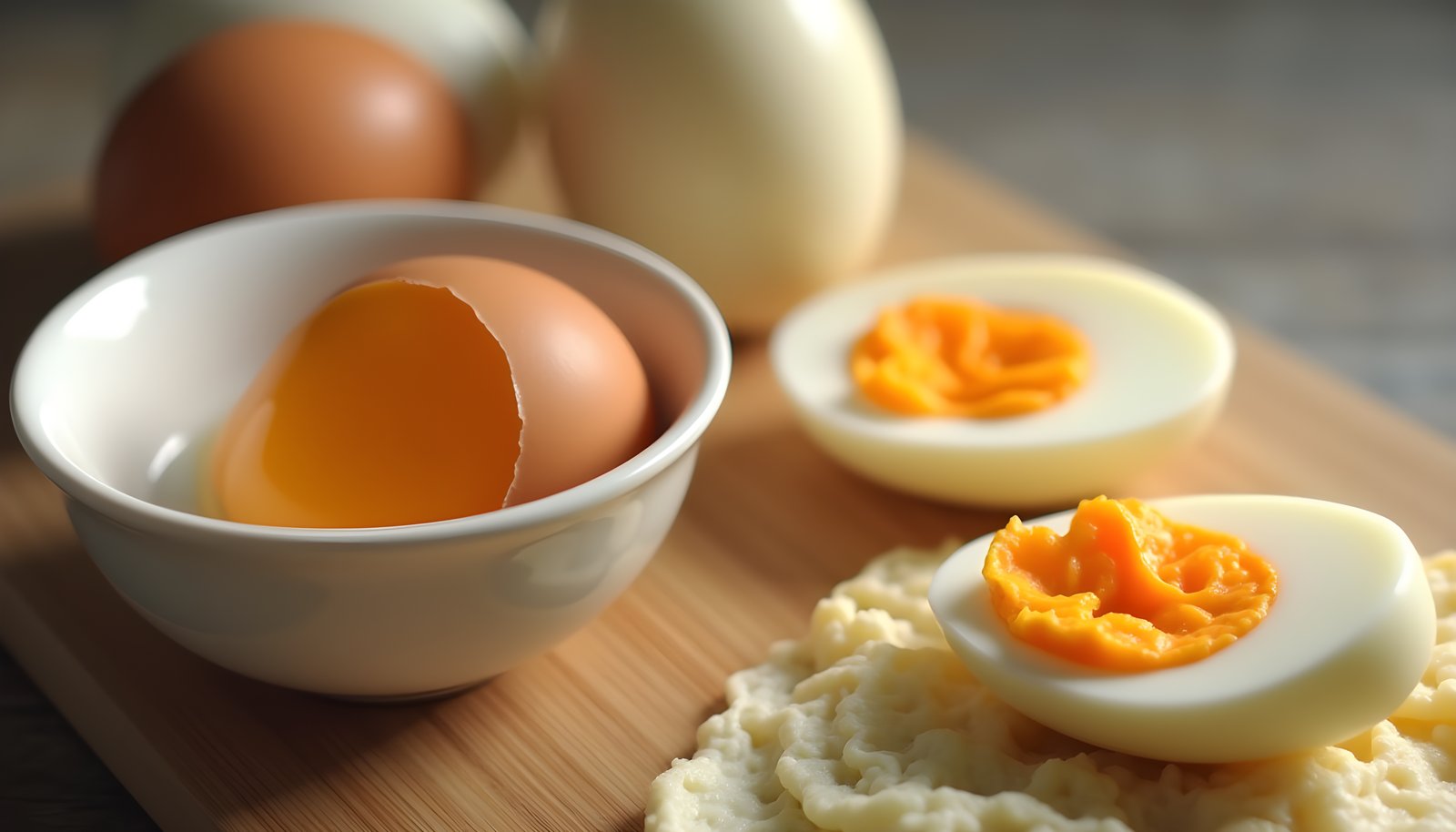
Plenty of people still believe a raw egg in a glass is the purest way to get an egg’s nutrition. On the raw vs cooked eggs fiber question, the myth doesn’t matter at all, since both versions carry 0 grams of fiber.
Where the raw egg habit really falls short is protein and vitamins. A heat source helps your body use more of what’s inside the shell, and it removes a safety problem along the way.
Why raw vs cooked eggs fiber is a tie
Fiber is the part of plant foods your body can’t digest or absorb, according to Mayo Clinic. An egg is an animal food made of protein, fat, water, vitamins and minerals, so there is no plant material to start with.
Heat can rearrange proteins and melt fat, but it can’t create fiber out of nothing. That’s why every egg entry in USDA FoodData Central, from raw to hard boiled, shows the same zero on the fiber line.
So if you’re comparing preparation methods, fiber drops out of the decision. The more useful questions are about calories, fat, sodium, absorption and safety.
Cooking eggs nutrition by method
Here’s how FoodData Central lists five common preparations, all per 100 grams so the numbers line up fairly:
| Preparation (100 g) | Calories | Protein | Fat | Fiber | Sodium |
|---|---|---|---|---|---|
| Raw | 143 | 12.6 g | 9.5 g | 0 g | 142 mg |
| Hard boiled | 155 | 12.6 g | 10.6 g | 0 g | 124 mg |
| Poached | 143 | 12.5 g | 9.5 g | 0 g | 298 mg |
| Fried | 196 | 13.6 g | 14.8 g | 0 g | 207 mg |
| Scrambled, with milk and fat | 149 | 10.0 g | 11.0 g | 0 g | 145 mg |
Raw, boiled and poached eggs sit very close together on calories, protein and fat. Frying adds the most energy, because the cooking fat soaks into the egg, and fried eggs land around 196 calories per 100 grams.
Scrambled eggs show a lower protein number for a simple reason. FoodData Central’s scrambled entry includes milk and fat, which dilute the egg itself.
The sodium surprise in poached eggs
Poached eggs list about 298 milligrams of sodium per 100 grams, roughly double the raw value. FoodData Central’s poached entry is cooked in salted water, and some of that salt stays with the egg.
If you poach at home in plain water, your egg will sit much closer to the raw number. The same goes for boiled eggs, which stay in their shells and come in lowest at 124 milligrams.
One egg on your plate
Per 100 grams is useful for comparing, but you eat eggs one at a time. These are FoodData Central’s own serving sizes for each method:
| Serving | Calories | Protein | Fat | Choline | Fiber |
|---|---|---|---|---|---|
| Raw, large (50 g) | 72 | 6.3 g | 4.8 g | 147 mg | 0 g |
| Hard boiled, large (50 g) | 78 | 6.3 g | 5.3 g | 147 mg | 0 g |
| Poached (50 g) | 72 | 6.3 g | 4.7 g | 117 mg | 0 g |
| Fried, large (46 g) | 90 | 6.3 g | 6.8 g | 146 mg | 0 g |
| Scrambled, large (61 g) | 91 | 6.1 g | 6.7 g | 135 mg | 0 g |
The protein on the label barely changes, around 6 grams per egg in every row. Fried and scrambled eggs gain about 18 to 19 calories over a raw egg, from the added cooking fat, plus milk in the scrambled version.
Choline, a nutrient your body uses for cell membranes and nerve signaling, holds steady in boiled and fried eggs. The poached and scrambled entries list somewhat less per serving, at 117 and 135 milligrams.
Boiled eggs fiber and other vitamins
Boiled eggs fiber is zero, but the vitamin story is more interesting. Comparing FoodData Central’s raw and hard boiled entries per 100 grams:
- Vitamin B12: 0.89 mcg raw, 1.11 mcg hard boiled
- Riboflavin: 0.46 mg raw, 0.51 mg hard boiled
- Folate: 47 mcg raw, 44 mcg hard boiled
- Choline: 294 mg in both
Those are small differences in both directions. Boiling doesn’t strip an egg of its B vitamins, and the hard boiled entry also lists 2.2 mcg of vitamin D per 100 grams.
For practical purposes, a boiled egg delivers the same vitamin package as a raw one. The big differences between raw and cooked eggs show up somewhere else: in what your gut can actually absorb.
How much protein you actually absorb
A 1998 study in the Journal of Nutrition tracked egg protein through the human gut using stable isotopes, harmless labeled forms of atoms that researchers can trace. It measured ileal digestibility, the share of protein absorbed by the end of the small intestine.
Cooked egg protein reached 90.9 percent digestibility. Raw egg protein managed only 51.3 percent.
In plain terms, nearly half the protein in a raw egg slipped past the small intestine unabsorbed.
That turns the raw egg shake idea upside down. Gulping raw eggs for muscle gives you less usable protein than eating the same eggs cooked.
The biotin problem with raw whites
Raw egg whites contain avidin, a protein that binds tightly to biotin, a B vitamin, and blocks its absorption in your gut. The NIH Office of Dietary Supplements notes that cooking denatures avidin, meaning heat changes its shape so it can no longer latch on.
A cooked whole egg provides about 10 mcg of biotin, or 33 percent of the Daily Value. Adults need about 30 mcg a day, so cooked eggs make a real contribution.
Eat the same egg raw, and the avidin in the white can tie up biotin before you get to use it.
Safety differences between raw and cooked
The FDA warns that even eggs with clean, uncracked shells can occasionally carry Salmonella, a bacterium that causes food poisoning. Symptoms usually start 12 to 72 hours after eating a contaminated food.
The FDA’s kitchen guidance is straightforward:
- Cook eggs until both the yolk and the white are firm, and don’t serve scrambled eggs runny
- Bring egg casseroles and other egg dishes to 160°F, checked with a food thermometer
- Reheat cooked egg dishes to 165°F
- Keep eggs in a refrigerator at 40°F or below
- Don’t leave cooked eggs out longer than 2 hours, or 1 hour above 90°F
For recipes that traditionally use raw eggs, such as Caesar dressing or homemade ice cream, the FDA recommends pasteurized shell eggs or pasteurized egg products. Children, older adults, pregnant women and people with weakened immune systems face the highest risk of serious illness.
Where raw eggs still sneak into your kitchen
Most people don’t drink raw eggs, but raw or lightly cooked egg turns up in more places than you might expect. The FDA points to dishes like Caesar dressing and homemade ice cream as typical examples.
For any recipe where the egg never gets fully cooked, pasteurized shell eggs or a carton of pasteurized egg product are the swap the FDA recommends. That way the dressing or dessert keeps its texture without relying on an unheated shell egg.
Keep in mind that a gently cooked yolk still has the same 0 grams of fiber as a firm one. Safety, not fiber, is the reason to cook eggs through.
Looking for egg dishes that are cooked through and loaded with beans and greens? Our recipe eBooks have plenty of easy ideas.
Myth vs fact: raw eggs are more natural, so they’re better
Myth: Cooking destroys an egg’s nutrients, so raw eggs give you more.
Fact: FoodData Central shows boiled eggs holding onto their B vitamins and choline, and cooked egg protein is absorbed far better, at 90.9 percent versus 51.3 percent. Cooking also frees biotin from avidin, so heat improves the deal rather than spoiling it.
Adding fiber to cooked eggs
Since no egg brings fiber, the method you choose matters less than what you cook alongside it. Mayo Clinic suggests about 25 grams a day for women 50 and younger and 38 grams for men 50 and younger.
These FoodData Central portions work well with eggs:
| Pair with your eggs | Amount | Fiber |
|---|---|---|
| Black beans, cooked | 1/2 cup | 7.5 g |
| Avocado | 1/2 cup | 5.0 g |
| Spinach, cooked | 1 cup | 4.3 g |
| Mushrooms | 1 cup | 3.4 g |
| Red bell pepper, raw | 1 cup | 3.1 g |
| Whole wheat tortilla | 1 oz | 2.8 g |
Three cooked egg meals with real fiber
- Breakfast taco: two scrambled eggs in a whole wheat tortilla with 1/2 cup black beans and 1/2 cup avocado, about 15.3 g
- Spinach and mushroom omelet: 1 cup cooked spinach plus 1 cup mushrooms folded into a two egg omelet, about 7.7 g
- Boiled egg snack box: two hard boiled eggs with 1 cup of red bell pepper strips, about 3.1 g
That breakfast taco alone covers more than 60 percent of the 25 gram target, with the eggs supplying the protein and the beans and avocado doing the fiber work.
Wondering what your own daily fiber number should be? Our fiber calculator works it out from a few quick details.
Choosing a cooking method that fits your goals
Fiber won’t separate these methods, so let your priorities decide. A quick decision rule:
- If you want the fewest calories, boil or poach in plain water
- If you’re watching sodium, choose hard boiled eggs, which list the least
- If you want a rich, filling breakfast, fry or scramble, and expect about 18 extra calories per egg
- If a recipe calls for raw eggs, switch to pasteurized eggs
And whatever method you pick, put a fiber food on the plate, because the egg will never bring any on its own.
What readers ask about raw and cooked eggs
Do cooked eggs have more fiber than raw eggs?
No. Raw and cooked eggs both have 0 grams of fiber. Fiber only comes from plant foods, and cooking can’t create it.
Do boiled eggs have fiber?
No. USDA FoodData Central lists 0 grams of fiber for a hard boiled egg. A large boiled egg provides about 78 calories and 6.3 grams of protein instead.
Is it better to eat eggs raw or cooked for protein?
Cooked. A 1998 study in the Journal of Nutrition found cooked egg protein was 90.9 percent digestible, compared with 51.3 percent for raw egg protein.
Does cooking eggs destroy their vitamins?
Not in a meaningful way. FoodData Central lists similar B12, riboflavin, folate and choline values for raw and hard boiled eggs.
Why are raw egg whites bad for biotin?
Raw whites contain avidin, which binds biotin and blocks its absorption. Cooking changes avidin’s shape, so a cooked whole egg can supply about 10 mcg of biotin.
Which cooking method adds the most calories to eggs?
Frying. A fried large egg lists about 90 calories, compared with 72 for a raw or poached egg, because it absorbs cooking fat.
What can I eat with eggs to get more fiber?
Beans, vegetables, avocado and whole grains. Half a cup of black beans adds about 7.5 grams, and a cup of cooked spinach adds about 4.3 grams.
Sources
- U.S. Department of Agriculture, Agricultural Research Service. “FoodData Central” (egg, whole, raw 171287; hard boiled 173424; fried 173423; scrambled 172187; poached 172186; black beans; avocado; spinach; mushrooms; red bell pepper; whole wheat tortilla). 2026. fdc.nal.usda.gov
- Evenepoel P, et al. “Digestibility of cooked and raw egg protein in humans as assessed by stable isotope techniques.” Journal of Nutrition 128(10):1716 to 1722. 1998. pubmed.ncbi.nlm.nih.gov
- National Institutes of Health, Office of Dietary Supplements. “Biotin: Fact Sheet for Health Professionals.” 2022. ods.od.nih.gov
- U.S. Food and Drug Administration. “What You Need to Know About Egg Safety.” 2025. www.fda.gov
- Mayo Clinic Staff. “Dietary fiber: Essential for a healthy diet.” Mayo Clinic. 2025. mayoclinic.org