
In this article
- Split peas fiber by the spoonful and the bowl
- Green or yellow split peas?
- Legume nutrition: split peas next to their relatives
- High fiber peas: split vs green
- Yellow pea flour and insulin: a Canadian trial
- How much fiber is in pea soup?
- A simple split pea soup checklist
- Split peas next to grains and starchy sides
- A dal night, counted
- Split peas and digestion
- Split peas in your weekly routine
- The catch with classic pea soup
- Split peas fiber FAQ
- Sources
Split peas are often treated as plain green peas in dried form, a vegetable that just takes longer to cook. In fiber terms they’re a different food: a cooked cup of split peas fiber adds up to about 16 grams, nearly twice the 8.8 grams in a cup of green peas.
That’s because split peas are the mature, dried seeds of the pea plant, harvested long after the sweet green stage. This guide covers how much fiber they bring, how pea soup fits in, and what a Canadian study found when people ate yellow pea flour every day.
Split peas fiber by the spoonful and the bowl
USDA FoodData Central lists these values for split peas boiled without salt:
| Split peas, boiled | Fiber | Calories | Protein |
|---|---|---|---|
| 1/4 cup | 4.1 g | 58 | 4.1 g |
| 1/2 cup | 8.2 g | 116 | 8.2 g |
| 1 cup (196 g) | 16.3 g | 231 | 16.3 g |
| 100 grams | 8.3 g | 118 | 8.3 g |
A cup covers more than half of the 28 gram Daily Value. The matching fiber and protein numbers aren’t a typo: split peas deliver the two in almost exactly equal amounts.
Mayo Clinic’s high-fiber food chart rounds the cup to 16 grams, which puts split peas at the very top of its list of legumes, just ahead of lentils at 15.5 and black beans at 15.
Green or yellow split peas?
Both colors come from varieties of the same pea plant, dried and split along the natural seam. USDA FoodData Central groups them in a single entry, and their fiber is effectively the same.
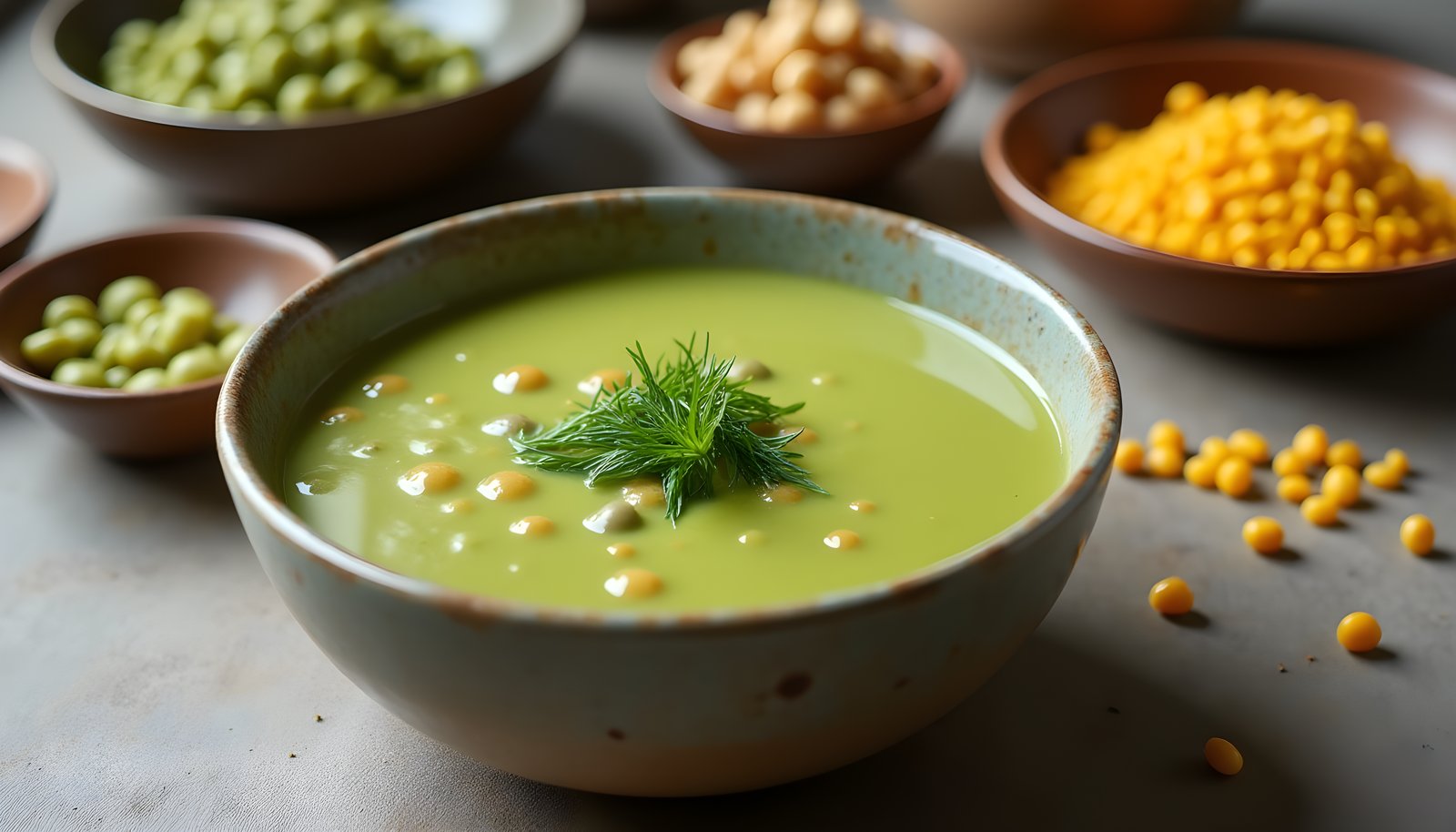
The difference is in flavor and use. Green split peas taste a little sweeter and give classic pea soup its color, while yellow split peas are milder and common in dal and in many European pea soups.
Splitting removes the outer seed coat, which is part of why split peas soften without soaking. Even without that coat, they keep enough fiber to lead the legume aisle.
Legume nutrition: split peas next to their relatives
Among legumes, split peas consistently rank near the top. From the Dietary Guidelines for Americans’ table of fiber sources, per half cup cooked:
| Legume, 1/2 cup cooked | Fiber | Calories |
|---|---|---|
| Navy beans | 9.6 g | 128 |
| Split peas | 8.2 g | 116 |
| Lentils | 7.8 g | 115 |
| Pinto beans | 7.7 g | 123 |
| Black beans | 7.5 g | 114 |
| Chickpeas | 6.3 g | 135 |
| Edamame | 4.1 g | 94 |
Split peas also come in among the lowest in calories in that group. Per 100 calories, they give about 7.1 grams of fiber, second only to navy beans in this table.
Harvard’s Nutrition Source notes that legumes as a group supply protein, folate, iron and phosphorus along with soluble and insoluble fiber, while staying low in saturated fat and, when unprocessed, sodium.
Not sure how a bowl of split peas fits your own fiber goal? Our fiber calculator works out a personal target in seconds.
High fiber peas: split vs green
Green peas are a great vegetable, but split peas pack more fiber into every bite. Per cooked cup, by USDA and Dietary Guidelines values:
- Split peas: 16.3 grams of fiber, 16.3 grams of protein, 231 calories
- Green peas: 8.8 grams of fiber, about 8.6 grams of protein, 134 calories
Green peas still win on vitamin C and sweetness, so they’re not interchangeable. If your goal is fiber and protein, though, split peas are the more concentrated choice.
Yellow pea flour and insulin: a Canadian trial
At the University of Manitoba, researchers recruited overweight adults with high cholesterol for a controlled feeding trial. Twenty-three people finished it, 7 men and 16 women.
In random order, each person spent four weeks eating two muffins a day made with whole yellow pea flour, about 50 grams a day, which matched the USDA guidance of a half cup of pulses daily. They also spent four weeks on muffins made with pea hull fiber and four weeks on plain white wheat flour, with washout breaks between.
What changed
- Fasting insulin was lower with whole pea flour than with wheat flour, at 37.8 versus 50.7 on the study’s scale.
- Muffins with pea hull fiber also lowered fasting insulin compared with wheat flour.
- Estimates of insulin resistance fell on both pea treatments.
- In women, whole pea flour slightly lowered the ratio of belly fat to hip fat compared with wheat flour.
Cholesterol didn’t differ between the treatments. It dropped in all three phases, so the pea flours didn’t stand out on that measure. The authors pointed to pea flours as a practical way to add pulses to familiar foods like baked goods.
The study was small and short, so it suggests rather than proves a benefit. It does show that peas don’t need to be eaten as soup to make a difference.
How much fiber is in pea soup?
A homemade split pea soup is one of the easiest ways to eat a full cup of split peas. Because the peas cook down completely, nearly all of their fiber ends up in the bowl.
If a pot made with cooked split peas yields four bowls and uses the equivalent of four cups of cooked peas, each bowl gets about 16 grams of pea soup fiber before any vegetables are added. Carrots, celery and onion add a little more.
Canned and restaurant versions vary widely. Many are thinner, with fewer peas per cup and more salt, so read the label for both fiber and sodium.
A simple split pea soup checklist
Split peas don’t need soaking, which makes soup night simple:
- Rinse the dry split peas and pick out any debris.
- Sauté onion, carrot and celery in a little olive oil.
- Add the peas with about four times their volume in water or low sodium broth.
- Simmer, stirring now and then, until the peas break down, usually about an hour.
- Season at the end, and blend part of the soup if you like it smooth.
Leftover soup thickens as it cools, so add a splash of water when you reheat it. It freezes well in single portions, too.
Want more cozy soups and stews built around legumes? Our recipe eBooks include plenty of easy, high-fiber options.
Split peas next to grains and starchy sides
Split peas also outperform the grains they often sit beside. The Dietary Guidelines table lists a half cup of cooked bulgur at 4.1 grams of fiber and pearled barley at 3.0, while Mayo Clinic puts a whole cup of brown rice at 3.5.
A half cup of split peas, at 8.2 grams, beats a half cup of bulgur by about two to one and a full cup of brown rice by more than double. Split peas also bring twice the protein of most grains for a similar number of calories.
That doesn’t make grains a poor choice. It just means a scoop of split peas can do the fiber work of a much bigger portion of rice or barley.
A dal night, counted
Picture a weeknight bowl of yellow split pea dal, about a cup, spooned over a half cup of brown rice. The dal brings roughly 16 grams of fiber and the rice adds close to 2 more.
That’s around 18 grams in one dinner, more than 60% of the Daily Value. Add a side of sautéed spinach or a cucumber and tomato salad, and the plate edges past 20 grams with very little extra effort.
Split peas and digestion
Like other legumes, split peas contain oligosaccharides and resistant starch that gut bacteria ferment in the colon. Harvard’s Nutrition Source explains that this produces short chain fatty acids, which support the colon lining, but also causes gas in some people.
Mayo Clinic suggests increasing fiber slowly and drinking plenty of water. A half cup portion of soup is a gentle place to start if legumes are new to you.
If your digestion needs extra support while you add more fiber, our gut health guides walk you through it one step at a time.
Split peas in your weekly routine
Mayo Clinic recommends about 25 grams of fiber a day for women and 38 grams for men. A cup of split peas meets about two thirds of the women’s target and over 40% of the men’s.
The Dietary Guidelines for Americans suggest about 3 cups of legumes a week, Harvard’s Nutrition Source notes. Two big bowls of split pea soup plus a dal night would get you there.
Cooking a big batch on the weekend makes that easy. Freeze the soup or dal in single portions, and a high fiber lunch is only a few minutes of reheating away.
The catch with classic pea soup
The traditional pot is simmered with a ham hock or bacon, and many canned versions lean heavily on salt. Those additions don’t take away fiber, but they can turn a very healthy legume into a high sodium meal.
Harvard’s Nutrition Source recommends checking processed legume products for added sodium. For the full benefit of split peas fiber without the salt load, cook your own with low sodium broth and use smoked paprika for that smoky flavor instead.
Split peas fiber FAQ
How much fiber is in a cup of split peas?
About 16.3 grams in a cup of cooked split peas, according to USDA FoodData Central. That’s more than half of the 28 gram Daily Value.
Do split peas have more fiber than green peas?
Yes, nearly twice as much. A cooked cup of split peas has about 16.3 grams of fiber, compared with 8.8 grams in a cup of green peas.
Is split pea soup high in fiber?
It can be. A homemade bowl made with about a cup of cooked split peas has around 16 grams, but canned soups vary, so check the label.
Do yellow and green split peas have the same fiber?
Essentially yes. USDA lists them as one food, and the difference between them is mostly flavor and color.
Do split peas need to be soaked?
No. Split peas cook without soaking and usually soften in about an hour of simmering.
Are split peas a good source of protein?
Yes. A cooked cup has about 16 grams of protein, matching its fiber gram for gram.
Can split peas help with blood sugar?
They may. In a small Canadian trial, overweight adults who ate yellow pea flour muffins daily for four weeks had lower fasting insulin than when they ate wheat flour muffins.
Sources
- Marinangeli CPF, Jones PJH. “Whole and fractionated yellow pea flours reduce fasting insulin and insulin resistance in hypercholesterolaemic and overweight human subjects.” British Journal of Nutrition. 2011. doi.org
- U.S. Department of Agriculture, Agricultural Research Service. “FoodData Central.” 2026. fdc.nal.usda.gov
- U.S. Department of Agriculture and U.S. Department of Health and Human Services. “Food Sources of Dietary Fiber.” Dietary Guidelines for Americans, 2020 to 2025. 2020. dietaryguidelines.gov
- Harvard T.H. Chan School of Public Health. “Legumes and Pulses.” The Nutrition Source. 2024. nutritionsource.hsph.harvard.edu
- Mayo Clinic Staff. “Chart of high-fiber foods.” Mayo Clinic. 2025. mayoclinic.org
- Mayo Clinic Staff. “Dietary fiber: Essential for a healthy diet.” Mayo Clinic. 2024. mayoclinic.org