
In this article
- Cottage cheese fiber by type
- Why cottage cheese has no fiber
- Myth: cottage cheese with vegetables counts as a fiber food
- Cottage cheese nutrition: what it does well
- How it stacks up against other high protein dairy
- The sodium catch
- Cottage cheese among digestion foods
- Cooking with cottage cheese for more fiber
- Where cottage cheese fits in your fiber day
- A savory cottage cheese lunch, counted
- Sweet pairings that bring fiber
- Flavored cups vs fruit you add yourself
- Make one swap today
- Cottage cheese and fiber: quick answers
- Sources
You finish a workout, grab a tub of cottage cheese and eat half a cup straight from the container. You get about 12 grams of protein for 92 calories, and exactly 0 grams of fiber.
That’s the cottage cheese fiber story in one snack. Every plain style in USDA FoodData Central lists zero, and the only cups that show a gram or so are flavored ones with fruit and pectin mixed in.
Cottage cheese fiber by type
This is how common cottage cheeses compare per serving, using USDA records and two Good Culture labels:
| Cottage cheese | Serving | Fiber | Protein | Calories | Sodium |
|---|---|---|---|---|---|
| Lowfat 2% (USDA) | 1/2 cup (113 g) | 0 g | 11.8 g | 92 | 348 mg |
| Lowfat 1%, no sodium added (USDA) | 1/2 cup (113 g) | 0 g | 14 g | 80 | 15 mg |
| Lowfat 1% with vegetables (USDA) | 1/2 cup (113 g) | 0 g | 12 g | 80 | 460 mg |
| Good Culture Whole Milk Classic 4% | 150 g | 0 g | 19 g | 160 | 460 mg |
| Good Culture Blueberry | 150 g | 1 g | 16 g | 150 | 390 mg |
Fat level doesn’t move the fiber line. Neither does the vegetable version, which surprises a lot of people.
The blueberry cup’s single gram most likely comes from the fruit and pectin in its ingredient list. It also brings 6 grams of added sugar, or 12% of the FDA’s 50 gram Daily Value.
Why cottage cheese has no fiber
Cottage cheese is made from milk curds, and milk carries no fiber. Mayo Clinic describes dietary fiber as the parts of plant foods your body can’t digest, so a food made only from milk has none to offer.
Ingredient lists back this up. Good Culture’s blueberry cup, the one style here with any fiber, is also the one that lists blueberries and pectin alongside its skim milk and whole milk.
That puts cottage cheese in the same zero fiber column as milk, yogurt and hard cheese. It’s a protein food, not a fiber food.
Myth: cottage cheese with vegetables counts as a fiber food
Fact: USDA’s record for lowfat cottage cheese with vegetables still lists 0 grams of fiber per 100 grams. Whatever vegetables go into the tub, they don’t add enough to register on the label.
If you want vegetable fiber with your cottage cheese, add the vegetables yourself. A cup of raw jicama sticks brings 5.9 grams, according to the Dietary Guidelines, which is more than any packaged cottage cheese delivers.
Cottage cheese nutrition: what it does well
Cottage cheese earns its reputation as a high protein dairy food. Half a cup of 2% cottage cheese gives you 11.8 grams of protein, about 24% of the FDA’s 50 gram Daily Value, for just 92 calories.
It also brings a good spread of B vitamins and minerals per half cup:
- Vitamin B12: 0.53 micrograms, about 22% of the Daily Value
- Riboflavin: 0.28 milligrams, about 22% DV
- Selenium: 13.4 micrograms, about 24% DV
- Phosphorus: 170 milligrams, about 14% DV
- Calcium: 125 milligrams, about 10% DV
Calcium is lower than many people expect from a dairy food. Half a cup of 2% cottage cheese has less than half the calcium of a cup of milk.
How it stacks up against other high protein dairy
Per 100 grams, 2% cottage cheese lists 10.4 grams of protein. Plain nonfat Greek yogurt lists about 10.2, so the two are nearly even, and both list 0 grams of fiber.
Cottage cheese pulls ahead when you look at the no sodium added version, which lists 12.4 grams of protein per 100 grams. Good Culture’s whole milk classic is higher still at about 12.7 grams per 100 grams.
For fiber, none of them gives you a head start. Whichever high protein dairy you choose, plan on adding fiber from another food.
The sodium catch
Cottage cheese carries far more salt than milk, which has about 105 milligrams per cup. Half a cup of regular 2% cottage cheese has 348 milligrams of sodium, about 15% of the FDA’s 2,300 milligram Daily Value.
The vegetable version goes higher at 460 milligrams per half cup, and Good Culture’s classic cup lists 460 milligrams per 150 grams. A full cup of regular 2% lands around 700 milligrams.
If sodium matters to you, the no sodium added style is a strong option. It lists just 15 milligrams per half cup with more protein than the regular version.
Cottage cheese among digestion foods
Some cottage cheeses list live and active cultures. Good Culture names Lactobacillus paracasei on both its classic and blueberry cups.
The National Institutes of Health describes probiotics as live microorganisms intended to have health benefits and notes that effects vary by strain. Cottage cheese with cultures can be part of that picture, but the evidence for any single food is limited.
For regularity, fiber is the more reliable tool. Mayo Clinic notes that fiber adds weight and size to stool and softens it, and cottage cheese can’t help with that on its own.
If you want a step by step plan for adding more fiber without upsetting your stomach, our gut health guides lay it out.
Cooking with cottage cheese for more fiber
Cottage cheese is a handy swap in baked pasta and casseroles, and that’s where it can ride along with plenty of fiber. The key is choosing what goes around it.
Stuffed shells or baked ziti made with whole wheat pasta start with about 6 grams of fiber per cooked cup, according to Mayo Clinic. Mix the cottage cheese filling with a cup of cooked spinach and you add another 4.3 grams, using Dietary Guidelines numbers.
Cottage cheese also blends smoothly into pancake and waffle batter. Pair it with oat bran or whole grain flour rather than white flour, and the stack carries real fiber along with the extra protein.
Even a simple baked potato works. A medium baked potato with the skin has about 3.9 grams of fiber, and a scoop of cottage cheese on top gives you a high protein topping in place of sour cream.
Where cottage cheese fits in your fiber day
Mayo Clinic suggests about 25 grams of fiber a day for women and 38 grams for men up to age 50. Cottage cheese contributes none of that, but it can anchor meals that do.
Treat it as the protein half of a plate. If the other half is fruit, vegetables, beans or whole grains, the meal can easily reach 8 to 12 grams of fiber.
Curious what your own daily fiber number should be? Our fiber calculator gives you a personal target in seconds.
A savory cottage cheese lunch, counted
Picture a desk lunch built around a half cup of 2% cottage cheese. On its own, that’s 92 calories, 11.8 grams of protein and no fiber.
Add half a cup of diced avocado and a cup of raw red bell pepper strips, then an ounce of whole wheat crackers on the side. The Dietary Guidelines list those at 5.0, 3.1 and 2.9 grams of fiber.
The plate reaches about 11 grams of fiber and roughly 375 calories, with the cottage cheese supplying the protein and the plants supplying all the fiber. That’s close to 40% of the 28 gram Daily Value in one meal.
Sweet pairings that bring fiber
Cottage cheese works just as well with fruit. These additions come straight from the Dietary Guidelines fiber list:
- 1 medium pear, sliced: 5.5 grams
- 1 medium apple, chopped: 4.8 grams
- 1 cup strawberries: 3.0 grams
- 1 cup cherries, pitted: 2.9 grams
- 1 tablespoon ground flaxseed: 2.8 grams
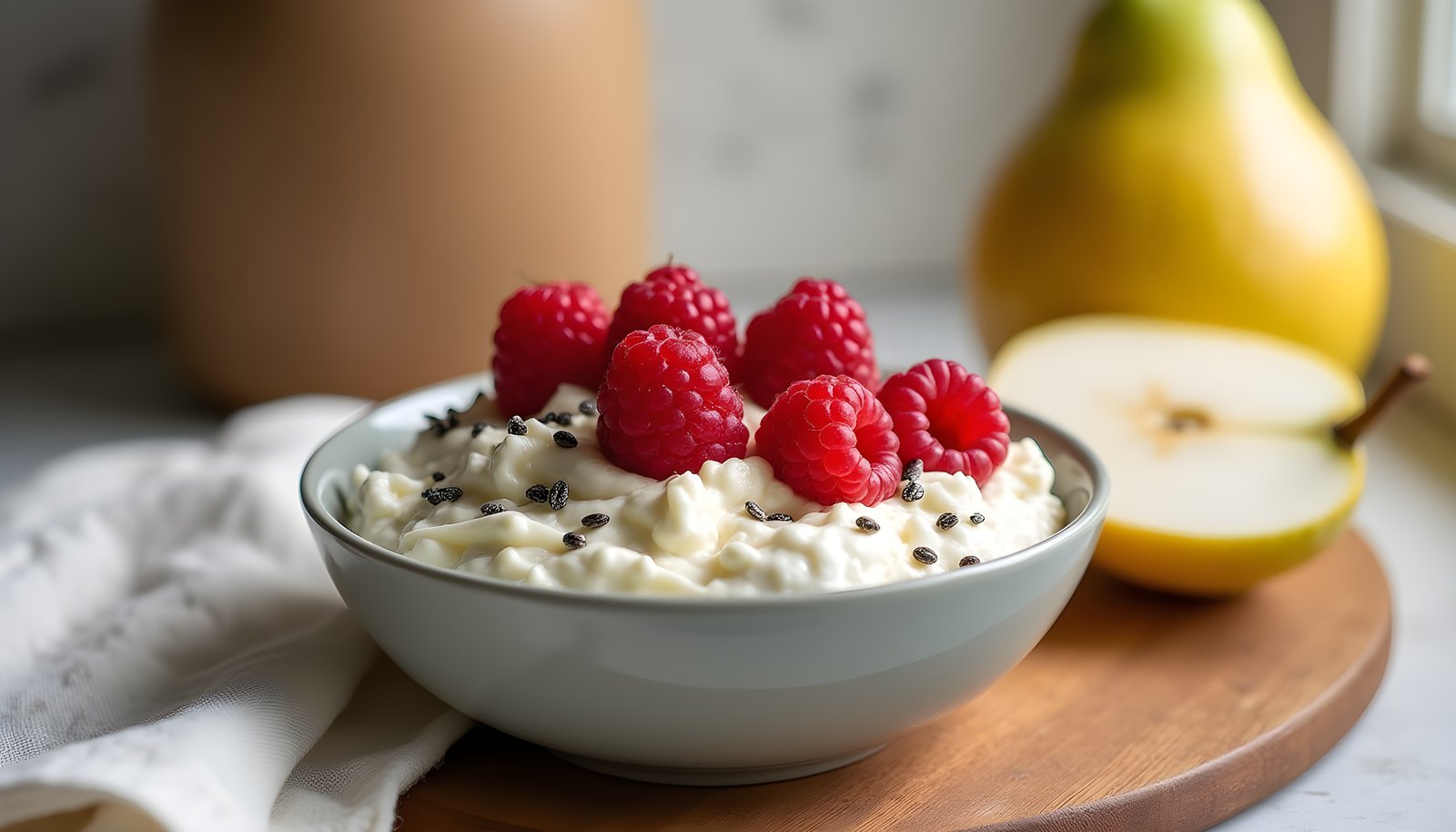
A half cup of cottage cheese with a sliced pear and a tablespoon of flax gives you about 8.3 grams of fiber. That beats the blueberry cup’s single gram by a wide margin, with no added sugar.
Want more snack and breakfast ideas that pair cottage cheese with high fiber foods? Our recipe eBooks are packed with simple combinations.
Flavored cups vs fruit you add yourself
Fruit flavored cottage cheese looks like the easy way to get fruit and protein in one cup. On the label, Good Culture’s blueberry version gives you 1 gram of fiber, 9 grams of total sugar and 6 grams of added sugar per 150 grams.
Now compare a half cup of plain 2% cottage cheese topped with a cup of fresh strawberries. You get 3 grams of fiber from the berries, about 4.5 grams of natural sugar from the cottage cheese, and no added sugar at all.
The homemade bowl has triple the fiber and none of the added sugar. It also lets you choose the fruit, so you can reach for a pear or a cup of cherries when you want something different.
Make one swap today
Next time you scoop cottage cheese, set a fiber food beside it before you sit down. A sliced pear or a handful of jicama sticks turns a 0 gram snack into a 5 to 6 gram one, and you keep every gram of the protein. Do it at one snack a day for a week and you’ve added roughly 35 to 40 grams of fiber you wouldn’t otherwise have eaten.
Cottage cheese and fiber: quick answers
Is there any fiber in cottage cheese?
No. Plain cottage cheese lists 0 grams of fiber at every fat level in USDA data. Only some fruit flavored cups show about 1 gram from added fruit and pectin.
Is cottage cheese good for constipation?
Not on its own. It has no fiber to add bulk, so pair it with high fiber foods like pears, raspberries or whole grain crackers.
Does cottage cheese with fruit have fiber?
A little. Good Culture’s blueberry cottage cheese lists 1 gram per 150 gram cup, along with 6 grams of added sugar.
How much protein is in cottage cheese?
About 11.8 grams per half cup of 2% cottage cheese. No sodium added lowfat versions list about 14 grams per half cup.
Is cottage cheese high in sodium?
Often, yes. Regular 2% cottage cheese has about 348 milligrams per half cup, while no sodium added versions list about 15 milligrams.
What can I eat with cottage cheese to add fiber?
Fruit, vegetables, seeds and whole grains. Half a cup of avocado adds 5 grams, a medium pear adds 5.5 grams, and a tablespoon of flax adds 2.8 grams.
Is cottage cheese or Greek yogurt better for fiber?
Neither. Both plain cottage cheese and plain Greek yogurt list 0 grams of fiber, so the choice comes down to protein, sodium and taste.
Sources
- USDA Agricultural Research Service. FoodData Central, SR Legacy entries for cottage cheese, lowfat 2% (172182), lowfat 1% no sodium added (168114), lowfat 1% with vegetables (167716) and Greek yogurt, plain, nonfat (170894), plus Good Culture Whole Milk Classic (2026) and Blueberry (2020) records. fdc.nal.usda.gov
- U.S. Food and Drug Administration. “Daily Value on the Nutrition and Supplement Facts Labels.” 2024. fda.gov
- National Center for Complementary and Integrative Health, National Institutes of Health. “Probiotics: What You Need To Know.” 2019. nccih.nih.gov
- U.S. Department of Agriculture and U.S. Department of Health and Human Services. “Food Sources of Dietary Fiber.” Dietary Guidelines for Americans, 2020 to 2025. dietaryguidelines.gov
- Mayo Clinic Staff. “Dietary fiber: Essential for a healthy diet.” Mayo Clinic. 2025. mayoclinic.org