
In this article
- What soluble fiber does, in plain terms
- Soluble fiber vegetables ranked
- A soluble fiber foods list by serving
- Okra, eggplant and the other standouts
- How cooking shifts the soluble share
- How much of each vegetable’s fiber is soluble
- Soluble fiber and cholesterol lowering foods
- One dinner, counted for soluble fiber
- Soluble fiber vegetables and gut health
- Easy ways to work these vegetables into your week
- One thing to do this week
- Soluble fiber vegetables: common questions
- Sources
The vegetables richest in soluble fiber aren’t the leafy greens most people picture. In a 2017 study of 29 vegetables, globe artichokes, Jerusalem artichokes, salsify and onions came out far ahead, with soluble fiber making up most of their total fiber.
Among everyday soluble fiber vegetables, Brussels sprouts stand out. The National Heart, Lung, and Blood Institute lists half a cup cooked at 3 grams of soluble fiber, three times what the same amount of broccoli or carrots provides.
What soluble fiber does, in plain terms
Mayo Clinic describes soluble fiber as fiber that dissolves in water to form a gel like material. That gel can help lower blood cholesterol and glucose levels.
Harvard Health explains the cholesterol part more directly: soluble fiber binds cholesterol and its building blocks in the digestive tract, so more of it leaves the body instead of entering the bloodstream.
UCSF Health adds that soluble fiber absorbs water during digestion. It lists fruits, vegetables, legumes, barley and oats as good sources, which is why vegetables are only one part of a soluble fiber plan, though often the easiest part to scale up.
Insoluble fiber is the other kind. It doesn’t dissolve, and it mainly helps material move through your gut. Most vegetables carry both, just in different proportions.
Soluble fiber vegetables ranked
The 2017 study, published in the International Journal of Food Sciences and Nutrition, measured soluble fiber in raw and steamed vegetables on a dry weight basis. To make the numbers easier to picture, the table below converts the steamed results to grams per 100 grams of cooked vegetable, using the study’s own dry matter figures.
| Steamed vegetable | Soluble fiber, g per 100 g dry matter | About g per 100 g as eaten |
|---|---|---|
| Salsify | 72.6 | 16.8 |
| Globe artichoke | 64.6 | 14.8 |
| Jerusalem artichoke | 72.0 | 12.3 |
| Onion | 40.6 | 5.3 |
| Parsnip | 15.7 | 3.3 |
| Brussels sprouts | 14.1 | 2.2 |
| Swede (rutabaga) | 17.7 | 1.9 |
| Leek | 15.7 | 1.6 |
| Broccoli | 12.0 | 1.5 |
| Turnip | 12.7 | 1.2 |
| Carrot | 8.6 | 1.0 |
| Asparagus | 9.3 | 0.6 |
The top four are in a league of their own. In this study, most of their soluble fiber came from fructans, chains of fructose that include inulin, which the researchers measured at similar levels.
Below them, parsnips, Brussels sprouts, swede and leeks form a strong second tier. Broccoli, turnips and carrots offer a steady gram or so per 100 grams, which still adds up when they appear at several meals.
These figures include fructans and come from a research lab rather than a food label, so treat them as a way to compare vegetables with each other rather than as label values.
A soluble fiber foods list by serving
The National Heart, Lung, and Blood Institute’s guide to lowering cholesterol gives soluble fiber by typical serving. Here are the vegetables it lists, alongside a few non-vegetable foods for scale.
| Food | Serving | Soluble fiber | Total fiber |
|---|---|---|---|
| Brussels sprouts, cooked | 1/2 cup | 3 g | 4.5 g |
| Broccoli, cooked | 1/2 cup | 1 g | 1.5 g |
| Carrots, cooked | 1/2 cup | 1 g | 2.5 g |
| Barley, cooked | 1/2 cup | 1 g | 4 g |
| Oatmeal, cooked | 1/2 cup | 1 g | 2 g |
| Pear | 1 medium | 2 g | 4 g |
| Psyllium seeds, ground | 1 tablespoon | 5 g | 6 g |
Brussels sprouts beat every other vegetable and grain on the list. Half a cup of them even beats a serving of oatmeal and a serving of barley put together.
Pears and citrus fruit reach 2 grams each per medium fruit, so Brussels sprouts sit right alongside the best fruits as well.
Okra, eggplant and the other standouts
Harvard Health singles out eggplant and okra as two low calorie vegetables that are good sources of soluble fiber.
Onions and leeks earn a place too. They’re easy to add to almost any savory dish, and the 2017 study found onions especially high in soluble fiber for an everyday vegetable.
Artichokes take more work but repay it. Steamed whole, they posted one of the highest soluble fiber levels of any vegetable in the study.
How cooking shifts the soluble share
Cooking doesn’t just soften vegetables. In the 2017 study, steaming moved part of the fiber from the insoluble column into the soluble one in many vegetables.
| Vegetable | Raw soluble, g/100 g DM | Steamed soluble, g/100 g DM |
|---|---|---|
| Brussels sprouts | 4.7 | 14.1 |
| Turnip | 2.5 | 12.7 |
| Swede | 5.0 | 17.7 |
| Parsnip | 6.4 | 15.7 |
| Radish | 2.4 | 9.3 |
Brussels sprouts tripled their soluble share, and turnips rose about fivefold. Total fiber stayed close to the same; what changed was the type.
A few vegetables went the other way. Butternut and other Cucurbita maxima squash lost soluble fiber after steaming, so don’t count on steaming to raise their soluble share.
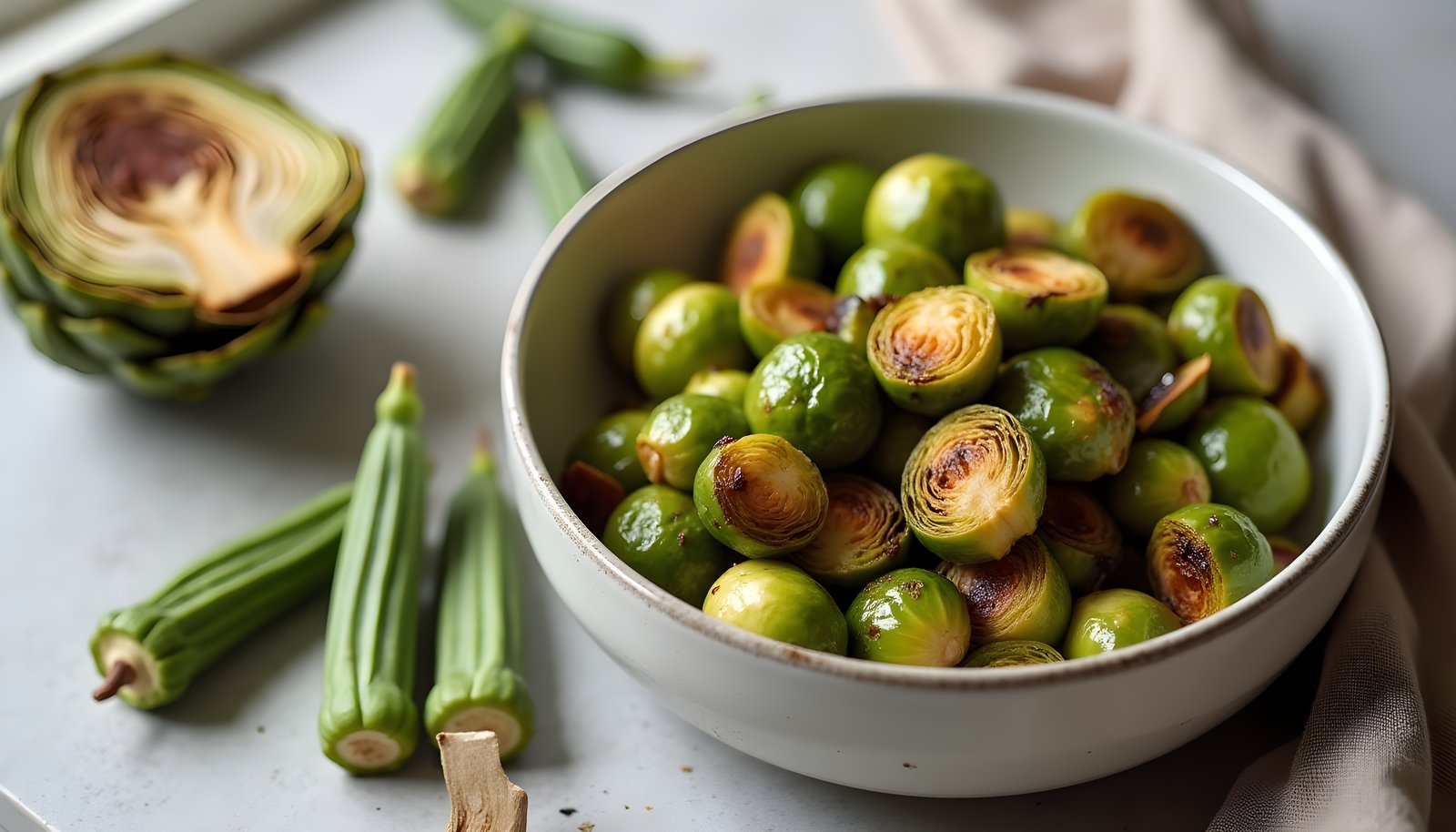
Looking for easy ways to cook Brussels sprouts, okra and artichokes? Our recipe eBooks are full of simple, high fiber dishes.
How much of each vegetable’s fiber is soluble
Total fiber and soluble fiber don’t always travel together. Looking at the raw results in the 2017 study shows how differently vegetables split their fiber.
- Mostly soluble: salsify (about 90% of its fiber), Jerusalem artichoke (about 88%), globe artichoke (about 83%) and onion (about 76%).
- A meaningful share: butternut squash (about 42%), asparagus and Swiss chard (about 29%), and leek (about 23%).
- Mostly insoluble when raw: broccoli and Brussels sprouts (about 13%), cauliflower and turnip (about 9%) and radish (about 7%).
That’s why a vegetable can be high in total fiber but only modest in soluble fiber. Broccoli and Brussels sprouts carry plenty of fiber, yet most of it is the insoluble kind until they’re cooked.
Soluble fiber and cholesterol lowering foods
Mayo Clinic says that 5 to 10 grams or more of soluble fiber a day can decrease LDL cholesterol, often called the bad cholesterol. The NHLBI guide puts the effect at about a 5% drop in LDL when people increase soluble fiber by 5 to 10 grams a day.
UCSF Health notes that many experts suggest about a quarter of your total fiber come from soluble fiber, roughly 6 to 8 grams a day. It also points out that there’s no official intake target for soluble fiber on its own.
Vegetables make that target easier to hit. Pair them with oats, barley, beans, apples and pears, which Mayo and Harvard also name as soluble fiber sources, and the grams add up across the day.
One dinner, counted for soluble fiber
Say you roast a cup of Brussels sprouts, add half a cup of cooked carrots and serve it all with half a cup of barley, then finish with a pear.
| Food | Soluble fiber | Total fiber |
|---|---|---|
| Brussels sprouts, 1 cup cooked | 6 g | 9 g |
| Carrots, 1/2 cup cooked | 1 g | 2.5 g |
| Barley, 1/2 cup cooked | 1 g | 4 g |
| Pear, 1 medium | 2 g | 4 g |
| Total | 10 g | 19.5 g |
That one meal reaches about 10 grams of soluble fiber, the top of the 5 to 10 gram range linked with lower LDL. It also brings nearly 20 grams of total fiber, well over half of most people’s daily goal.
Curious how much total fiber your day should hold? Our fiber calculator gives you a personal target in seconds.
Soluble fiber vegetables and gut health
The fructan rich vegetables at the top of the list are concentrated sources, so a large serving adds a lot of fiber at once. Mayo Clinic notes that adding fiber too quickly can bring gas, bloating and cramping.
Mayo Clinic recommends adding fiber gradually over a few weeks and drinking plenty of water, which gives the bacteria in your gut time to adjust. Starting with half portions of these vegetables is a gentle way to begin.
If your gut needs a slower start, our guides walk you through building up soluble and insoluble fiber step by step.
Easy ways to work these vegetables into your week
- Roast halved Brussels sprouts on a sheet pan with carrots and parsnips.
- Add sliced okra or cubed eggplant to tomato based stews and curries.
- Start soups and sauces with a generous base of onions and leeks.
- Toss steamed artichoke hearts into pasta, grain bowls or salads.
- Mash parsnips or swede in place of part of your usual potatoes.
- Slice Jerusalem artichokes thin and roast them like potatoes, starting with a small portion.
None of these swaps asks you to change how you eat in a big way. They just move a few high soluble fiber vegetables onto plates you’re already making.
One thing to do this week
Add half a cup of cooked Brussels sprouts or okra to dinner three nights this week. Based on the NHLBI figures, the sprouts alone add about 3 grams of soluble fiber each time.
Choose whichever you like best, since enjoying the vegetable is what keeps the habit going. Roasted sprouts and stewed okra both reheat well, so one batch can cover two of those nights.
Keep the rest of your plate the same at first. Once that feels easy, swap in barley or beans as your grain, and you’ll be well inside the 5 to 10 gram range without changing much else.
Soluble fiber vegetables: common questions
Which vegetable has the most soluble fiber?
In a 2017 study of 29 vegetables, salsify, globe artichokes and Jerusalem artichokes had the most soluble fiber, mostly as fructans. Among common vegetables, Brussels sprouts lead, with about 3 grams per half cup cooked.
Is broccoli high in soluble fiber?
Moderately. Half a cup of cooked broccoli has about 1 gram of soluble fiber and 1.5 grams of total fiber, according to the NHLBI.
How much soluble fiber do you need a day?
There’s no official target, but Mayo Clinic says 5 to 10 grams or more a day can lower LDL cholesterol. Many experts suggest about a quarter of your total fiber, roughly 6 to 8 grams, come from soluble fiber.
Does cooking vegetables increase soluble fiber?
Often, yes. In a 2017 study, steaming moved part of the fiber into the soluble form in many vegetables, including Brussels sprouts, turnips and parsnips, while total fiber stayed similar.
Are carrots a good source of soluble fiber?
They’re a steady source. Half a cup of cooked carrots has about 1 gram of soluble fiber out of 2.5 grams total.
Do okra and eggplant have soluble fiber?
Yes. Harvard Health names eggplant and okra as low calorie vegetables that are good sources of soluble fiber.
Can soluble fiber vegetables lower cholesterol?
They can help. Soluble fiber binds cholesterol in the gut, and raising soluble fiber by 5 to 10 grams a day has been linked with about a 5% drop in LDL.
Sources
- Kalala G, Kambashi B, Everaert N, et al. “Characterization of fructans and dietary fibre profiles in raw and steamed vegetables.” International Journal of Food Sciences and Nutrition, 2017. sites.uclouvain.be
- National Heart, Lung, and Blood Institute. “Your Guide to Lowering Your Cholesterol with TLC.” NIH, 2005. nhlbi.nih.gov
- Harvard Health Publishing. “11 foods that lower cholesterol.” 2024. health.harvard.edu
- Mayo Clinic Staff. “Cholesterol: Top foods to improve your numbers.” Mayo Clinic, 2026. mayoclinic.org
- Mayo Clinic Staff. “Dietary fiber: Essential for a healthy diet.” Mayo Clinic, 2024. mayoclinic.org
- UCSF Health. “Increasing Fiber Intake.” Patient Education, 2026. ucsfhealth.org