
In this article
- Why you want both kinds of fiber
- What counts as a balanced fiber food
- Balanced fiber foods, ranked by total fiber
- High fiber foods that lean one way
- Beans and vegetables that balance a plate
- Fruit and grains that pull their weight
- A day of balanced fiber, start to finish
- Balanced foods vs fiber supplements
- Your balanced fiber checklist
- One change to make today
- Balanced fiber foods: common questions
- Sources
The best balanced fiber foods are black beans, Brussels sprouts, sweet potatoes, broccoli, apricots, oranges and mango, because each serving delivers a solid amount of both soluble and insoluble fiber. The twist is that several foods famous for fiber don’t make the cut, since most of what they offer is one type.
Kidney beans, raspberries, okra and whole wheat bread are all useful fiber sources, but about three quarters or more of their fiber is insoluble. Below are lab based numbers for both types, plus a simple way to use them.
Why you want both kinds of fiber
Mayo Clinic explains that soluble fiber dissolves in water and forms a gel in your stomach that slows digestion, which can help lower cholesterol and blood sugar. Insoluble fiber doesn’t dissolve; it helps move material through your digestive system and adds bulk to stool.
Those are two different jobs, which is why a diet built on only one type misses out. Mayo notes that the amount of each type varies from plant to plant, and that you get both by eating a variety of fiber rich foods.
What counts as a balanced fiber food
There’s no official ratio to hit. Mayo’s targets, from the National Academy of Medicine, are for total fiber: 25 grams a day for women 50 and under, 21 grams for women over 50, 38 grams for men 50 and under and 30 grams for men over 50.
The NHLBI’s cholesterol guide adds that 5 to 10 grams of soluble fiber a day is a helpful minimum, and 10 to 25 grams is even better. If you hit 25 grams of total fiber with 5 to 10 grams soluble, soluble fiber makes up roughly 20 to 40% of what you eat.
For this article, a food counts as balanced if one serving has at least about 2.4 grams of total fiber, and soluble fiber is between roughly a third and two thirds of it. That keeps out foods that are tiny sources, and foods that are almost all one type.
Balanced fiber foods, ranked by total fiber
All figures below come from the fiber tables in the Endotext chapter on diet and cholesterol, hosted on NIH’s NCBI Bookshelf. They’re adapted from James Anderson’s lab analyses in Plant Fiber in Foods.
| Food and serving | Total fiber | Soluble | Insoluble | Soluble share |
|---|---|---|---|---|
| Black beans, cooked, 1/2 cup | 6.1 g | 2.4 g | 3.7 g | 39% |
| Turnip, cooked, 1/2 cup | 4.8 g | 1.7 g | 3.1 g | 35% |
| Sweet potato, cooked, 1/2 cup | 4.0 g | 1.8 g | 2.2 g | 45% |
| Brussels sprouts, cooked, 1/2 cup | 3.8 g | 2.0 g | 1.8 g | 53% |
| Apricots, fresh with skin, 4 | 3.5 g | 1.8 g | 1.7 g | 51% |
| Dried figs, 1 1/2 | 3.0 g | 1.4 g | 1.6 g | 47% |
| Mango, 1/2 small | 2.9 g | 1.7 g | 1.2 g | 59% |
| Orange, 1 small | 2.9 g | 1.8 g | 1.1 g | 62% |
| Pear with skin, 1/2 large | 2.9 g | 1.1 g | 1.8 g | 38% |
| Asparagus, cooked, 1/2 cup | 2.8 g | 1.7 g | 1.1 g | 61% |
| Apple with skin, 1 small | 2.8 g | 1.0 g | 1.8 g | 36% |
| Strawberries, 1 1/4 cups | 2.8 g | 1.1 g | 1.7 g | 39% |
| Pumpernickel bread, 1 slice | 2.7 g | 1.2 g | 1.5 g | 44% |
| Broccoli, cooked, 1/2 cup | 2.4 g | 1.2 g | 1.2 g | 50% |
| Plums, 2 medium | 2.4 g | 1.1 g | 1.3 g | 46% |
Black beans stand out, with the most fiber of any food on the list and a healthy share of both types. Brussels sprouts and broccoli are the most evenly split, at close to 50:50.
Fruit dominates the middle of the table. Apricots, mango and oranges all carry more than 1.5 grams of soluble fiber per serving, which is a lot for a snack.
High fiber foods that lean one way
These foods are still worth eating, but on their own they won’t balance your fiber. Same source, same servings:
| Food and serving | Total fiber | Soluble share | Leans toward |
|---|---|---|---|
| Kidney beans, cooked, 1/2 cup | 7.9 g | 25% | Insoluble |
| Lentils, cooked, 1/2 cup | 5.2 g | 12% | Insoluble |
| Okra, cooked, 1/2 cup | 4.1 g | 24% | Insoluble |
| Raspberries, 1 cup | 3.3 g | 27% | Insoluble |
| Kale, cooked, 1/2 cup | 2.5 g | 28% | Insoluble |
| Wheat flakes, 3/4 cup | 2.3 g | 17% | Insoluble |
| Corn, canned, 1/2 cup | 1.6 g | 12% | Insoluble |
| Whole wheat bread, 1 slice | 1.5 g | 20% | Insoluble |
| Grapefruit, 1/2 medium | 1.6 g | 69% | Soluble |
Notice how few foods lean toward soluble fiber. In these tables, most foods carry more insoluble than soluble fiber, so balance usually means adding soluble rich foods rather than cutting back on anything.
Lopsided doesn’t mean low. Kidney beans still deliver 2.0 grams of soluble fiber per half cup, more than most foods on the balanced list, simply because their total is so large.
One more caution about fiber charts: the grain table in the same chapter lists wheat bran and dry oatmeal with soluble and insoluble values that don’t add up to their totals. We left those two rows out rather than guess.
Beans and vegetables that balance a plate
Black beans are the easiest single fix. A half cup adds 2.4 grams of soluble fiber and 3.7 grams of insoluble, more of both than most vegetables.
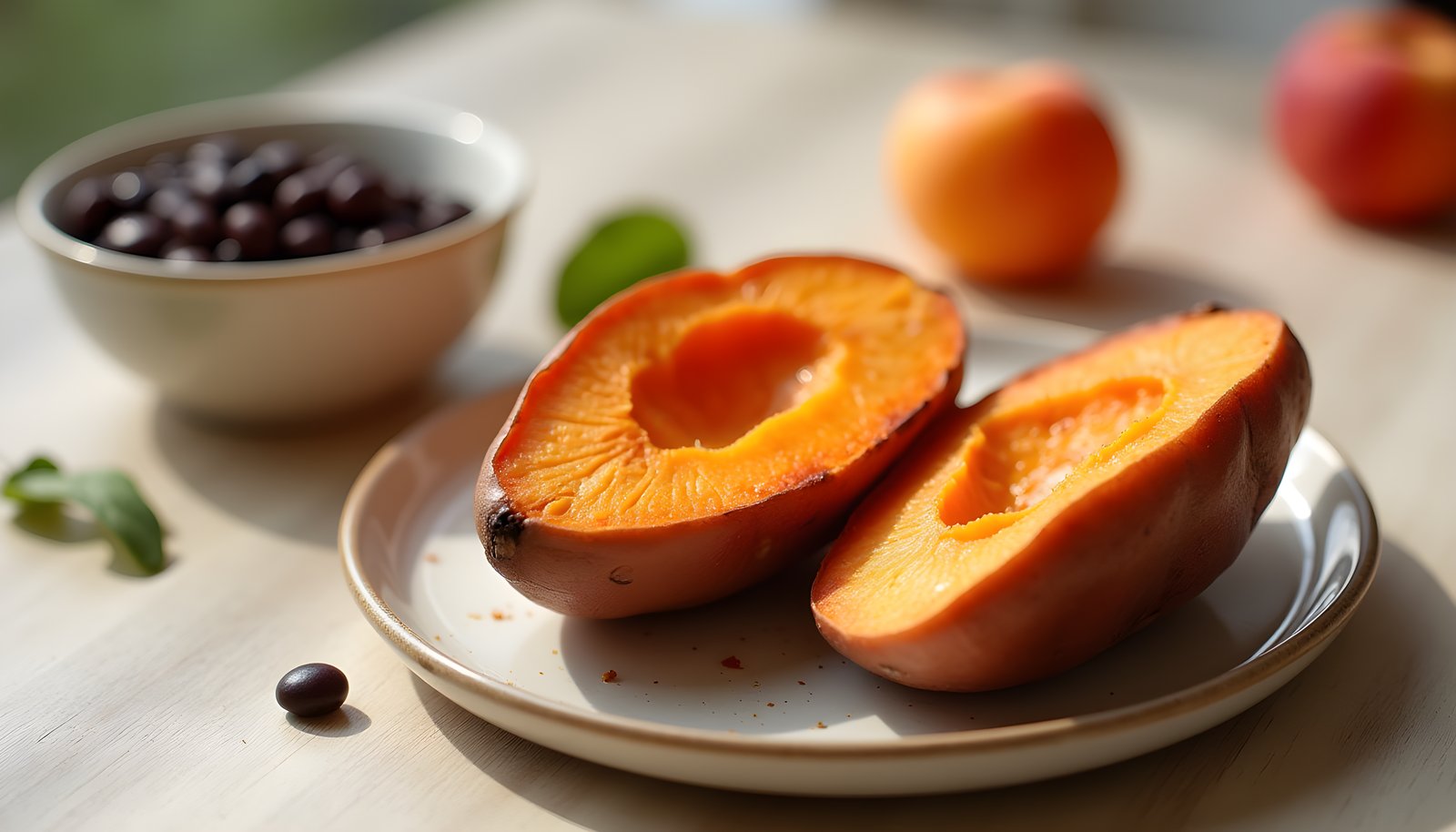
Sweet potatoes and Brussels sprouts are the vegetable leaders, each near 4 grams of total fiber per half cup with close to half of it soluble. Broccoli and asparagus are smaller sources but just as well balanced.
Navy beans just miss the cutoff at 34% soluble, but with 6.5 grams of total fiber and 2.2 grams soluble per half cup, they’re nearly as useful as black beans.
Turnips sit right on the edge at about 35% soluble, with a generous 4.8 grams of total fiber per half cup. They’re a good swap for white potatoes in a mash or roast.
Want more ideas for cooking black beans, sweet potatoes and Brussels sprouts? Our recipe eBooks are full of easy, high fiber meals.
Fruit and grains that pull their weight
Fresh apricots, mango and oranges give you nearly as much soluble fiber per serving as a half cup of Brussels sprouts, at 1.7 to 1.8 grams versus 2.0. Pears, apples and strawberries lean a little more toward insoluble, but still land comfortably in the balanced range.
Among breads, pumpernickel and rye are the balanced choices, at about 44% soluble per slice. Whole wheat bread, by contrast, is about 80% insoluble.
Mayo Clinic notes that refining grain removes the bran, which lowers its fiber. White bread and white rice end up with very little of either type, so they can’t balance anything.
A day of balanced fiber, start to finish
Here’s what a day built from the balanced list looks like, using the same NIH hosted figures:
| Meal | Foods | Total fiber | Soluble fiber |
|---|---|---|---|
| Breakfast | 1 small orange, 2 slices pumpernickel toast | 8.3 g | 4.2 g |
| Lunch | 1/2 cup black beans, 1/2 cup sweet potato | 10.1 g | 4.2 g |
| Snack | 4 fresh apricots | 3.5 g | 1.8 g |
| Dinner | 1/2 cup Brussels sprouts, 1/2 cup broccoli, 1/2 cup pearled barley | 9.2 g | 4.0 g |
| Day total | 31.1 g | 14.2 g |
That clears Mayo’s targets for women and for men over 50. Men 50 and under, with a 38 gram target, would want about 7 grams more, which a second half cup of black beans nearly covers. The soluble total of about 14 grams lands in the NHLBI’s “even better” range of 10 to 25 grams.
Not sure what your own daily target should be? Our fiber calculator gives you a personal number in seconds.
Balanced foods vs fiber supplements
A supplement can add one type of fiber quickly, but Mayo Clinic says whole foods are generally better. Supplements don’t provide the variety of fiber, vitamins, minerals and other nutrients that whole foods do.
That matters here because balance comes from variety. A spoonful of a single fiber powder can’t give you the mix that a plate of beans, vegetables and fruit does.
Your balanced fiber checklist
- Eat beans, ideally black beans, at least once a day.
- Include one balanced vegetable at lunch and dinner, such as Brussels sprouts, sweet potato or broccoli.
- Choose apricots, oranges, mango or pears for fruit snacks.
- Swap some whole wheat bread for pumpernickel or rye.
- Keep enjoying kidney beans, lentils and raspberries, but pair them with a soluble rich food.
- Add fiber gradually and drink plenty of water.
Mayo Clinic recommends adding fiber slowly over a few weeks and drinking plenty of water, since fiber works best when it absorbs water.
If your digestion needs a gentler start, our gut health guides walk you through building up step by step.
One change to make today
Look at your next meal and add a soluble rich food to it. If it’s toast, make it pumpernickel and add an orange; if it’s a grain bowl, stir in half a cup of black beans.
That one swap adds roughly 2 grams of soluble fiber without taking anything away. Repeat it at a second meal tomorrow and you’ve added a meaningful chunk of the 5 to 10 gram soluble minimum.
Balanced fiber foods: common questions
What is a good ratio of soluble to insoluble fiber?
There’s no official ratio. Mayo Clinic’s targets are for total fiber, and the NHLBI suggests at least 5 to 10 grams of soluble fiber a day, which works out to roughly 20 to 40% of a 25 gram day.
Which foods have equal soluble and insoluble fiber?
Broccoli and peaches are split about 50:50, and Brussels sprouts and fresh apricots come close. Each gives 2 to 3.8 grams of total fiber per serving.
Are beans soluble or insoluble fiber?
Both, but mostly insoluble. Black beans are the most balanced, at about 39% soluble, while kidney beans and lentils are 25% and 12% soluble.
Is whole wheat bread a balanced fiber food?
Not really. A slice has about 1.5 grams of fiber, and only about 20% of it is soluble. Pumpernickel and rye are more balanced, at about 44% soluble.
Which fruits have the most soluble fiber per serving?
Oranges and fresh apricots, at about 1.8 grams per serving, followed by mango at 1.7 grams. Grapefruit is mostly soluble but smaller, at 1.1 grams per half.
Can I balance fiber with a supplement?
Partly, but Mayo Clinic says whole foods are generally better. Supplements don’t provide the variety of fiber, vitamins and minerals that whole foods do.
How much fiber should I eat per day?
Mayo Clinic lists 25 grams for women 50 and under and 38 grams for men 50 and under. Women over 50 need 21 grams and men over 50 need 30 grams.
Sources
- Enkhmaa B, Surampudi P, Anuurad E, et al. “Lifestyle Changes: Effect of Diet, Exercise, Functional Food, and Obesity Treatment on Lipids and Lipoproteins,” Tables 8, 9, 10 and 12. Endotext, NCBI Bookshelf, 2018. ncbi.nlm.nih.gov
- Mayo Clinic Staff. “Dietary fiber: Essential for a healthy diet.” Mayo Clinic, 2025. mayoclinic.org
- National Heart, Lung, and Blood Institute. “Your Guide to Lowering Your Cholesterol with TLC.” NIH, 2005. nhlbi.nih.gov