
In this article
- Poppy seeds fiber by the spoonful
- Poppy seed nutrition: calcium and manganese in a tiny package
- Poppy seeds compared with other seeds
- Fiber per calorie: where poppy seeds land
- Baking seeds fiber: why the muffin falls short
- Getting real fiber from poppy seeds
- Poppy seeds and digestive support
- One swap to try today
- What people also ask about poppy seeds and fiber
- Sources
You grab a lemon poppy seed muffin with your coffee, and the dark specks make it feel a little more wholesome than a plain one. On fiber, though, the seeds are doing far less than they look. One bakery muffin in USDA’s database lists just 1 gram of fiber in 550 calories.
That isn’t the seeds’ fault. Poppy seeds fiber is genuinely high, at 19.5 grams per 100 grams, and a tablespoon brings about 1.7 grams. The problem is that most recipes use a few teaspoons spread across a whole batch.
Poppy seeds fiber by the spoonful
Poppy seeds are so light that a tablespoon weighs under 9 grams. The table uses USDA FoodData Central figures for plain poppy seeds.
| Amount | Weight | Fiber | % DV (28 g) | Calories |
|---|---|---|---|---|
| 1 teaspoon | 2.8 g | 0.5 g | 2% | 15 |
| 1 tablespoon | 8.8 g | 1.7 g | 6% | 46 |
| 2 tablespoons | 17.6 g | 3.4 g | 12% | 92 |
| 1 ounce | 28 g | 5.5 g | 20% | 149 |
| 100 grams | 100 g | 19.5 g | 70% | 525 |
Few people eat an ounce of poppy seeds in one go, but 2 tablespoons in a dressing, a filling or a batch of baked goods is realistic. That amount brings 3.4 grams of fiber for under 100 calories.
Most of the rest of a poppy seed is fat, about 42% by weight, along with 18% protein. Carbohydrate is 28%, and fiber makes up roughly two thirds of that, with only about 3 grams of sugar per 100 grams.
Poppy seed nutrition: calcium and manganese in a tiny package
Per gram, poppy seeds are one of the most calcium dense plant foods you can buy. USDA lists 1,438 mg of calcium per 100 grams, more than whole sesame seeds at 975 mg.
One tablespoon (8.8 g) provides roughly:
| Nutrient | Amount | % Daily Value |
|---|---|---|
| Manganese | 0.59 mg | 26% |
| Copper | 0.14 mg | 16% |
| Calcium | 127 mg | 10% |
| Magnesium | 31 mg | 7% |
| Phosphorus | 77 mg | 6% |
| Zinc | 0.7 mg | 6% |
| Thiamin | 0.08 mg | 6% |
| Iron | 0.9 mg | 5% |
Manganese, a trace mineral your body needs only in small amounts, is the standout. A single tablespoon covers about a quarter of the Daily Value.
Protein comes in at about 1.6 grams per tablespoon, and the seeds contain almost no sodium on their own. That makes plain poppy seeds an easy way to add a little crunch and nutrition without added salt.
Want to see how a spoonful of seeds fits your personal fiber number? Our fiber calculator can show you in seconds.
Poppy seeds compared with other seeds
By weight, poppy seeds rank near the top. By the tablespoon, their light weight pulls them back toward the middle of the pack.
| Seed | Fiber per 100 g | Fiber per tablespoon |
|---|---|---|
| Chia seeds | 34.4 g | 4.1 g |
| Flaxseed, whole | 27.3 g | 2.8 g |
| Poppy seeds | 19.5 g | 1.7 g |
| Sesame seeds, whole | 11.8 g | 1.1 g |
| Sunflower kernels, dry roasted | 11.1 g | 0.9 g |
A tablespoon of poppy seeds beats the same spoon of sesame or sunflower, and it delivers about 60% of what flax does. Chia still carries more than twice as much per spoon.
Measured by the ounce instead of the spoon, the order shifts back toward poppy. An ounce of poppy seeds has about 5.5 grams of fiber, more than an ounce of whole sesame at 3.3 grams or roasted sunflower kernels at 3.1 grams.
For calcium, poppy leads this group. A tablespoon of poppy seeds has about 127 mg, compared with about 88 mg in a tablespoon of whole sesame.
Fiber per calorie: where poppy seeds land
Seeds are calorie dense, so it helps to ask how much fiber you get for the energy. Dividing USDA’s fiber figure by calories gives a quick fiber per 100 calories score:
- Chia: about 7.1 grams per 100 calories
- Flax: about 5.1 grams
- Poppy: about 3.7 grams
- Sesame, whole: about 2.1 grams
- Sunflower kernels, dry roasted: about 1.9 grams
Poppy seeds give you nearly twice the fiber per calorie of sesame or sunflower. That’s useful if you’re keeping an eye on calories but still want a seed that pulls its weight.
For context, a medium pear scores higher still, at about 5 grams per 100 calories, which is why pairing seeds with fruit or vegetables works so well.
Baking seeds fiber: why the muffin falls short
Poppy seeds are mostly baking seeds, and baking is where their fiber gets diluted. Compare the plain seeds with the foods people actually buy:
| Food | Serving | Fiber | Added sugar |
|---|---|---|---|
| Plain poppy seeds | 1 tablespoon | 1.7 g | 0 g |
| Bakery poppy seed muffin | 1 muffin (128 g) | 1 g | 33 g |
| Lemon poppy seed protein muffin (Flapjacked) | 1 muffin (55 g) | 5 g | 7 g |
| Poppy seed pastry filling | 2 tablespoons (36 g) | 0 g | 16 g |
| Poppy seed salad dressing | 2 tablespoons (29 g) | about 0.1 g | not listed (6.9 g total sugar) |
The bakery muffin lists sugar as its first ingredient and 33 grams of added sugar, about two thirds of the 50 gram Daily Value. Poppy seeds come sixth on its ingredient list.
Canned poppy seed filling lists corn syrup as its first ingredient and sugar third, and its label shows 0 grams of fiber per serving. Bottled poppy seed dressing tells a similar story, with almost no fiber and about 274 mg of sodium in 2 tablespoons.
Homemade baking doesn’t automatically fix this. A lemon poppy seed loaf that uses 2 tablespoons of seeds and is cut into 10 slices gives each slice only about 0.3 grams of fiber from the poppy seeds.
The flour matters far more. Swapping a cup of white flour for whole wheat flour in the same loaf adds roughly 9 grams of fiber across the batch, or close to a gram more per slice, nearly three times what the seeds contribute.
The packaged protein muffin shows the difference a base makes. Built on whey, pea protein and oats, it lists 5 grams of fiber and 230 calories, five times the fiber of the bakery muffin in well under half the calories.
Myth: Anything with poppy seeds in it is a good fiber choice.
Fact: The seeds themselves are fiber rich, but the amount in most muffins, cakes and dressings is too small to matter. The base ingredients decide the fiber, not the specks on top.
Getting real fiber from poppy seeds
To make poppy seeds count, use them by the tablespoon and pair them with a fiber rich base:
- Bake with whole wheat flour, which USDA lists at about 10.7 grams of fiber per 100 grams, then fold in 2 tablespoons of poppy seeds per batch.
- Whisk a tablespoon of seeds into a simple vinaigrette of olive oil, vinegar and a little honey instead of buying bottled dressing.
- Stir a teaspoon or two into overnight oats along with a tablespoon of chia seeds.
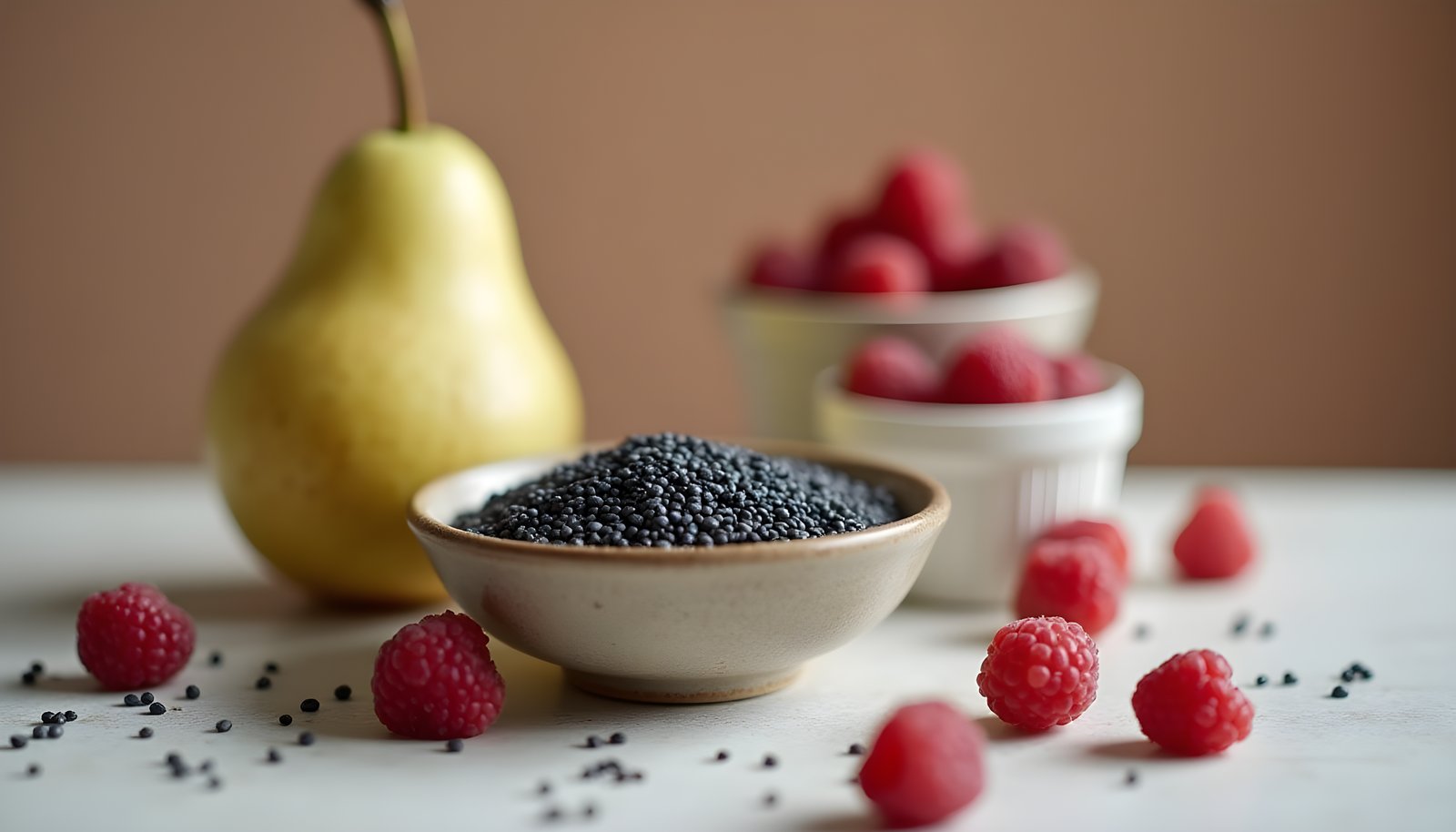
- Sprinkle poppy seeds over a fruit salad of pear, apple and raspberries.
- Add them to homemade crackers or bread dough with sesame and flax for a mixed seed crust.
The fruit salad is a good example of letting the base do the work. A medium pear has 5.5 grams of fiber and a cup of raspberries has 8 grams, so a tablespoon of poppy seeds on top brings the bowl to about 15 grams.
Overnight oats show how quickly the small amounts stack up. Half a cup of dry rolled oats has about 4 grams of fiber, a tablespoon of chia adds 4.1 and two teaspoons of poppy seeds add about 1 gram, for roughly 9 grams before you add any fruit.
Top that jar with half a cup of raspberries and you’re past 13 grams, close to half of the Daily Value, at breakfast.
Looking for baking ideas that put more whole grains and seeds on the table? Our recipe eBooks are full of easy high fiber options.
Poppy seeds and digestive support
Any fiber you add helps your gut in the same basic ways. Mayo Clinic notes that fiber adds bulk and softness to stool, helps keep bowel movements regular and supports a healthy weight.
Poppy seeds on their own are too small a portion to change much, so think of them as one piece of a fiber rich day alongside beans, whole grains, fruit and vegetables. If you’re adding more fiber overall, Mayo Clinic recommends building up gradually over a few weeks and drinking plenty of water.
One swap to try today
Next time you want something with poppy seeds, make the dressing yourself. Whisk 2 tablespoons of olive oil, 1 tablespoon of vinegar, a teaspoon of honey and a tablespoon of poppy seeds, then pour it over greens with sliced pear.
You’ll get about 1.7 grams of fiber from the seeds alone, plus 5.5 grams from the pear, instead of the near zero fiber and 274 mg of sodium in a bottled version.
If you bake often, keep the poppy seeds on the same shelf as your whole wheat flour, so the next batch of muffins gets both the seeds and a fiber rich base.
What people also ask about poppy seeds and fiber
How much fiber is in a tablespoon of poppy seeds?
About 1.7 grams. A tablespoon of plain poppy seeds weighs about 8.8 grams and has 46 calories.
Are poppy seeds high in fiber?
Yes, by weight. They have 19.5 grams of fiber per 100 grams, more than sesame or sunflower seeds, though less than chia or flax.
Do lemon poppy seed muffins have fiber?
Usually very little. One bakery muffin in USDA’s database lists 1 gram of fiber, 550 calories and 33 grams of added sugar.
Are poppy seeds a good source of calcium?
Yes. They have 1,438 mg of calcium per 100 grams, so a tablespoon gives you about 127 mg, roughly 10% of the Daily Value.
Does poppy seed filling have fiber?
Not much. One canned poppy seed filling lists 0 grams of fiber and 16 grams of added sugar per 2 tablespoon serving.
Should poppy seeds be toasted before eating?
It’s optional. Toasting briefly in a dry pan brings out a nuttier flavor, and the seeds can be eaten raw on salads or in dressings.
Are poppy seeds good for digestion?
They can help as part of a high fiber diet. A tablespoon adds about 1.7 grams of fiber, which works best alongside beans, whole grains and produce.
Sources
- USDA Agricultural Research Service. FoodData Central: SR Legacy Spices, poppy seed (171330); poppy seed dressing (2710210); branded records for Bakery Fresh Goodness Poppy Seed Muffins (2415201), Flapjacked Lemon Poppy Seed Mighty Muffin (2131296) and Solo Poppy Seed Cake and Pastry Filling (2673136); plus records for chia, flax, pumpkin, sesame and sunflower seeds, rolled oats, pears, whole wheat flour and white flour. fdc.nal.usda.gov
- U.S. Food and Drug Administration. “Daily Value on the Nutrition and Supplement Facts Labels.” 2024. fda.gov
- U.S. Department of Agriculture and U.S. Department of Health and Human Services. “Food Sources of Dietary Fiber.” Dietary Guidelines for Americans, 2020 to 2025. dietaryguidelines.gov
- Mayo Clinic Staff. “Dietary fiber: Essential for a healthy diet.” Mayo Clinic. 2025. mayoclinic.org