
In this article
- Soy milk fiber, carton by carton
- Why soy milk carries so little of the bean’s fiber
- Myth: soy milk is a good fiber source because soybeans are
- Plant protein drinks: where soy milk stands out
- Soy beverage nutrition beyond protein
- Sweetened, vanilla and unsweetened soy milk
- Soy milk among the dairy alternatives
- Building fiber around a glass of soy milk
- How soy milk fits into a day of fiber
- A simple rule for choosing soy milk
- One thing to try this week
- Soy milk fiber: common questions
- Sources
You’re standing at the fridge case comparing two cartons of plain soy milk. One label says 2 grams of fiber per cup, while USDA’s own lab analysis of unsweetened soy milk lists 0 grams.
Both numbers are real, and that’s the first thing to know about soy milk fiber. It’s a small amount that varies by brand and by method, so it’s never the reason to choose soy milk. Protein is.
Soy milk fiber, carton by carton
These figures come from USDA FoodData Central, which includes lab analyzed reference records and labels submitted by brands. A cup of 2% dairy milk and half a cup of edamame frame the range.
| Drink or food | Serving | Fiber | Calories | Protein | Sugar |
|---|---|---|---|---|---|
| USDA unsweetened soy milk | 1 cup | 0 g | 90 | 9 g | 1 g |
| USDA sweetened soy milk | 1 cup | 0 g | 130 | 8 g | 11 g |
| Silk Unsweetened Organic (label) | 1 cup | 2 g | 80 | 7 g | 1 g |
| Silk Unsweetened (USDA analysis) | 1 cup | about 1 g | 80 | 7 g | 1 g |
| Silk Original | 1 cup | 2 g | 110 | 8 g | 6 g |
| Edensoy Extra Vanilla | 240 g | 1 g | 150 | 7 g | 15 g |
| Edamame, cooked | 1/2 cup | 4.1 g | 94 | not listed | not listed |
| Reduced fat 2% milk | 1 cup | 0 g | 120 | 8 g | 12 g |
The Silk rows are worth a second look. Silk’s unsweetened label lists 2 grams, yet USDA’s older lab analysis of the same style of drink found about 0.97 grams per cup.
Labels round to whole grams and formulas change over time, so small gaps like this are normal. Either way, a cup of soy milk carries at most about 7% of the 28 gram Daily Value.
Why soy milk carries so little of the bean’s fiber
Mayo Clinic defines fiber as the parts of plant foods your body can’t digest or absorb. Soybeans have plenty, and half a cup of cooked edamame brings 4.1 grams by the Dietary Guidelines list.
Soy milk is made from soybeans and water, and much of the bean’s solid matter doesn’t end up in the glass. Mayo Clinic notes that removing the pulp from fruit juice lowers its fiber, and soy milk follows a similar pattern.
The ingredient lists confirm how simple the drink is. Silk’s unsweetened version lists “organic soymilk (filtered water, organic soybeans)” followed by a vitamin and mineral blend, sea salt, natural flavor and gellan gum, a thickener used in small amounts.
Myth: soy milk is a good fiber source because soybeans are
Fact: USDA’s Foundation Foods analysis of unsweetened, shelf stable soy milk found 0 grams of fiber per 100 grams. Its reference records for both sweetened and unsweetened soy milk also list 0 grams per cup.
Soybeans are a strong fiber food, and soy milk is not. The bean’s protein carries over into the drink far better than its fiber does.
Plant protein drinks: where soy milk stands out
Soy milk is the plant milk that comes closest to dairy for protein. USDA’s unsweetened soy milk lists 9 grams per cup, and Silk’s unsweetened label lists 7 grams, compared with 8 grams in 2% dairy milk.
Most other plant milks sit far lower. Unsweetened almond milk is around 1 gram per cup, and USDA’s reference oat milk has about 1.6 grams.
Soy protein also brings a full lineup of essential amino acids. USDA’s Foundation analysis lists measurable amounts of all nine, including leucine and lysine, in plain soy milk.
At 7 to 9 grams per cup, one glass covers roughly 14 to 18% of the 50 gram Daily Value for protein. That makes soy milk a practical swap if you want a dairy alternative that still pulls its weight at breakfast.
Soy beverage nutrition beyond protein
Fortification does much of the work for minerals and vitamins. USDA’s unsweetened soy milk lists 250 milligrams of calcium per cup, and Silk’s labels range from 300 milligrams in the unsweetened carton to 450 in the Original.
That’s about 19 to 35% of the 1,300 milligram Daily Value, depending on the carton. Silk lists calcium carbonate, vitamin A, vitamin D2, riboflavin and vitamin B12 in its vitamin blend.
Potassium is a natural strength. USDA’s unsweetened soy milk lists about 390 milligrams per cup, roughly 8% of the Daily Value, and Silk’s cartons list 350 to 380 milligrams.
Vitamin B12 is another fortification win. USDA’s unsweetened soy milk lists about 1.0 microgram per cup, roughly 42% of the 2.4 microgram Daily Value, along with 1.3 milligrams of iron, about 7%.
If you eat mostly plants, a fortified carton is an easy way to get some B12 into your morning. Check the label, since amounts vary from brand to brand.
Fat is moderate at 4 to 5 grams per cup, with only 0.5 to 1 gram saturated. Sodium is low, about 75 to 95 milligrams per cup across the records here.
Choosing between soy, oat, almond and dairy for your weekly shop? Our comparison charts line up protein, calcium and fiber for the popular options.
Sweetened, vanilla and unsweetened soy milk
Sugar is where soy milk cartons differ most. Unsweetened versions list about 1 gram per cup, while USDA’s sweetened soy milk lists 11 grams and Silk Original lists 6 grams with cane sugar in the ingredients.
Edensoy Extra Vanilla is a useful example of a flavored carton. It lists 15 grams of sugar and 150 calories per 240 gram serving, with malted wheat and barley extract as the sweetener.
That Edensoy ingredient is also worth knowing if you avoid gluten grains. Silk’s unsweetened soy milk, by contrast, doesn’t list wheat or barley in its ingredients.
Soy milk among the dairy alternatives
Each plant milk has a trade off, and soy milk’s main one is its low fiber. Its protein and potassium put it closest to dairy milk.
Oat milk usually carries a little more fiber, about 1 to 2 grams per cup in the brands we checked, but much less protein. Almond milk is lighter in calories and very low in both fiber and protein.
Dairy milk has no fiber at all. So on fiber alone, soy milk ties or slightly beats dairy, while the real gap between them is small enough that other factors should decide.
Building fiber around a glass of soy milk
Because soy milk brings protein but very little fiber, it pairs well with high fiber foods that are low in protein. These combinations use fiber values from the Dietary Guidelines list.
- Blackberry smoothie: a cup of soy milk, a cup of blackberries (7.6 g) and a tablespoon of flaxseed (2.8 g) make about 10 to 12 grams of fiber with 7 to 9 grams of protein.
- Bran flakes and dates: three quarters of a cup of bran flakes (5.5 g) with soy milk and a quarter cup of chopped dates (3.0 g) lands around 9 grams.
- Creamy mashed potatoes: mashing a skin on potato (3.9 g) with soy milk instead of dairy keeps the fiber from the skin and adds protein to the side dish.
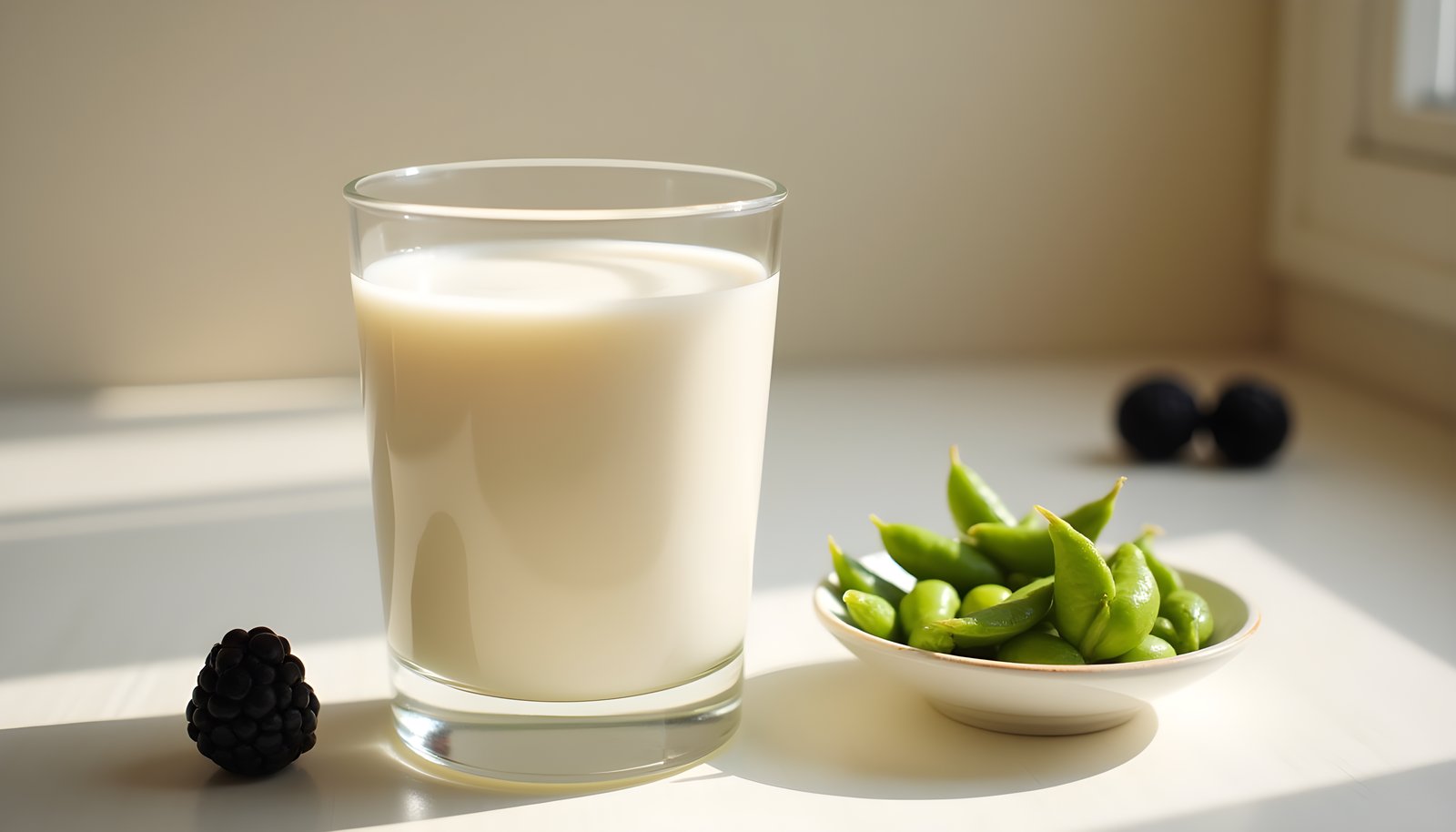
- Soy milk with edamame: a glass alongside half a cup of edamame (4.1 g) as an afternoon snack brings the fiber the drink is missing, plus more protein.
Want more smoothies, cereal bowls and savory dishes made with plant milks? Our recipe eBooks are full of easy, high fiber ideas.
How soy milk fits into a day of fiber
Mayo Clinic suggests about 25 grams of fiber a day for women and 38 grams for men up to age 50. Even at Silk’s 2 grams per cup, soy milk covers about 8% of the lower target.
So soy milk is best thought of as a protein drink that happens to be low in fiber. The fiber in your day comes from what you eat with it.
Mayo Clinic also suggests adding fiber gradually and drinking plenty of fluids. A glass of soy milk counts toward the fluid side while you build up the fiber side.
Curious how many grams you should aim for? Our fiber calculator gives you a personal target in seconds.
A simple rule for choosing soy milk
If you want protein with the least sugar, pick an unsweetened soy milk with at least 7 grams of protein and 20% or more of the Daily Value for calcium.
If you prefer some sweetness, compare added sugar and pick the lowest, since cartons in this comparison range from about 1 to 15 grams of total sugar per cup. If fiber is the goal, don’t hunt for it on the soy milk shelf, because no carton here tops 2 grams.
One thing to try this week
Pick one breakfast and pour soy milk over a high fiber cereal instead of drinking it on its own. Three quarters of a cup of bran flakes with soy milk brings about 5.5 grams of fiber and 7 to 9 grams of protein before you add any fruit.
Add a handful of berries on top and you have a bowl that covers both protein and fiber without any extra effort.
Soy milk fiber: common questions
Does soy milk have fiber?
A little, at most. USDA lists 0 grams per cup for its reference soy milks, while Silk’s labels list up to 2 grams per cup.
Why does soy milk have less fiber than soybeans?
Much of the bean’s solid matter doesn’t make it into the drink. Half a cup of edamame has 4.1 grams of fiber, while a cup of soy milk has 0 to 2 grams.
Is soy milk higher in fiber than oat milk?
Usually not. The oat milks we checked list 1 to 2 grams per cup, while soy milk ranges from 0 to 2 grams.
How much protein is in soy milk?
About 7 to 9 grams per cup. That’s close to the 8 grams in 2% dairy milk and far more than almond or oat milk.
Is unsweetened soy milk healthier than sweetened?
It’s lower in sugar. Unsweetened soy milk has about 1 gram of sugar per cup, while sweetened versions list 6 to 11 grams.
Does soy milk have calcium?
Fortified versions do. Cartons in this comparison list 250 to 450 milligrams per cup, about 19 to 35% of the Daily Value.
How can I add fiber to soy milk?
Blend it with high fiber fruit and seeds. A cup of blackberries and a tablespoon of flaxseed add about 10.4 grams of fiber to a glass.
Sources
- USDA Agricultural Research Service. FoodData Central entries for soy milk, unsweetened, plain, shelf stable (Foundation Foods 1999630), soy milk, unsweetened (2705405), soy milk, sweetened (2705404), Silk Unsweetened soymilk (SR Legacy 175223) and reduced fat 2% milk (171267), plus branded records for Silk Unsweetened Organic Soymilk (2021), Silk Original Soy Milk (2021) and Edensoy Extra Vanilla (2026). fdc.nal.usda.gov
- U.S. Food and Drug Administration. “Daily Value on the Nutrition and Supplement Facts Labels.” 2024. fda.gov
- U.S. Department of Agriculture and U.S. Department of Health and Human Services. “Food Sources of Dietary Fiber.” Dietary Guidelines for Americans, 2020 to 2025. dietaryguidelines.gov
- Mayo Clinic Staff. “Dietary fiber: Essential for a healthy diet.” Mayo Clinic. 2025. mayoclinic.org