
In this article
- Refried beans fiber, can by can
- Why the traditional can has less fiber
- Mexican beans nutrition per 100 grams
- A taco night plate, counted
- Bean dip fiber at a party
- Pinto or black: does the bean matter?
- Refried beans vs other legume side dishes
- Sodium, fat and the label
- What else refried beans offer
- Easy ways to get more from a can
- Homemade refried beans with more fiber
- A quick decision rule for picking a can
- Refried beans questions
- Sources
Six grams. That’s the fiber in a half cup of Old El Paso Fat Free Refried Beans, twice the 3 grams in the same brand’s traditional can sitting next to it on the shelf.
Refried beans fiber depends far more on the recipe than on the mashing. Most canned versions land between 3 and 6 grams per half cup, which is 11 to 21% of the FDA’s 28 gram Daily Value.
Refried beans fiber, can by can
USDA FoodData Central holds brand records and generic records for refried beans. Here’s a half cup of each, about 120 to 130 grams:
| Refried beans (1/2 cup) | Calories | Fiber | Protein | Fat | Sodium |
|---|---|---|---|---|---|
| Old El Paso Fat Free (130 g) | 120 | 6 g | 7 g | 0 g | 380 mg |
| USDA canned vegetarian (121 g) | 100 | 5.7 g | 6.4 g | 1.1 g | 520 mg |
| Old El Paso Black Bean (130 g) | 110 | 5 g | 5 g | 3 g | 460 mg |
| USDA generic refried beans (130 g) | 117 | 4.8 g | 6.5 g | 2.6 g | 481 mg |
| Old El Paso Traditional (120 g) | 90 | 3 g | 5 g | 1.5 g | 450 mg |
The fat free and vegetarian versions come out on top for fiber. The traditional can, made with lard, comes in lowest.
A full cup, the amount in a generous burrito or a shared dip, doubles everything. USDA’s generic record puts a 260 gram cup at 9.6 grams of fiber.
Why the traditional can has less fiber
Lard itself doesn’t remove fiber. The difference shows up in the calories: Old El Paso Traditional works out to about 75 calories per 100 grams, while the fat free version comes to about 92.
Fewer calories from a recipe that includes fat means more water and fewer beans in each spoonful. Both cans list beans and water at the top of the ingredients, so the order alone won’t tell you the ratio.
The fiber line and the calories per 100 grams give you a better read on it.
Mexican beans nutrition per 100 grams
Comparing by weight takes the serving size out of the picture:
| Per 100 g | Calories | Fiber | Fat | Sodium |
|---|---|---|---|---|
| Pinto beans, boiled, no salt (USDA) | 143 | 9.0 g | Low | Not salted |
| Restaurant refried beans (USDA) | 177 | 7.8 g | 9.5 g | 402 mg |
| Canned vegetarian refried beans (USDA) | 83 | 4.7 g | 0.9 g | 430 mg |
| Old El Paso Fat Free | 92 | 4.6 g | 0 g | 292 mg |
| Old El Paso Black Bean | 85 | 3.8 g | 2.3 g | 354 mg |
| USDA generic refried beans | 90 | 3.7 g | 2.0 g | 370 mg |
| Old El Paso Traditional | 75 | 2.5 g | 1.3 g | 375 mg |
Plain boiled pintos lead with 9 grams per 100 grams. Canned refried beans hold roughly a third to a half of that, because water is part of the recipe.
Restaurant refried beans surprise many people. USDA’s fast food and restaurant record lists 7.8 grams of fiber per 100 grams, nearly twice the canned average, along with about 9.5 grams of fat.
That pattern fits a thicker, cooked down mash with oil or lard added. You get more fiber per spoonful and more calories at the same time.
Choosing between canned refried beans for your pantry? Our comparison charts set the popular cans side by side.
A taco night plate, counted
Say dinner is two soft tacos with a scoop of refried beans on the side. A half cup of Old El Paso Fat Free adds 6 grams of fiber and 7 grams of protein for 120 calories.
Swap in the traditional can and the same scoop drops to 3 grams. Over a taco night every week, that’s about 150 grams of fiber a year left in the can.
Spreading a few spoonfuls inside each taco instead of serving them on the side doesn’t change the math. The total amount of beans is what counts.
Adding a quarter cup of drained whole black beans to the taco filling would bring the plate up by about another 3.7 grams, based on the Dietary Guidelines figure for black beans.
Bean dip fiber at a party
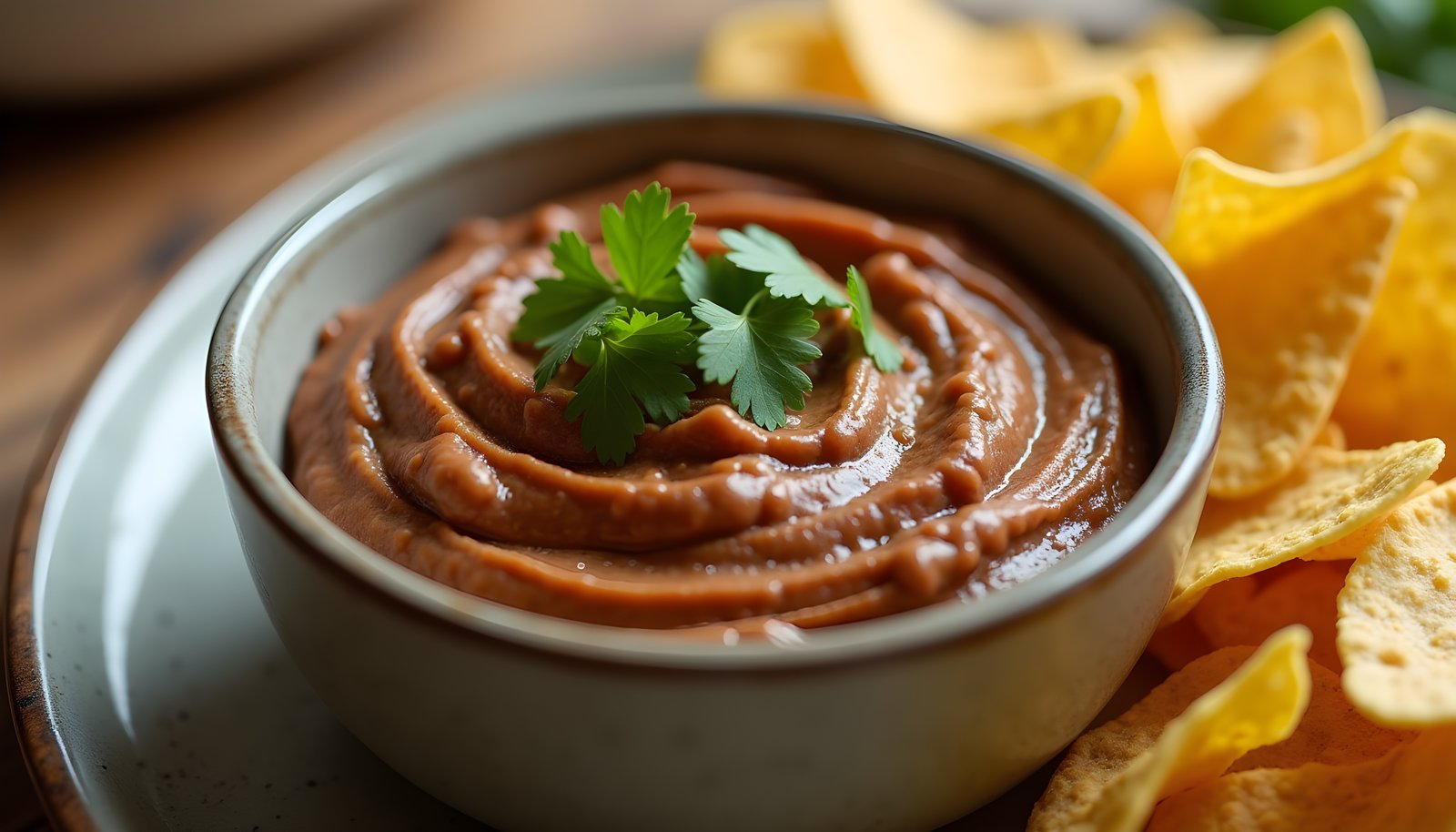
Refried beans are the base of many bean dips. A quarter cup of USDA’s generic refried beans, about 65 grams, comes to 2.4 grams of fiber before any toppings.
Layered dips dilute that further with sour cream, cheese and salsa. If you want the dip to pull its weight, make the bean layer the thickest one, or choose a fat free can as the base.
Stirring in a few spoonfuls of drained whole pinto or black beans adds texture and pushes the fiber higher. It also makes the dip feel more like a meal.
Pinto or black: does the bean matter?
Many canned refried beans are made from pinto beans, and black bean versions sit right beside them. In Old El Paso’s records, the black bean can lists 5 grams of fiber per half cup, between its traditional and fat free pinto cans.
That tells you the bean variety matters less than the recipe. A pinto can made with less water can beat a black bean can, and the reverse is also true.
Flavor is the bigger difference. Black refried beans taste a little earthier and look darker on the plate, while pinto versions are creamier and milder.
Refried beans vs other legume side dishes
On the Dietary Guidelines’ list of fiber sources, a half cup of cooked black beans brings 7.5 grams, cooked lentils 7.8 and cooked chickpeas 6.3.
That puts most canned refried beans a step behind whole beans. The fat free and vegetarian cans close most of the gap, at about 6 grams.
If you serve a bean side most nights, rotating whole beans with refried beans keeps variety on the table. Both still count as beans toward your fiber intake.
Sodium, fat and the label
Canned refried beans run between 380 and 520 milligrams of sodium per half cup in these records. Against the FDA’s 2,300 milligram Daily Value, that’s 17 to 23% from a side dish.
USDA’s reduced sodium record for traditional refried beans lists just 138 milligrams per 100 grams, a little over a third of the regular version. If you eat refried beans often, a reduced sodium can is the easiest change.
Fat varies more than most people expect. The traditional and black bean cans list 1.5 to 3 grams per half cup, while restaurant versions can carry far more.
What else refried beans offer
Harvard’s Nutrition Source describes legumes as a source of protein, folate, iron and phosphorus with little fat. Refried beans carry the same beans, so much of that comes along.
Old El Paso Fat Free lists 490 milligrams of potassium and 1.9 milligrams of iron per half cup. USDA’s canned vegetarian record lists 830 milligrams of potassium and 4.1 milligrams of iron in a full cup.
Want more weeknight meals built around beans, from tostadas to breakfast burritos? Our recipe eBooks are packed with high-fiber ideas.
Easy ways to get more from a can
A can of refried beans is one of the fastest ways to add fiber to a meal that would otherwise have very little. A few ideas that take five minutes or less:
- Breakfast tacos: spread a spoonful on a warm tortilla before adding eggs
- Tostadas: use refried beans as the base layer instead of cheese alone
- Quesadillas: spread a thin layer inside to make them more filling
- Loaded sweet potato: top a baked sweet potato with beans, salsa and greens
- Soup thickener: stir a few spoonfuls into tortilla or vegetable soup
Each of these adds roughly 1 to 3 grams of fiber for a quarter cup of beans, depending on the can. Small additions across the day add up faster than one big bean meal.
An opened can keeps for a few days in a covered container in the fridge. Freezing leftovers in small portions makes it easy to add a scoop whenever a meal needs it.
Homemade refried beans with more fiber
Making refried beans at home lets you set the ratio. Mash cooked pinto or black beans with a splash of their cooking liquid, a little oil, garlic, onion and cumin, and stop when the texture is spreadable.
Less added water means more beans per spoonful, so a homemade batch can sit closer to the 9 grams per 100 grams of plain pintos. Leaving some beans partly whole adds texture too.
Since beans can cause gas for some people, Mayo Clinic’s advice to increase fiber gradually and drink plenty of fluids applies here. A half cup is a sensible starting point.
A quick decision rule for picking a can
- If you want the most fiber: choose a fat free or vegetarian can with at least 5 grams per half cup
- If sodium matters most: pick a reduced sodium can, or make your own
- If you love the traditional flavor: mix the traditional can with a can of mashed plain pintos
- If you’re eating out: enjoy the fiber, and treat a restaurant scoop as a richer side
Any of these choices still brings fiber and protein to the plate. The rule simply helps you get the most from the can you buy.
Refried beans questions
Do refried beans have fiber?
Yes. Canned refried beans list about 3 to 6 grams of fiber per half cup, depending on the brand and recipe.
Do refried beans have less fiber than whole beans?
Usually, yes. Plain boiled pinto beans have about 9 grams of fiber per 100 grams, while canned refried beans hold about 2.5 to 4.7 grams because of added water.
Are fat free refried beans higher in fiber?
Often. Old El Paso Fat Free lists 6 grams per half cup, compared with 3 grams in its traditional can.
How much fiber is in a cup of refried beans?
USDA’s generic record lists about 9.6 grams of fiber in a 260 gram cup.
Are black refried beans higher in fiber than pinto?
Not always. Old El Paso Black Bean lists 5 grams per half cup, more than its traditional pinto can but less than its fat free can.
Do restaurant refried beans have more fiber?
Per 100 grams, yes. USDA lists restaurant refried beans at 7.8 grams of fiber, but they also carry about 9.5 grams of fat.
Are refried beans good for digestion?
Their fiber supports regularity. Start with a half cup if you’re not used to beans, since they can cause gas.
Sources
- U.S. Department of Agriculture, Agricultural Research Service. “Refried beans (2707396); Refried beans, from fast food / restaurant (2707397); Refried beans, canned, vegetarian (174296); Refried beans, canned, traditional, reduced sodium (174298); Beans, pinto, mature seeds, cooked, boiled, without salt; Branded Foods: Old El Paso Fat Free Refried Beans (2740595), Old El Paso Traditional Refried Beans (2740594), Old El Paso Black Bean Refried Beans (2740609).” FoodData Central. 2019 to 2025. fdc.nal.usda.gov
- U.S. Food and Drug Administration. “Daily Value on the Nutrition and Supplement Facts Labels.” 2024. fda.gov
- U.S. Department of Agriculture and U.S. Department of Health and Human Services. “Food Sources of Dietary Fiber.” Dietary Guidelines for Americans, 2020 to 2025. 2020. dietaryguidelines.gov
- Harvard T.H. Chan School of Public Health. “Legumes and Pulses.” The Nutrition Source. 2024. nutritionsource.hsph.harvard.edu
- Mayo Clinic Staff. “Chart of high-fiber foods.” Mayo Clinic. 2025. mayoclinic.org