
In this article
- How much baked beans fiber is in a serving
- Why the sauce lowers the fiber per bite
- Canned baked beans fiber vs plain beans
- Why two cans can differ by 3 grams
- Fiber per 100 calories
- Myth vs fact: baked beans and fiber
- The added sugar and sodium that come along
- What else baked beans offer
- Baked beans among high fiber comfort foods
- Making baked beans with more fiber at home
- Going easy on your gut
- A quick decision rule for choosing a can
- The biggest caveat: the sweetener
- Baked beans: what people ask
- Sources
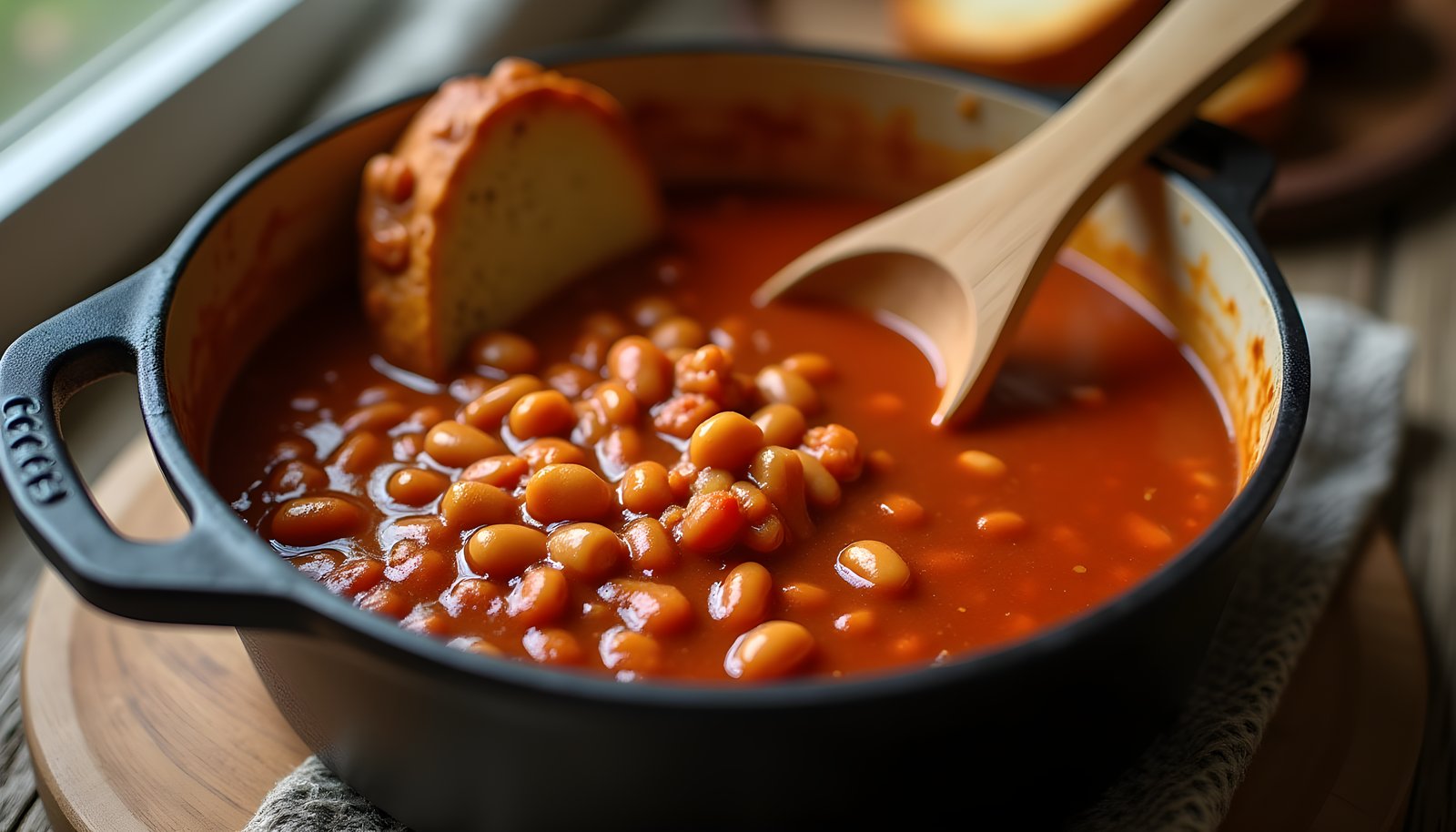
Picture a cookout plate: a burger, a scoop of potato salad and a big spoonful of baked beans. Only one of those three gives you real fiber, and it’s the beans. Baked beans fiber comes to about 5 grams per half cup in most canned brands.
That’s 18% of the FDA’s 28 gram Daily Value from a side dish. The catch is the sauce, which adds sugar and sodium and takes up room the beans would otherwise fill.
How much baked beans fiber is in a serving
USDA FoodData Central holds both brand records and generic survey records for baked beans. Here’s how a half cup compares, which is about 130 grams:
| Baked beans (1/2 cup, about 130 g) | Calories | Fiber | Protein | Total sugars | Sodium |
|---|---|---|---|---|---|
| Bush’s Original (with bacon) | 160 | 5 g | 8 g | 12 g (11 g added) | 560 mg |
| Bush’s Vegetarian | 140 | 4 g | 6 g | 13 g (11 g added) | 570 mg |
| Heinz Baked Beans | 130 | 5 g | 6 g | 9 g | 350 mg |
| USDA generic baked beans | 137 | 5.7 g | 5.9 g | 10.7 g | 508 mg |
| USDA reduced sodium baked beans | 135 | 7.2 g | 6.2 g | 10 g | 351 mg |
Most canned versions land between 4 and 6 grams per half cup. The reduced sodium record runs higher on fiber, which shows how much the recipe matters even within one food.
A full cup, the size many people actually scoop at a barbecue, doubles everything. USDA’s generic record puts a 260 gram cup at about 11 grams of fiber and 270 calories.
Why the sauce lowers the fiber per bite
Nearly every can of baked beans starts with navy beans, a small white bean. The Dietary Guidelines list a half cup of plain cooked navy beans at 9.6 grams of fiber, the highest of any bean on its chart.
Baked beans keep the same beans but suspend them in sauce made from water, brown sugar, tomato and seasonings. Per 100 grams, USDA’s generic baked beans hold 4.4 grams of fiber, so a spoonful is part bean and part sauce.
The fiber hasn’t been cooked away. There are simply fewer beans in each scoop, and the sauce brings calories from sugar instead.
Canned baked beans fiber vs plain beans
Here’s how a half cup of baked beans lines up with plain cooked beans on the Dietary Guidelines list:
| Half cup serving | Fiber | Notes |
|---|---|---|
| Navy beans, cooked | 9.6 g | Same bean, no sauce |
| Lentils, cooked | 7.8 g | No soaking needed |
| Black beans, cooked | 7.5 g | Common in tacos and bowls |
| Chickpeas, cooked | 6.3 g | Base of hummus |
| Baked beans, canned (typical) | 5 g | Sweet sauce, added sugar |
Plain navy beans offer almost twice the fiber of the baked version for the same scoop. Even so, 5 grams works out to 18% of the Daily Value, just under the FDA’s 20% line for a high fiber serving.
Choosing between canned bean products for your pantry? Our comparison charts put the common options side by side.
Why two cans can differ by 3 grams
The spread in the table, from 4 grams to just over 7, comes down to how much of the can is bean and how much is sauce. Brands don’t publish that ratio, but the fiber line gives it away.
A thicker, bean packed can tends to list more fiber and more protein per half cup. A thinner, saucier can lists more sugar relative to its fiber.
Comparing two labels takes a few seconds. Put the fiber grams next to the total sugar grams: Heinz lists 5 grams of fiber to 9 of sugar, while Bush’s Vegetarian lists 4 to 13.
Flavored versions such as maple, honey or barbecue usually lean sweeter still. If the fiber line stays at 4 or 5 grams while the sugar climbs, the extra calories are coming from the sauce.
Fiber per 100 calories
Another way to compare is fiber per 100 calories, which shows how much of a food’s energy comes packaged with fiber.
Heinz works out to about 3.8 grams per 100 calories, Bush’s Original to about 3.1 and Bush’s Vegetarian to about 2.9. USDA’s reduced sodium record reaches about 5.3, the best of the group.
For most people, the difference matters only if baked beans are a regular part of the week. If they’re a few spoonfuls at a summer cookout, any can will do.
Myth vs fact: baked beans and fiber
Myth: Baked beans are junk food, so the fiber doesn’t count.
Fact: The 5 grams in a half cup comes from the beans themselves, and your body treats it the same as fiber from any other bean. The sugar and sodium are separate issues worth weighing, but they don’t cancel the fiber.
Myth: Vegetarian baked beans are the lighter, healthier pick.
Fact: In Bush’s records, the vegetarian version drops the bacon and the fat, but it lists 1 gram less fiber, slightly more sugar and slightly more sodium than the original. Vegetarian means no meat, not less sauce.
The added sugar and sodium that come along
Bush’s Original lists 11 grams of added sugar per half cup. Against the FDA’s 50 gram Daily Value, that’s 22% of a day’s added sugar limit from one side dish.
Sodium follows a similar pattern. At 560 milligrams, the same half cup supplies about a quarter of the 2,300 milligram Daily Value.
The FDA’s own rule of thumb helps here: 5% DV or less per serving is low, and 20% or more is high. By that measure, a typical half cup of baked beans sits just under high for fiber while landing high for added sugar and sodium.
Heinz’s record shows less sodium, at 350 milligrams, and 9 grams of total sugar. USDA’s reduced sodium baked beans record sits close to that, at about 350 milligrams per half cup.
What else baked beans offer
Beans bring more than fiber to the plate. Harvard’s Nutrition Source describes legumes as sources of protein, folate, iron and phosphorus with little fat.
Bush’s Original lists 8 grams of protein, 380 milligrams of potassium and 1.8 milligrams of iron per half cup. That’s about 10% of the Daily Value for iron.
USDA’s SR Legacy record for home prepared baked beans, which includes pork, lists 5.5 grams of fiber per 100 grams with 5.15 grams of fat. Homemade recipes with meat carry more fat than most canned versions, though the fiber holds steady.
Baked beans among high fiber comfort foods
Comfort food rarely means fiber. Baked beans are one of the few classics that bring a meaningful amount without any special effort.
They also pair well with foods that add even more. A few combinations to try:
- Beans on whole wheat toast: a British style breakfast that adds the grain’s fiber to the beans
- Baked beans with a baked potato: eat the skin and the plate gains more fiber
- Bean and vegetable chili base: stir a can of baked beans into chili with plain kidney beans
- Cookout plate swap: double the beans and halve the chips
Want more cozy, bean based dishes for cold nights? Our recipe eBooks are packed with easy high-fiber meals.
Making baked beans with more fiber at home
Homemade baked beans let you control the ratio of beans to sauce. Use more beans and less liquid, and each spoonful carries more fiber.
Start with plain canned or cooked navy beans, then add tomato, onion, mustard and a small amount of brown sugar or molasses. Cutting the sweetener in half still gives a rich, savory pot.
Simmering the pot uncovered for longer thickens the sauce without adding more sugar.
Going easy on your gut
Beans are known for causing gas in some people, and baked beans are no exception. A full cup brings about 11 grams of fiber at once, which is a big jump for someone who usually eats little.
Mayo Clinic recommends increasing fiber gradually over a few weeks and drinking plenty of fluids. Starting with a half cup and building up gives your gut time to adjust.
A quick decision rule for choosing a can
Reading labels can feel slow at the store. One simple rule makes it easier:
- If you want the most fiber: pick a reduced sodium version or make your own with extra beans
- If sodium is your concern: look for 400 milligrams or less per half cup
- If added sugar is your concern: compare the added sugars line and choose the lowest you enjoy
- If you want plain fiber: skip the sauce and buy canned navy beans instead
Any of these still counts toward your daily fiber goal. The difference is what comes along with it.
The biggest caveat: the sweetener
The strongest reason to think twice about baked beans isn’t the fiber, it’s the 11 grams of added sugar that many cans carry. If you eat them several times a week, that sugar adds up faster than the fiber does.
A practical middle ground is to mix a can of baked beans with a can of rinsed plain navy beans. You keep the flavor, raise the fiber per half cup from about 5 grams to about 7 and cut the added sugar per serving roughly in half.
Baked beans: what people ask
Are baked beans high in fiber?
Yes. Most canned baked beans list 4 to 6 grams of fiber per half cup, which is 14 to 21% of the Daily Value.
Do canned baked beans have less fiber than regular beans?
Yes. A half cup of plain cooked navy beans has 9.6 grams of fiber, while baked beans usually have about 5 grams because the sauce takes up part of each serving.
How much fiber is in a can of baked beans?
A 16 ounce can holds about 3.5 half cup servings. At 5 grams each, the whole can comes to roughly 17 grams of fiber.
Do vegetarian baked beans have more fiber?
Not necessarily. Bush’s vegetarian baked beans list 4 grams per half cup, compared with 5 grams in its original version.
Are baked beans good for digestion?
They can help, since the fiber supports regularity. Start with a half cup and build up slowly, because beans can cause gas.
How much sugar is in baked beans?
Bush’s Original lists 12 grams of total sugar and 11 grams of added sugar per half cup. Heinz lists 9 grams of total sugar.
Do homemade baked beans have more fiber?
Often, yes. USDA lists home prepared baked beans at 5.5 grams of fiber per 100 grams, compared with 4.4 grams for its generic canned record.
Sources
- U.S. Department of Agriculture, Agricultural Research Service. “Baked beans (2707390); Baked beans, vegetarian (2707391); Baked beans, reduced sodium (2707410); Beans, baked, home prepared (173731); Branded Foods: Bush’s Original Baked Beans (2741634), Bush’s Vegetarian Baked Beans (2739742), Heinz Baked Beans (1624816).” FoodData Central. 2018 to 2025. fdc.nal.usda.gov
- U.S. Food and Drug Administration. “Daily Value on the Nutrition and Supplement Facts Labels.” 2024. fda.gov
- U.S. Department of Agriculture and U.S. Department of Health and Human Services. “Food Sources of Dietary Fiber.” Dietary Guidelines for Americans, 2020 to 2025. 2020. dietaryguidelines.gov
- Harvard T.H. Chan School of Public Health. “Legumes and Pulses.” The Nutrition Source. 2024. nutritionsource.hsph.harvard.edu
- Mayo Clinic Staff. “Chart of high-fiber foods.” Mayo Clinic. 2025. mayoclinic.org