
In this article
- Food processing fiber loss, step by step
- Refined foods fiber: what milling takes out
- Heat, canning and freezing: the gentler steps
- Whole foods nutrition: what else leaves with the fiber
- Processed food health: why the missing fiber matters
- Cornbread, two ways
- Swaps that win back the most fiber
- Reading labels on processed foods
- The edge case: processing that adds fiber
- Processing and fiber: what people want to know
- Sources
Yes, processing can reduce fiber, but the word “processed” tells you surprisingly little. A can of plain pumpkin is processed, and it has nearly three times the fiber of fresh boiled pumpkin per 100 grams.
Food processing fiber loss comes down to one question: did the step take part of the plant away? Milling, juicing and peeling remove fiber-rich parts, so they cut fiber. Cooking, canning and freezing mostly change texture, so the fiber stays.
Food processing fiber loss, step by step
Here’s how common processing steps compare, using USDA FoodData Central values per 100 grams. Each pair starts with the less processed form.
| Processing step | Example | Fiber per 100 g | What happened |
|---|---|---|---|
| Milling and refining | Whole wheat flour vs white flour | 10.7 g vs 2.7 g | Bran and germ removed |
| Degerming | Whole grain cornmeal vs degermed cornmeal | 7.3 g vs 3.9 g | Germ and hull removed |
| Polishing | Brown rice vs white rice, cooked | 1.8 g vs 0.4 g | Bran layer removed |
| Peeling and pureeing | Apple with skin vs unsweetened applesauce | 2.4 g vs 1.1 g | Skin left out of the sauce |
| Juicing | Apple vs bottled apple juice | 2.4 g vs 0.2 g | Pulp and skin filtered off |
| Canning | Boiled pumpkin vs canned pumpkin | 1.1 g vs 2.9 g | Water cooked off; fiber concentrated |
The pattern is clear. The steps at the top of the table separate the plant into parts and keep only the starchy or sugary one, while canning leaves the whole vegetable in the can.
Applesauce lands close to a peeled apple, which USDA lists at about 1.3 grams per 100 grams. Blending doesn’t destroy fiber, but the skin usually doesn’t make it into the jar.
Refined foods fiber: what milling takes out
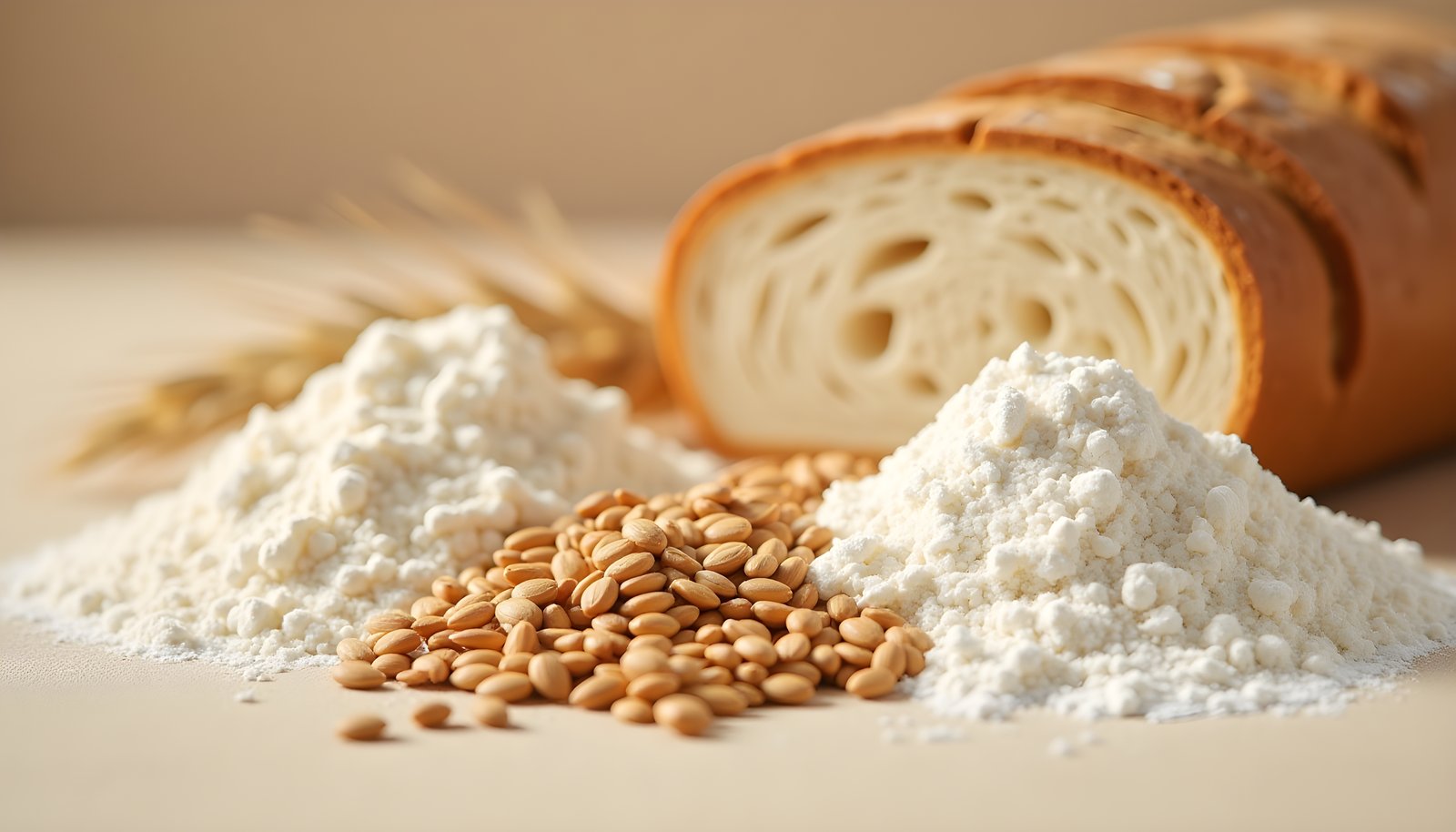
A grain kernel has three parts. The bran is the fiber-rich outer layer, the germ is the small core where the seed sprouts, and the endosperm is the starchy interior that makes up most of the kernel.
Refining strips away the bran and germ and keeps the endosperm. According to Harvard’s Nutrition Source, refining wheat removes more than half of its B vitamins, 90% of its vitamin E and virtually all of its fiber.
USDA numbers put the drop at roughly three quarters by weight, since the starchy endosperm keeps a little fiber of its own. Either way, the bran is where most of the grain’s fiber lives.
Enrichment doesn’t fix the fiber gap. The FDA notes that enriched grains get iron and B vitamins such as thiamin, riboflavin and niacin added back, but fiber isn’t part of that list.
Why the germ goes first
The germ holds healthy fats, and fat shortens shelf life. Harvard’s Nutrition Source points to that as a main reason millers remove it, which is also why whole grain flour is best kept cool and used sooner.
Wondering how many grams of fiber your own day should hold? Our fiber calculator gives you a personal target from a few quick details.
Heat, canning and freezing: the gentler steps
Heat works differently from milling. A 2003 review in the Proceedings of the Nutrition Society explained that heat can break long fiber chains into shorter pieces, a process called depolymerization, and the severity of the treatment decides how far that goes.
Shorter chains mostly affect soluble fiber, which can become less thick and gel-like. The total amount of fiber, though, changes little once you account for the water foods lose or gain during cooking.
The same review found no effect on dietary fiber from freezing or mild microwave treatment. A UC Davis review of fresh, frozen and canned produce agreed that fiber changes little with processing, with the main exception being products that were peeled first.
When numbers seem to go up
Canned pumpkin looks like a fiber upgrade at 2.9 grams per 100 grams against 1.1 grams for boiled fresh pumpkin. Most of that gap is water: boiled pumpkin is about 94% water, so the same weight holds less pumpkin.
Dried fruit works the same way. Drying removes water, so fiber per gram rises, but so do sugar and calories, and the fiber in a whole fruit doesn’t change.
Whole foods nutrition: what else leaves with the fiber
The parts that processing removes rarely carry fiber alone. Harvard’s Nutrition Source lists the nutrients packed into each part of a grain kernel:
- Bran: fiber, B vitamins, iron, copper, zinc, magnesium and antioxidants
- Germ: healthy fats, vitamin E, B vitamins and plant compounds called phytochemicals
- Endosperm: mostly starch, with some protein and small amounts of B vitamins and minerals
So a switch from white flour to whole wheat flour brings back far more than fiber. Fortification can replace a few of the missing nutrients, but Harvard notes the phytochemicals and other whole grain components can’t be added back.
Processed food health: why the missing fiber matters
Fiber in an intact grain slows the breakdown of starch into glucose. Harvard’s Nutrition Source explains that this helps keep blood sugar steadier, while refined grains tend to have a higher glycemic index, a measure of how fast a food raises blood sugar.
Large cohort studies line up with that. In the Nurses’ Health Study, women who ate 2 to 3 servings of whole grains a day had about a 30% lower risk of heart attack or death from heart disease over 10 years, compared with those who ate less than one serving a week.
Rice tells a similar story. Harvard reports that eating white rice 5 or more times a week was linked to a 17% higher risk of type 2 diabetes, while eating brown rice at least twice a week was linked to an 11% lower risk.
These are observational findings, so they show links rather than proof. Still, they match what the fiber numbers suggest: the most refined versions of a food tend to be the least helpful ones.
If you’re adding fiber back after years of refined staples, our gut health guides can help you build up gently so your digestion keeps pace.
Cornbread, two ways
Picture a pan of cornbread made with 1 cup of cornmeal. With degermed cornmeal, that cup weighs about 157 grams and brings roughly 6.1 grams of fiber to the whole pan.
Switch to whole grain cornmeal, at about 122 grams per cup, and the pan gets about 8.9 grams. The lighter cup still carries more fiber because the germ and hull came along.
Cut the pan into eight pieces and each square gains about a third of a gram. That’s small per bite, which is why the larger wins come from staples you eat every day, like bread, rice and breakfast cereal.
Looking for ways to cook with whole grain flours and cornmeal without the dense results? Our recipe eBooks have plenty of high-fiber bakes and grain dishes to start with.
Swaps that win back the most fiber
The biggest fiber gains come from switching the refined staples you eat most often. These per-serving numbers come from USDA FoodData Central:
| Refined choice | Fiber | Less processed swap | Fiber |
|---|---|---|---|
| 1 slice white bread (29 g) | 0.8 g | 1 slice whole wheat bread (32 g) | 1.9 g |
| 1 cup cooked white rice (158 g) | 0.6 g | 1 cup cooked brown rice (195 g) | 3.5 g |
| 1 cup apple juice | 0.5 g | 1 medium apple with skin | 4.8 g |
| 1 cup all-purpose flour (125 g) | 3.4 g | 1 cup whole wheat flour (120 g) | 12.8 g |
Two slices of toast, a cup of rice and an apple in place of juice add about 9 grams of fiber to a day. That’s roughly a third of the FDA’s Daily Value, from foods you were already eating.
Reading labels on processed foods
A Nutrition Facts label makes the comparison easy. The FDA’s Daily Value for fiber is 28 grams, and a serving with 5% DV or less is considered low while 20% DV or more is high.
- Check the first ingredient: “whole wheat flour” or “whole grain oats” means the bran came along.
- Watch for “enriched” or “wheat flour” without “whole”; that’s refined flour.
- Compare fiber per serving between brands of the same food.
- Choose whole fruit over juice and skin-on options where you can.
The edge case: processing that adds fiber
Some processed foods carry more fiber than any whole food could, because fiber was added back in an isolated form. Bars, cereals and yogurts often list ingredients like inulin, chicory root fiber or psyllium.
Under current labeling rules, the FDA only lets an isolated or synthetic fiber count toward the label number if it has a proven benefit, such as lowering blood sugar or cholesterol or improving bowel regularity. Approved examples include beta-glucan, psyllium husk, cellulose, guar gum and pectin, with others like inulin allowed while the rules are updated.
These added fibers can help, but they don’t bring along the vitamins, minerals and plant compounds that came with the original bran or skin. A high fiber number on a heavily processed food is a good sign, not a perfect substitute for the whole food.
Processing and fiber: what people want to know
Does cooking food destroy fiber?
No. Cooking can shorten some fiber chains and soften soluble fiber, but a 2003 review found the effect on total fiber is small once water changes are accounted for.
Does blending fruit remove fiber?
No. Blending breaks fiber into smaller pieces but keeps it in the glass. Applesauce has less fiber than a whole apple mainly because the skin is usually removed.
Is white flour completely fiber-free?
Not completely. White flour has about 2.7 grams of fiber per 100 grams compared with 10.7 grams in whole wheat flour, according to USDA data.
Does enriched bread add fiber back?
No. Enrichment adds back iron and B vitamins like thiamin, riboflavin and niacin, but the FDA’s list of added nutrients doesn’t include fiber.
Do frozen and canned vegetables lose fiber?
Very little. Research reviews found freezing has no effect on fiber and canning changes it only slightly, unless the vegetable was peeled first.
Is added fiber like inulin as good as natural fiber?
It can help, and the FDA only counts added fibers with a proven benefit on labels. Added fiber doesn’t bring the vitamins, minerals and plant compounds found in whole grains and produce, though.
Which processing steps remove the most fiber?
Refining grains and juicing remove the most. Milling wheat into white flour removes about three quarters of its fiber, and apple juice keeps less than a tenth of an apple’s fiber.
Sources
- Harvard T.H. Chan School of Public Health. “Whole Grains.” The Nutrition Source. 2025. nutritionsource.hsph.harvard.edu
- Nyman EM. “Importance of processing for physico-chemical and physiological properties of dietary fibre.” Proceedings of the Nutrition Society. 2003. cambridge.org
- Rickman JC, Bruhn CM, Barrett DM. “Nutritional comparison of fresh, frozen, and canned fruits and vegetables II. Vitamin A and carotenoids, vitamin E, minerals and fiber.” Journal of the Science of Food and Agriculture. 2007. ucanr.edu
- U.S. Department of Agriculture, Agricultural Research Service. “FoodData Central.” 2026. fdc.nal.usda.gov
- U.S. Food and Drug Administration. “Questions and Answers on Dietary Fiber.” 2024. fda.gov
- U.S. Food and Drug Administration. “Interactive Nutrition Facts Label: Dietary Fiber.” 2021. accessdata.fda.gov