
In this article
- Pumpkin seeds fiber by form
- Why the shell changes the numbers
- Pumpkin seeds next to other seeds and nuts
- Pepitas as a protein topping
- The magnesium headline
- Zinc in pumpkin seeds
- Pumpkin seeds and digestion
- Roasting the seeds from a carved pumpkin
- Easy ways to use pumpkin seeds
- Pumpkin seeds in a day’s fiber
- Reading a pumpkin seed label
- Pepitas or whole seeds: a quick rule
- Pumpkin seed fiber: common questions
- Sources
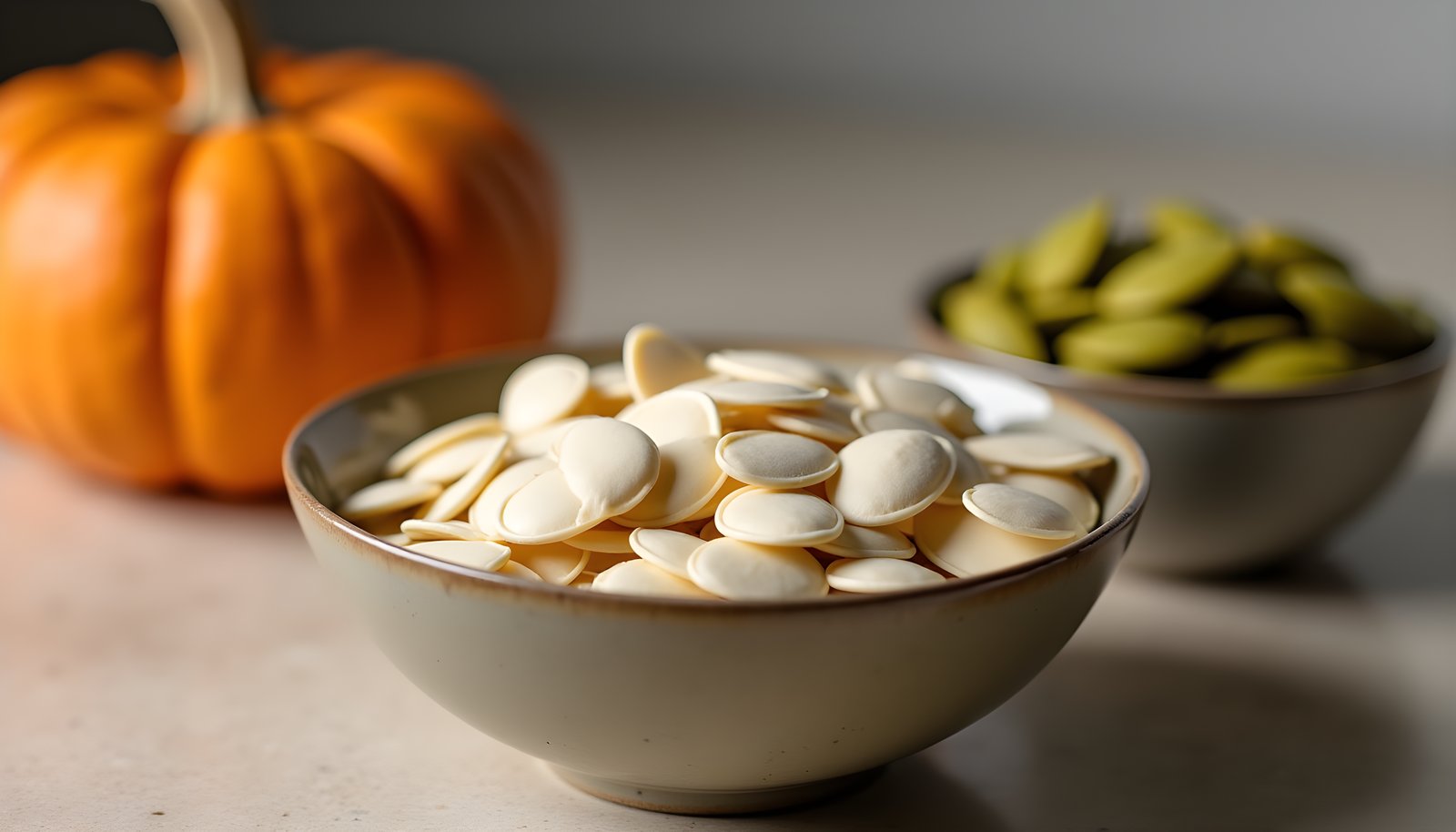
An ounce of shelled pumpkin seeds, the green kernels often sold as pepitas, gives you only about 1.7 grams of fiber. Keep the white shell on and roast the seeds whole, and the same ounce jumps to about 5.2 grams, according to USDA FoodData Central.
That shell is the whole story behind pumpkin seeds fiber. The kernels bring the protein, magnesium and zinc, while the hull supplies most of the fiber and cuts the calories per bite.
Here’s how the two forms compare, what pumpkin seeds do for your minerals and digestion, and how to make the most of the seeds from your next carved pumpkin.
Pumpkin seeds fiber by form
USDA lists three versions of pumpkin and squash seeds. Per ounce, they look like this:
| Pumpkin seed form, 1 oz (USDA) | Fiber | Calories | Protein | Fat |
|---|---|---|---|---|
| Shelled kernels (pepitas), dried | 1.7 g | 158 | 8.6 g | 13.9 g |
| Shelled kernels, roasted, no salt | 1.8 g | 163 | 8.4 g | 13.9 g |
| Whole seeds in shell, roasted, no salt | 5.2 g | 126 | 5.3 g | 5.5 g |
Whole roasted seeds carry about three times the fiber of shelled ones. They also come in lighter at 126 calories, because the shell replaces some of the oily kernel by weight.
Per 100 grams, the gap is even plainer: 18.4 grams of fiber for whole roasted seeds versus 6.0 to 6.5 grams for the kernels. That puts whole pumpkin seeds among the more fiber dense seeds you can snack on.
Shelled kernels win on protein, with about 8.6 grams per ounce. If you sprinkle seeds on salads and bowls mainly for protein and minerals, pepitas still earn their spot.
Why the shell changes the numbers
The hull adds fiber but very little fat. Per 100 grams, USDA lists whole roasted seeds at 19.4 grams of fat and 446 calories, against 49 grams of fat and 559 to 574 calories for the shelled kernels.
Protein drops too, from about 30 grams per 100 grams in kernels to 18.6 grams in whole seeds. You’re trading some protein and fat for a big jump in fiber.
That trade works in your favor if fiber is what you’re short on. Most people are, since Harvard’s Nutrition Source puts the average American intake at about 15 grams a day.
Pumpkin seeds next to other seeds and nuts
Seeds vary widely in fiber. Here’s where pumpkin seeds land among popular choices, using USDA values per ounce:
| Seed or nut, 1 oz (USDA) | Fiber | Calories | Fiber per 100 calories |
|---|---|---|---|
| Chia seeds | 9.8 g | 138 | 7.1 g |
| Flaxseed, whole | 7.7 g | 151 | 5.1 g |
| Pumpkin seeds, whole roasted | 5.2 g | 126 | 4.1 g |
| Almonds | 3.5 g | 164 | 2.2 g |
| Pumpkin seed kernels (pepitas) | 1.7 g | 158 | 1.1 g |
Whole roasted pumpkin seeds hold their own against flax and beat almonds comfortably. Pepitas fall to the bottom of the list for fiber, below even almonds.
Pumpkin seeds don’t compete with chia or flax on omega-3 fat, though. USDA lists only about 0.12 grams of ALA per 100 grams of kernels, a tiny fraction of what flax or chia supply.
Not sure how many grams you should be aiming for each day? Our fiber calculator sets a personal target based on your age and sex.
Pepitas as a protein topping
Shelled pumpkin seeds are rich in protein. An ounce supplies about 8.6 grams, which is 17% of the FDA’s 50 gram Daily Value for protein.
That’s more protein per ounce than almonds, at about 6 grams. A tablespoon or two scattered over soup or salad adds a meaningful boost without changing the dish much.
Iron is a smaller bonus. An ounce of pepitas has about 2.5 milligrams, 14% of the FDA’s 18 milligram Daily Value.
The magnesium headline
Pumpkin seeds top the NIH Office of Dietary Supplements’ table of magnesium rich foods. An ounce of roasted kernels supplies about 156 milligrams, or 37% of the Daily Value, ahead of chia seeds at 111 milligrams and almonds at 80.
The ODS sets the adult magnesium RDA at 400 to 420 milligrams for men and 310 to 320 milligrams for women. One ounce of pepitas covers roughly half of a woman’s daily need.
Magnesium and fiber often arrive in the same foods. The ODS notes that, in general, foods containing dietary fiber provide magnesium, and seeds are a good example.
Zinc in pumpkin seeds
Zinc is the other mineral pumpkin seeds are known for. The ODS lists an ounce of roasted pumpkin seeds at 2.2 milligrams, or 20% of the 11 milligram Daily Value.
Adult men need 11 milligrams of zinc a day and women need 8, according to the ODS. An ounce of pepitas gives a woman more than a quarter of that.
There’s a catch with plant zinc. The ODS explains that beans, nuts and whole grains contain phytates, natural compounds that bind zinc and reduce how much your body absorbs, so zinc from plant foods may count for a little less than the label number suggests.
Whole roasted seeds list a little more zinc per ounce in USDA data, about 2.9 milligrams, so keeping the shell on doesn’t cost you this mineral.
| Mineral in 1 oz pepitas (USDA) | Amount | % Daily Value |
|---|---|---|
| Magnesium | 168 mg | 40% |
| Manganese | 1.3 mg | 56% |
| Copper | 0.38 mg | 42% |
| Phosphorus | 350 mg | 28% |
| Zinc | 2.2 mg | 20% |
| Iron | 2.5 mg | 14% |
Pumpkin seeds and digestion
Most of the extra fiber in whole seeds comes from the shell, the chewy, crunchy part. Mayo Clinic explains that insoluble fiber, found in foods such as nuts, wheat bran and beans, helps move material through your digestive system and adds bulk to stool.
Mayo links a higher fiber diet to a lower risk of hemorrhoids and diverticular disease and notes that fiber helps soften stool so it’s easier to pass. Whole roasted seeds can help on that front at about 19% of the fiber Daily Value per ounce.
Shells are fibrous, so chew whole seeds well and don’t go from zero to a big bowl overnight. Mayo Clinic recommends adding fiber gradually over a few weeks and drinking plenty of water as you do.
If your gut needs a gentle reset before you load up on seeds, our gut health guides walk you through a slower plan.
Roasting the seeds from a carved pumpkin
Picture the pile of seeds you scoop out when carving a jack-o-lantern. Most of it goes in the trash, but rinsed, dried and roasted whole, those seeds are the high fiber version in the USDA table.
A one ounce handful of homemade whole roasted seeds gives you about 5.2 grams of fiber and 2.9 milligrams of zinc for 126 calories. Buy a bag of pepitas for the same snack and you’d get 1.7 grams of fiber for 158 calories.
Pepitas can still pull their weight on fiber if you pair them well. Half a cup of cooked black beans brings about 7.5 grams of fiber, so a bean and grain bowl topped with an ounce of pepitas lands near 9.2 grams before you count the grain.
Skip heavy salting if you can, since the unsalted USDA values above assume no added salt. A light toss with oil and spices keeps the snack close to those numbers.
Want more ways to turn seeds into breakfasts, salads and snacks? Our recipe eBooks are full of easy, fiber rich ideas.
Easy ways to use pumpkin seeds
- Snack on whole roasted seeds in the shell when fiber is the priority
- Scatter pepitas over oatmeal, yogurt or a grain bowl for protein, magnesium and crunch
- Blend pepitas into pesto or a green sauce in place of pine nuts
- Add a spoonful of pepitas to a bean salad, which brings the fiber the kernels lack
- Mix pepitas with chia or flax in a jar so every sprinkle carries more fiber
Pumpkin seeds in a day’s fiber
Mayo Clinic suggests 25 grams of fiber a day for women and 38 grams for men up to age 50, falling to 21 and 30 grams after 50. Harvard’s Nutrition Source notes the typical American gets only about 15 grams.
An ounce of whole roasted seeds covers about a fifth of a 25 gram target. An ounce of pepitas covers about 7%, so they work best paired with higher fiber foods such as beans, berries or whole grains.
Reading a pumpkin seed label
Bags of pumpkin seeds don’t always make the form obvious. Look for words such as in shell, whole or roasted seeds versus kernels, shelled or pepitas.
The fiber line settles it quickly. A one ounce serving with 1 or 2 grams of fiber is almost certainly shelled kernels, while 5 grams or more points to whole seeds in the shell.
Check sodium as well on seasoned versions. The USDA values in this guide are for unsalted seeds, so salted snack packs can differ a lot on that line.
Pepitas or whole seeds: a quick rule
If your main goal is fiber, choose whole roasted pumpkin seeds in the shell, which give about three times the fiber for fewer calories. If you want the most protein, magnesium and zinc per sprinkle, choose shelled pepitas and pair them with a higher fiber food on the same plate.
Pumpkin seed fiber: common questions
Are pumpkin seeds high in fiber?
It depends on the form. Whole roasted pumpkin seeds have about 5.2 grams of fiber per ounce, or 19% of the Daily Value, while shelled pepitas have only about 1.7 grams.
Do pepitas have less fiber than pumpkin seeds in the shell?
Yes. USDA lists shelled kernels at 6.0 to 6.5 grams of fiber per 100 grams and whole roasted seeds at 18.4 grams, because the shell holds most of the fiber.
Can you eat the pumpkin seed shell?
Yes. Whole roasted seeds are eaten shell and all, and the shell is where most of their fiber comes from, so chew them well and add them gradually.
How much zinc is in pumpkin seeds?
An ounce of roasted pumpkin seeds has about 2.2 milligrams of zinc, or 20% of the Daily Value, according to the NIH Office of Dietary Supplements.
Are pumpkin seeds good for magnesium?
Yes. Pumpkin seeds top the NIH list of magnesium foods, with about 156 milligrams per roasted ounce, or 37% of the Daily Value.
Are pumpkin seeds good for digestion?
Whole seeds can help. Their fibrous shells add insoluble fiber, which Mayo Clinic says adds bulk to stool and helps material move through your digestive system.
How many pumpkin seeds should I eat a day?
There’s no official amount. One ounce is a typical serving and gives 126 to 163 calories depending on form, so it fits easily into most snack plans.
Sources
- U.S. Department of Agriculture, Agricultural Research Service. “FoodData Central” (Pumpkin and squash seed kernels, dried 170556; kernels, roasted, without salt 170557; seeds, whole, roasted, without salt 170188; chia seeds 170554; flaxseed 169414; almonds 170567). 2026. fdc.nal.usda.gov
- National Institutes of Health, Office of Dietary Supplements. “Magnesium: Fact Sheet for Health Professionals.” 2026. ods.od.nih.gov
- National Institutes of Health, Office of Dietary Supplements. “Zinc: Fact Sheet for Health Professionals.” 2026. ods.od.nih.gov
- Mayo Clinic Staff. “Dietary fiber: Essential for a healthy diet.” Mayo Clinic. 2025. mayoclinic.org
- Harvard T.H. Chan School of Public Health. “Fiber.” The Nutrition Source. 2024. nutritionsource.hsph.harvard.edu
- U.S. Food and Drug Administration. “Daily Value on the Nutrition and Supplement Facts Labels.” 2024. fda.gov