
In this article
- Flaxseed fiber by form: whole, ground and oil
- Why ground flax is the form to buy
- Soluble and insoluble fiber in one seed
- Flax and gut health
- Flax next to other seeds and brans
- What else a tablespoon of flax brings
- How much flax a day
- Two flax breakfasts, side by side
- Whole, ground or oil: a quick rule
- Flaxseed fiber: common questions
- Sources
Many people buy whole flaxseeds on the idea that the intact seed is the purest form. Mayo Clinic points the other way: whole flaxseed may pass through your intestine undigested, so ground flax is the form most nutrition experts recommend.
That choice decides how much flaxseed fiber, omega-3 fat and other nutrients you actually absorb. Here’s how each form compares, how much to use and how flax stacks up against other seeds and brans.
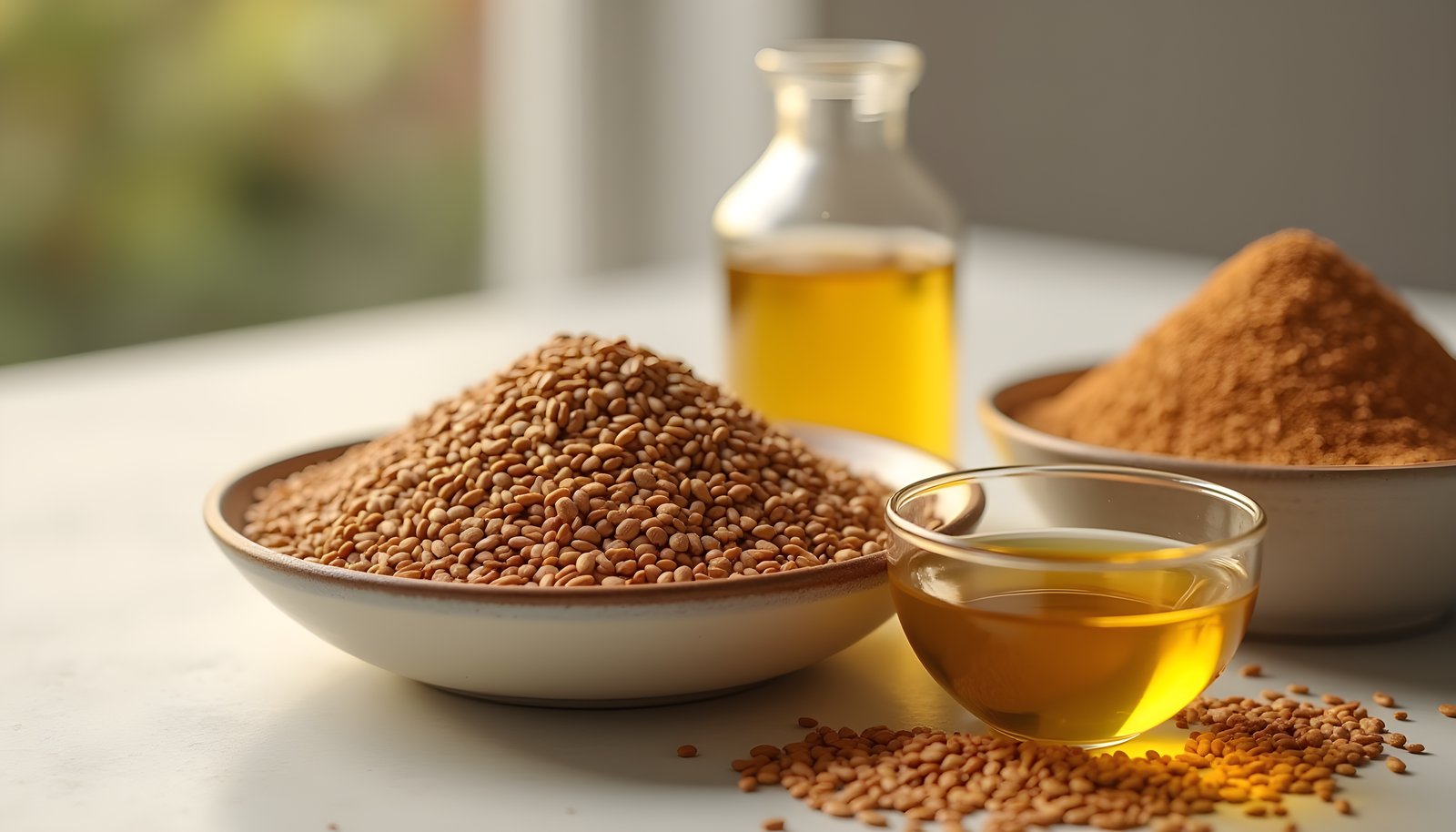
Flaxseed fiber by form: whole, ground and oil
USDA FoodData Central lists whole flaxseed at 27.3 grams of fiber per 100 grams, with 534 calories. A tablespoon of whole seeds weighs about 10.3 grams.
| Flax form | Serving | Fiber | Calories | Omega-3 (ALA) |
|---|---|---|---|---|
| Whole flaxseed (USDA) | 1 tbsp, 10.3 g | 2.8 g | 55 | 2.3 g |
| Ground flaxseed (Mayo Clinic) | 1 tbsp, 7 g | 2 g | 37 | About 2 g of polyunsaturated fat |
| Flaxseed oil (USDA) | 1 tbsp, 14 g | 0 g | 124 | 7.5 g |
A spoonful of ground flax weighs less than a spoonful of whole seeds because grinding fluffs the seed into a looser meal. That’s why the whole seed shows more fiber per tablespoon even though the two have the same seed inside.
USDA’s Foundation Foods record for ground flaxseed lists 23.1 grams of fiber per 100 grams, a little lower than the whole seed record. Samples vary, so treat roughly 2 to 3 grams per tablespoon as the working range.
Why flaxseed oil drops out of the fiber picture
Pressing flax for oil leaves the fiber behind in the seed meal. USDA lists flaxseed oil at 0 grams of fiber and 100% fat, with about 7.5 grams of alpha-linolenic acid per tablespoon.
Mayo Clinic notes that flaxseed oil carries more alpha-linolenic acid than ground flaxseed but lacks some of its other nutrients. If fiber is your goal, the oil doesn’t count.
Why ground flax is the form to buy
Digestion is the reason. Mayo Clinic explains that ground flaxseed is easier to digest, while whole seeds may pass through the intestine intact, taking some of their benefits with them.
You can buy flax already ground or grind whole seeds at home in a coffee grinder or food processor. Mayo Clinic suggests keeping ground flax in an airtight container and refrigerating or freezing it, grinding just before use when you can.
Whole seeds still have a place. They keep well in the pantry, and a quick pulse in the grinder turns them into fresh meal in seconds.
Soluble and insoluble fiber in one seed
Mayo Clinic lists both soluble and insoluble fiber among flaxseed’s nutrients. Soluble fiber dissolves in water into a gel-like material, while insoluble fiber adds bulk that helps material move through the digestive system.
Mayo Clinic adds that soluble fiber can help lower cholesterol and blood sugar, while insoluble fiber helps with constipation. Having both in one spoonful is part of what makes flax so useful as an add-in.
Flax is also rich in lignans, antioxidant plant compounds. Mayo Clinic describes flaxseed as a plant source of omega-3 fat called alpha-linolenic acid, or ALA, along with that fiber and lignan mix.
Mayo Clinic adds that flaxseed may help lower total and LDL cholesterol, which may help reduce the risk of heart disease. It also notes that it’s not yet clear which part of the seed is responsible for those heart benefits.
Want a fiber goal to build your flax habit around? Our fiber calculator sets a personal daily number for you in a few quick steps.
Flax and gut health
Mayo Clinic says flaxseed is commonly used to improve digestive health or relieve constipation. That fits the broader fiber picture: Mayo’s dietary fiber guidance explains that fiber increases the weight and size of stool and softens it, making it easier to pass.
Flax should go down with plenty of water or other fluids, as with any fiber source. Mayo Clinic also advises adding fiber gradually over a few weeks so gut bacteria can adjust and gas or bloating stays mild.
Mayo Clinic’s fiber guidance also links a high fiber diet with a lower risk of hemorrhoids and of small pouches forming in the colon, known as diverticular disease. Flax is one small, steady way to push your daily total in that direction.
One timing detail is worth knowing. Mayo Clinic recommends not taking flaxseed at the same time as oral medications or other supplements.
If your digestion tends to protest when you add new fiber, our gut health guides show you a slower, steadier way to build up.
Flax next to other seeds and brans
Tablespoon for tablespoon, flax sits in the middle of the popular add-in options. USDA data put the common choices side by side:
| Add-in (USDA) | Serving | Fiber | Calories |
|---|---|---|---|
| Chia seeds | 1 tbsp, about 12 g | 4.1 g | 58 |
| Whole flaxseed | 1 tbsp, 10.3 g | 2.8 g | 55 |
| Ground flaxseed | 1 tbsp, 7 g | About 2 g | 37 |
| Oat bran, raw | 1 tbsp, about 6 g | 0.9 g | 14 |
| Flaxseed oil | 1 tbsp, 14 g | 0 g | 124 |
Chia carries about twice the fiber of ground flax per spoon, while oat bran comes in far lighter per tablespoon. Flax earns its spot with ALA: a tablespoon of whole flaxseed holds about 2.3 grams, and flax has 22.8 grams of ALA per 100 grams compared with 17.8 grams for chia.
Matching flax’s fiber with oat bran would take about three tablespoons of bran for every tablespoon of whole flax. Both work well together in hot cereal, where the bran adds bulk and the flax adds richness.
Per calorie, whole flax delivers about 5.1 grams of fiber per 100 calories. That’s ahead of almonds at 2.2 grams and rolled oats at 2.7, but behind chia at 7.1.
What else a tablespoon of flax brings
A tablespoon of whole flaxseed (10.3 grams) also supplies:
- Copper: 0.13 mg, about 14% of the Daily Value
- Manganese: 0.26 mg, about 11% of the Daily Value
- Magnesium: 40 mg, about 10% of the Daily Value
- Protein: 1.9 grams
- Sugars: about 0.2 grams
Flax also brings a little protein, about 18.3 grams per 100 grams of seed. It won’t replace a protein food, but it adds up when flax shows up in several meals.
Most of the seed’s calories come from fat, at 42.2 grams per 100 grams. Saturated fat is only 3.7 of those grams, and more than half the total is ALA.
How much flax a day
Mayo Clinic suggests adding 1 to 4 tablespoons of ground flaxseed a day to meals and snacks. Using its figure of 2 grams per tablespoon, that range supplies about 2 to 8 grams of fiber and 37 to 148 calories.
Harvard’s Nutrition Source puts a good daily fiber target at 25 to 35 grams and notes that most Americans get about 15. Four tablespoons of ground flax alone could close roughly 40 to 80% of the gap between that average and the 25 to 35 gram range.
Mayo Clinic also notes that unripe and raw flaxseed can contain compounds that may be harmful in large amounts, and that toasting, cooking or baking can destroy them. Baking flax into muffins or breads is one easy way to use it at the higher end of the range.
Easy places to hide a spoonful
- A tablespoon of ground flax stirred into hot or cold breakfast cereal
- A tablespoon mixed into an 8 ounce container of yogurt
- A teaspoon blended into mayonnaise or mustard for a sandwich
- Ground flax folded into muffin, cookie or bread batter
Looking for more breakfasts and bakes that work flax in naturally? Our recipe eBooks are full of easy, high-fiber ideas.
Two flax breakfasts, side by side
Picture two bowls of oatmeal, each made with half a cup of dry rolled oats and topped with half a cup of raspberries. Both start at about 8 grams of fiber.
The first bowl gets a tablespoon of flaxseed oil drizzled on top. It gains about 124 calories and 7.5 grams of ALA, but its fiber stays at roughly 8 grams.
The second bowl gets two tablespoons of ground flax stirred in. It gains about 74 calories, roughly 4 grams of polyunsaturated fat and about 4 more grams of fiber, landing near 12 grams, or about 43% of the 28 gram Daily Value.
Same seed, two very different results. The ground version adds fiber and costs fewer calories, while the oil adds fat only.
Keep that second bowl going for a week and the flax alone adds about 28 grams of fiber. That’s one full day’s Daily Value spread across seven breakfasts.
Whole, ground or oil: a quick rule
If you want the fiber, buy ground flax or grind whole seeds yourself, and store the meal cold. If you want omega-3 fat with no fiber, flaxseed oil fits, but keep it out of your fiber count.
If you only have whole seeds on hand, pulse them in a grinder before sprinkling. Tonight, measure one tablespoon into tomorrow’s oatmeal or yogurt and you’ve added about 2 grams of fiber with almost no effort.
Flaxseed fiber: common questions
How much fiber is in a tablespoon of ground flaxseed?
About 2 grams, according to Mayo Clinic, in a 7 gram tablespoon with 37 calories. A tablespoon of whole seeds weighs more, about 10.3 grams, and lists 2.8 grams of fiber.
Is ground flaxseed better than whole?
Yes, for most people. Mayo Clinic notes that whole flaxseed may pass through the intestine undigested, while ground flax is easier to digest and absorb.
Does flaxseed oil have fiber?
No. USDA lists flaxseed oil at 0 grams of fiber, though a tablespoon has about 7.5 grams of the omega-3 fat ALA and 124 calories.
Does flaxseed help with constipation?
It can. Mayo Clinic says flaxseed is commonly used to improve digestive health or relieve constipation, and recommends taking it with plenty of water.
Is flaxseed fiber soluble or insoluble?
Both. Mayo Clinic lists soluble and insoluble fiber among flaxseed’s nutrients, along with lignans and the omega-3 fat ALA.
How much flaxseed should I eat a day?
Mayo Clinic suggests 1 to 4 tablespoons of ground flaxseed a day, which adds about 2 to 8 grams of fiber.
How should I store ground flaxseed?
Keep it in an airtight container in the refrigerator or freezer. Mayo Clinic suggests grinding whole seeds just before use to protect taste and nutrients.
Sources
- U.S. Department of Agriculture, Agricultural Research Service. “FoodData Central” (Seeds, flaxseed 169414; Flaxseed, ground 2262075; Flaxseed oil 2710185; Seeds, chia seeds, dried 170554; Oat bran, raw 168872; almonds; oats). 2026. fdc.nal.usda.gov
- Mayo Clinic Staff. “Does ground flaxseed have more health benefits than whole flaxseed?” Mayo Clinic. 2023. mayoclinic.org
- Zeratsky K. “Mayo Clinic Q and A: Flaxseed, a nutritional powerhouse.” Mayo Clinic News Network. 2017. newsnetwork.mayoclinic.org
- Mayo Clinic Staff. “Dietary fiber: Essential for a healthy diet.” Mayo Clinic. 2025. mayoclinic.org
- U.S. Food and Drug Administration. “Daily Value on the Nutrition and Supplement Facts Labels.” 2024. fda.gov
- Harvard T.H. Chan School of Public Health. “Fiber.” The Nutrition Source. 2024. nutritionsource.hsph.harvard.edu