
In this article
- Do oranges have fiber? How much by size
- Does orange juice contain fiber?
- Both kinds of fiber in one fruit
- Oranges vs mandarins, clementines and tangerines
- How oranges compare with other everyday fruit
- What else a medium orange delivers
- More reasons to eat your citrus whole
- A citrus heavy day, counted up
- How to get the most fiber from oranges
- Your one swap for tomorrow morning
- Questions about oranges and fiber
- Sources
You pour a tall glass of orange juice at breakfast and figure you’ve covered your fruit for the morning. So do oranges have fiber in that glass? Barely: a cup of juice has about half a gram.
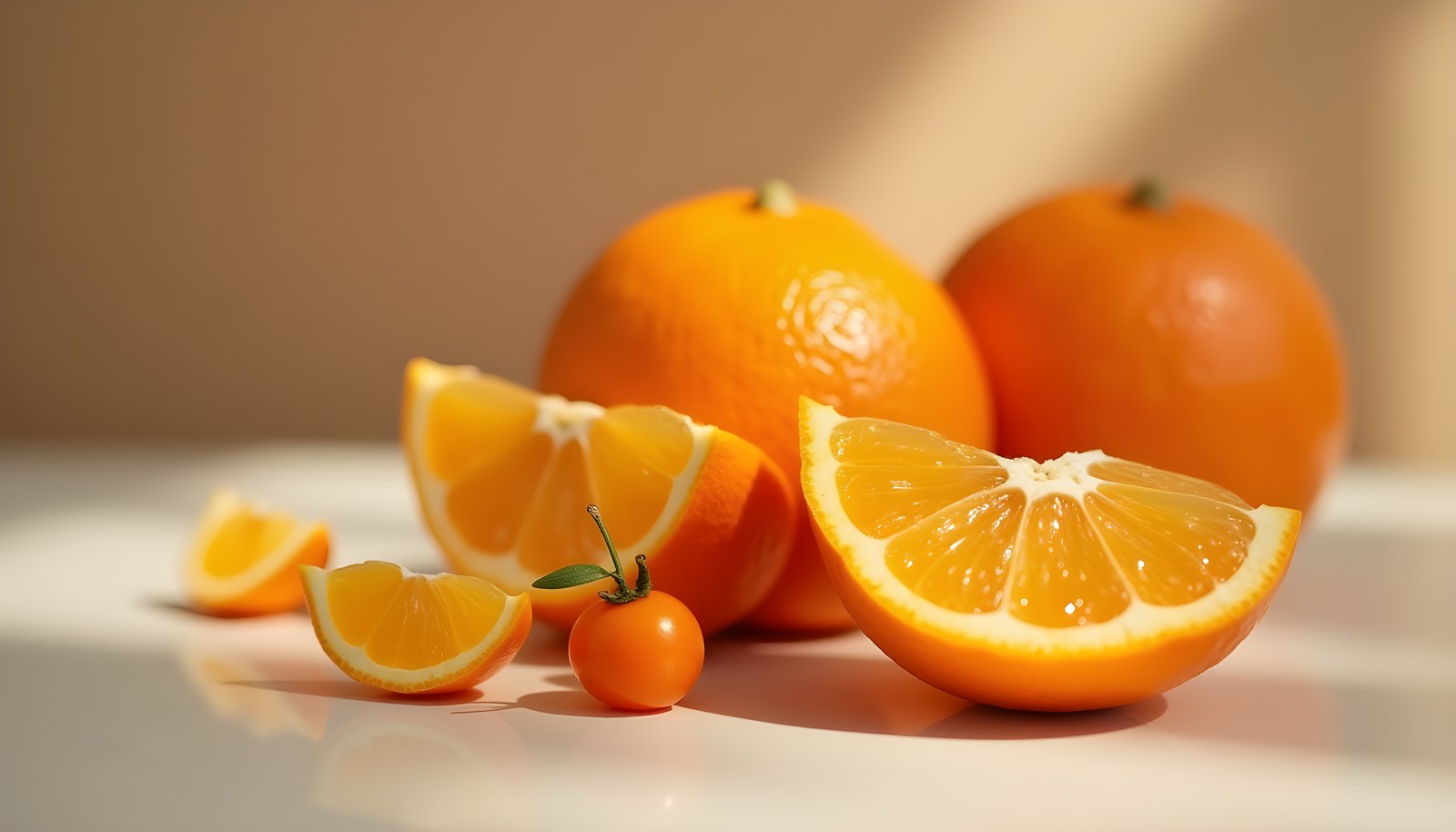
Peel and eat a medium orange instead and you get about 3.1 grams of fiber for 62 calories, according to USDA. That’s six times the fiber of the juice for about half the calories.
Here’s how much fiber is in an orange by size, how oranges stack up against mandarins, clementines and other fruit, and how to keep the most fiber when you eat them.
Do oranges have fiber? How much by size
USDA FoodData Central lists raw oranges at 2.4 grams of fiber per 100 grams. Here’s what that means for the fruit you actually buy:
| Orange | Weight | Fiber | Calories | % Daily Value |
|---|---|---|---|---|
| Small (2 3/8 inch) | 96 g | 2.3 g | 45 | 8% |
| Medium (2 5/8 inch) | 131 g | 3.1 g | 62 | 11% |
| Navel (2 7/8 inch) | 140 g | 3.1 g | 69 | 11% |
| Large (3 1/16 inch) | 184 g | 4.4 g | 86 | 16% |
| 1 cup sections | 180 g | 4.3 g | 85 | 15% |
A cup of sections weighs about as much as one and a third medium oranges, which is why its fiber lands closer to the large fruit.
The % Daily Value is based on the FDA’s 28 gram target. A large orange gets you nearly a sixth of the way there on its own.
You may see slightly different numbers elsewhere. The FDA’s raw fruit label lists a 154 gram medium orange at 3 grams of fiber, and the Dietary Guidelines list puts a medium orange at 3.7 grams and 73 calories, so the answer to how many grams of fiber in an orange depends on how big your “medium” really is.
Does orange juice contain fiber?
Very little. USDA lists fresh squeezed orange juice at 0.2 grams of fiber per 100 grams, compared with 2.4 grams in the whole fruit.
| Per serving | Fiber | Calories | Sugars |
|---|---|---|---|
| 1 medium orange (131 g) | 3.1 g | 62 | 12.2 g |
| 1 cup fresh orange juice (248 g) | 0.5 g | 112 | 20.8 g |
| Juice to match one orange’s fiber (about 6 cups) | 3.0 g | about 670 | about 125 g |
That last row is the real eye opener. To drink the fiber in one medium orange, you’d need about six cups of juice and more than ten times the calories.
Cleveland Clinic dietitian Julia Zumpano puts it plainly: you need to eat the fruit to get the benefits of its fiber. Even fresh squeezed juice with pulp, she notes, contains only a little bit.
Store bought juice can also come with added sugar, which raises the calories further. If you do drink juice, a small glass alongside a whole fruit is a better bet than juice in place of it.
Both kinds of fiber in one fruit
Citrus fruits contain both soluble fiber, which dissolves in water, and insoluble fiber, which doesn’t. Each does a different job, according to Cleveland Clinic.
- Soluble fiber feeds the helpful bacteria in your gut.
- Insoluble fiber adds bulk to stool and keeps things moving.
- Together, Cleveland Clinic notes, the fiber in citrus can help improve cholesterol and blood sugar.
That mix is one reason oranges are an easy everyday fruit. You get both kinds without having to think about it.
If you’re working on regularity or a happier gut, our gut health guides walk you through adding fiber at a pace your body can handle.
Oranges vs mandarins, clementines and tangerines
Smaller citrus fruits are handy, but they carry less fiber each. Here’s how they compare, using USDA, FDA and Dietary Guidelines figures:
| Citrus fruit | Serving | Fiber | Calories |
|---|---|---|---|
| Orange, large | 1 fruit, 184 g | 4.4 g | 86 |
| Mandarin oranges | 1 cup | 3.5 g | 103 |
| Orange, medium | 1 fruit, 131 g | 3.1 g | 62 |
| Tangerine | 1 medium, 109 g | 2 g | 50 |
| Grapefruit | 1/2 medium | 2 g | 60 |
| Clementine | 1 fruit, 74 g | 1.3 g | 35 |
Mandarin oranges measured by the cup hold their own at 3.5 grams, close to a whole medium orange. At 103 calories, though, they’re the highest calorie option on this list.
A clementine has a little less fiber per 100 grams than an orange, 1.7 grams compared with 2.4. It’s also much smaller, so you’d need two or three to match one medium orange.
That’s not a problem if you enjoy them. Two clementines give you about 2.6 grams of fiber for 70 calories, close to a medium orange.
How oranges compare with other everyday fruit
Using the Dietary Guidelines list, here’s where a medium orange lands among common fruits:
| Fruit (standard serving) | Fiber | Calories |
|---|---|---|
| Raspberries, 1 cup | 8.0 g | 64 |
| Pear, 1 medium | 5.5 g | 103 |
| Kiwi, 1 cup | 5.4 g | 110 |
| Apple, 1 medium | 4.8 g | 104 |
| Orange, 1 medium | 3.7 g | 73 |
| Blueberries, 1 cup | 3.6 g | 84 |
| Banana, 1 medium | 3.2 g | 112 |
| Strawberries, 1 cup | 3.0 g | 49 |
Oranges sit right in the middle. They beat bananas for fiber and come in with about 40 fewer calories.
Pears and apples have more fiber per fruit, but they also carry about 30 more calories each. If you’re counting fiber per calorie, an orange is a solid, light choice.
What else a medium orange delivers
Fiber is only part of the story. Here’s what a medium orange, about 131 grams, provides according to USDA, with % Daily Value from the FDA:
- Vitamin C: about 70 milligrams, around 78% of the Daily Value. A large orange tops 100%.
- Folate: about 39 micrograms, around 10%.
- Potassium: about 237 milligrams.
- Calcium: about 52 milligrams.
- Natural sugars: about 12 grams, with no added sugar.
Cleveland Clinic notes that you can get almost all of your daily vitamin C from a single orange. Because vitamin C is water soluble, your body doesn’t store it, so a daily orange is an easy habit to keep.
Oranges also contain flavonoids, plant compounds with anti-inflammatory properties. Cleveland Clinic points to two of them, hesperidin and naringenin, that may help ease inflammation in blood vessels.
More reasons to eat your citrus whole
Cleveland Clinic lists a few more ways whole oranges pull their weight, beyond fiber and vitamin C:
- Heart support: the folate in citrus helps keep plaque from building up in your arteries, and potassium helps keep blood pressure in a healthy range.
- Blood vessels: hesperidin and naringenin may help lower blood pressure by easing inflammation.
- Kidney stones: oranges contain citrate, a natural compound that can reduce acid in urine and help prevent calcium based stones.
Grapefruit is the exception on that last point. Zumpano cites studies suggesting grapefruit may raise kidney stone risk rather than lower it, so oranges, lemons and limes are the better picks there.
None of these perks come from a single orange overnight. They’re one more reason to make whole citrus a regular part of your week.
A citrus heavy day, counted up
Curious how far oranges can carry you toward 28 grams? Here’s one simple day built with Dietary Guidelines and USDA numbers:
- Breakfast: a medium orange (3.7 g) with half a cup of cooked oat bran (2.9 g).
- Lunch: a salad with a cup of orange sections (4.3 g) and half a cup of chickpeas (6.3 g).
- Snack: two clementines (2.6 g) and an ounce of almonds (3.5 g).
- Dinner: a cup of cooked broccoli (5.2 g).
That adds up to about 28.5 grams, right at the Daily Value. Citrus alone supplies about 10.6 grams of it, more than a third of the day.
How to get the most fiber from oranges
A few small habits make a real difference:
- Eat the segments whole rather than juicing them.
- Pick large oranges when you can. A large one has about 1.3 grams more fiber than a medium.
- Toss orange sections into salads with spinach or kale for a fiber double up.
- Pair an orange with a handful of almonds for a snack with about 6.6 grams of fiber.
- Keep clementines for kids’ lunches and on the go snacks, and plan on two.
Want more easy ways to bring citrus into breakfasts, salads and snacks? Our recipe eBooks have plenty of simple, high-fiber ideas.
Wondering how many oranges’ worth of fiber you need in a day? Our fiber calculator gives you a personal target in seconds.
Your one swap for tomorrow morning
If orange juice is part of your breakfast, try replacing it with a whole orange tomorrow. You’ll trade about half a gram of fiber for about 3, and cut roughly 50 calories in the process.
Miss the taste of juice? Pour a half cup next to your orange instead of a full glass. You’ll still get about 3.4 grams of fiber for around 118 calories in total.
Keep a bowl of oranges on the counter where the juice carton used to sit. Peeling one takes less than a minute, and the fiber only comes with the whole fruit.
Questions about oranges and fiber
Does an orange contain fiber?
Yes. A medium orange has about 3.1 grams of fiber, roughly 11% of the Daily Value, and a large orange has about 4.4 grams. Most of that fiber is lost when oranges are juiced.
How many grams of fiber are in an orange?
It depends on size. A small orange has about 2.3 grams, a medium about 3.1 grams and a large about 4.4 grams, based on USDA’s 2.4 grams per 100 grams.
Is orange juice with pulp a good source of fiber?
No. Cleveland Clinic notes that even fresh squeezed juice with pulp contains only a little fiber. A cup of fresh orange juice has about 0.5 grams.
Are oranges high in fiber?
They’re a good source rather than a top one. A medium orange has 3.1 to 3.7 grams, more than a banana but less than a pear, apple or a cup of raspberries.
Do clementines have as much fiber as oranges?
Not quite. One clementine has about 1.3 grams of fiber, so you’d need two or three to match a medium orange.
Do navel oranges have more fiber than other oranges?
No. Navel oranges have about 2.2 grams of fiber per 100 grams, slightly less than the 2.4 grams USDA lists for all commercial oranges. A typical navel still gives you about 3.1 grams.
How many oranges a day should I eat for fiber?
There’s no set number. Two medium oranges give you about 6 grams of fiber, around 22% of the Daily Value, alongside other fruits, vegetables and whole grains.
Sources
- U.S. Department of Agriculture, Agricultural Research Service. “Oranges, raw, all commercial varieties (169097); Oranges, raw, navels (169917); Orange juice, raw (169098); Clementines, raw (168195).” FoodData Central, SR Legacy. 2019. fdc.nal.usda.gov
- U.S. Food and Drug Administration. “Nutrition Information for Raw Fruits.” 2017. www.fda.gov
- U.S. Department of Agriculture and U.S. Department of Health and Human Services. “Food Sources of Dietary Fiber.” Dietary Guidelines for Americans, 2020 to 2025. dietaryguidelines.gov
- U.S. Food and Drug Administration. “Daily Value on the Nutrition and Supplement Facts Labels.” 2026. www.fda.gov
- Cleveland Clinic. “8 Reasons To Eat More Citrus Fruits.” 2025. health.clevelandclinic.org