
In this article
- A sour berry from the Amazon floodplains
- Camu camu fiber in the fresh pulp
- Soluble fiber makes up most of it
- Camu camu powder fiber, worked out
- Why the vitamin C gets all the attention
- Camu camu compared with other fruit and powders
- What the research says about immune support and more
- One smoothie, before and after a few swaps
- How to read a camu camu label
- The one thing to watch with camu camu
- Camu camu questions, answered
- Sources
Fresh camu camu pulp holds about 1.2 grams of dietary fiber per 100 grams, which is less than an orange gives you. So camu camu fiber is real but small, and a spoonful of the powder adds only around half a gram.
Its fame comes from vitamin C instead. The same 100 grams of pulp carried about 862 milligrams in one Brazilian analysis, close to ten times the Daily Value, and that is why this Amazon berry ended up in the powder aisle.
A sour berry from the Amazon floodplains
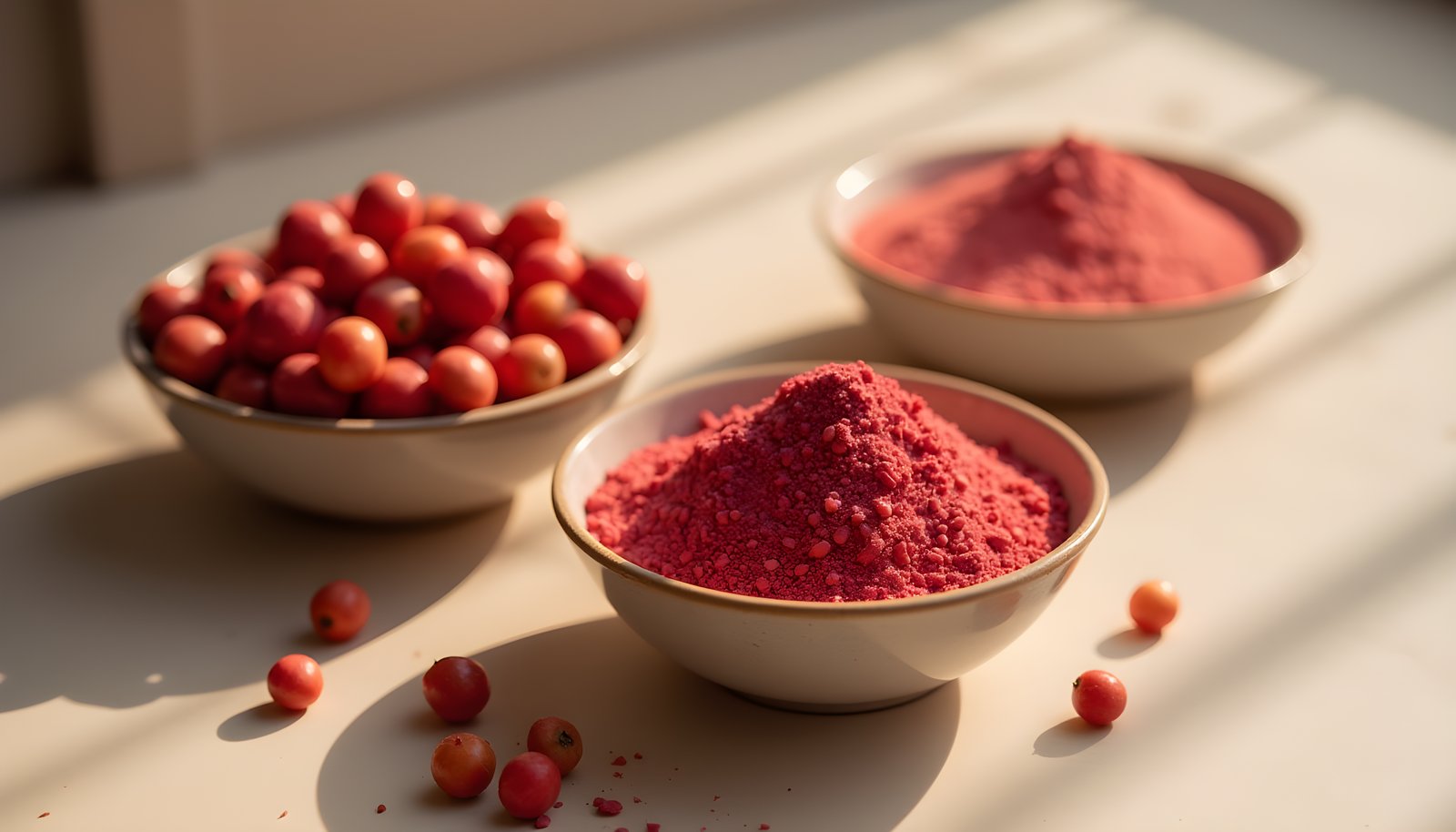
Camu camu, Myrciaria dubia, is a small round fruit from shrubs that grow along rivers and flooded forest in the Amazon basin. Ripe fruit turns from green to reddish purple, and the pulp is sharply sour, with a pH of about 2.6 in a 2013 Brazilian analysis.
A 2023 review in ACS Omega covers the fruit as fresh pulp, frozen pulp, juice and dried powder. Outside South America, the powder is the form you’re most likely to find.
That matters for fiber, because the form changes the numbers a lot. Juice loses most of the solids, while a powder concentrates whatever the dried fruit kept.
Camu camu fiber in the fresh pulp
The clearest fiber data comes from that same 2013 study in Anais da Academia Brasileira de Ciências, which analyzed pulp from fruit grown near Manaus. It measured 1.23 grams of total dietary fiber per 100 grams of pulp.
The same pulp was 92.65% water, with just 0.29 grams of protein and 0.05 grams of fat. Like a melon, camu camu is mostly liquid held together by a thin skin.
| Camu camu pulp, per 100 g | Amount |
|---|---|
| Water | 92.65 g |
| Total dietary fiber | 1.23 g |
| Soluble fiber | 0.73 g |
| Insoluble fiber | 0.48 g |
| Reducing sugars | 4.4 g |
| Protein | 0.29 g |
| Fat | 0.05 g |
| Vitamin C | 862 mg |
An older study from Paraná State, published in Archivos Latinoamericanos de Nutrición in 2000, found a similar picture: 94.1% water and only 3.5 grams of carbohydrate per 100 grams of pulp. That team reported crude fiber, a narrower lab measure than the dietary fiber you see on labels, so its 0.1 gram figure isn’t directly comparable.
Soluble fiber makes up most of it
Of the 1.23 grams in that pulp sample, 0.73 grams was soluble and 0.48 grams insoluble. That’s roughly a 60 to 40 split in favor of the soluble side.
Soluble fiber dissolves in water and turns into a gel as it moves through your gut. Insoluble fiber stays intact and adds bulk instead.
The study measured pulp alone, without the skin or seeds. Powders that include the peel could have a somewhat different balance, but published numbers for whole fruit powder are scarce.
Camu camu powder fiber, worked out
Most camu camu powder fiber estimates start from the same idea: drying removes the water and keeps everything else. In the 2013 pulp sample, only about 7.35 grams out of every 100 were solids, and 1.23 grams of those solids were fiber.
That puts fiber at roughly 17% of the dry matter. If a powder were nothing but dried pulp, 100 grams of it would carry about 17 grams of fiber by that math.
Real servings are much smaller. The table below assumes a teaspoon of fine fruit powder weighs about 3 grams:
| Amount of pure pulp powder (estimate) | Fiber | % of 28 g Daily Value |
|---|---|---|
| 1 teaspoon (about 3 g) | about 0.5 g | 2% |
| 2 teaspoons (about 6 g) | about 1 g | 4% |
| 1 tablespoon (about 9 g) | about 1.5 g | 5% |
| 100 g | about 17 g | 61% |
These are our estimates from the published pulp numbers, not lab values for a specific product. Spray dried powders often include a carrier such as maltodextrin, which dilutes the fiber further, so check the Nutrition Facts panel on yours.
Want to see how half a gram fits into your own day? Our fiber calculator turns your age and sex into a personal target in a few seconds.
Why the vitamin C gets all the attention
Camu camu is famous because of its vitamin C fiber pairing, though the vitamin carries almost all the weight. The 2013 pulp contained about 862 milligrams per 100 grams, while the Paraná study reported 1.41 grams, or 1,410 milligrams.
The ACS Omega review collected values from many studies and found even higher figures, including about 1,882 milligrams per 100 grams of pulp. Numbers swing widely with ripeness, growing region and how long the fruit was stored.
Storage clearly matters. In the Paraná study, frozen pulp lost about 23% of its vitamin C in the first 28 days and about 26% after 335 days.
For scale, the FDA sets the Daily Value for vitamin C at 90 milligrams. The NIH Office of Dietary Supplements lists a medium orange at 70 milligrams and a medium kiwifruit at 64.
Camu camu compared with other fruit and powders
Here’s how camu camu stacks up against everyday fruit and familiar fiber add ins, using the Dietary Guidelines food source list for the fiber values:
| Food | Portion | Fiber | Vitamin C |
|---|---|---|---|
| Camu camu pulp | 100 g | 1.2 g | about 860 to 1,880 mg |
| Camu camu powder (estimate) | 1 teaspoon | about 0.5 g | varies by product |
| Orange | 1 medium | 3.7 g | 70 mg |
| Kiwifruit | 1 cup | 5.4 g | 1 medium has 64 mg |
| Strawberries | 1 cup | 3.0 g | 1/2 cup sliced has 49 mg |
| Raspberries | 1 cup | 8.0 g | not listed |
| Chia seeds | 1 tablespoon | 4.1 g | not listed |
For fiber, the winner is obvious: a tablespoon of chia seeds or a cup of raspberries gives you several times what a camu camu serving offers. An ordinary orange covers both jobs reasonably well, with almost 4 grams of fiber and most of a day’s vitamin C.
Camu camu wins only on vitamin C per gram. If that’s what you’re after, it does the job in a tiny scoop, but it won’t move your fiber total much.
Comparing camu camu with other vitamin C powders and fiber supplements? Our comparison charts lay the popular options out side by side.
What the research says about immune support and more
Marketing often links camu camu with immune support, mainly through vitamin C. The NIH Office of Dietary Supplements notes that vitamin C helps immune function, and that people who smoke need 35 milligrams more per day than nonsmokers.
Human research on the fruit itself is small. The ACS Omega review summarizes a trial in which smokers who drank camu camu juice showed lower markers of inflammation and oxidative stress, and another in which 23 healthy adults had lower blood glucose after a meal when they drank 300 milliliters of the juice.
A study of 58 adults with obesity, also covered in the review, found lower blood pressure and triglycerides with freeze dried camu camu. These are early results, and none of them point to fiber as the reason.
The review also notes that camu camu’s polyphenols, including ellagitannins, appear to work partly through gut bacteria in animal studies. That’s a gut health angle worth watching, though it isn’t the same as the fruit being a fiber source.
One smoothie, before and after a few swaps
Picture a smoothie made with a cup of water, a banana and a teaspoon of camu camu powder. The banana brings about 3.2 grams of fiber, according to the Dietary Guidelines list, and the camu camu adds about half a gram.
Now keep the camu camu and the banana, and add a cup of frozen raspberries and a tablespoon of chia. The fiber jumps to roughly 15.8 grams, more than half of the 28 gram Daily Value.
The camu camu still does what it’s good at, the tart flavor and the vitamin C. The fruit and seeds do the fiber work.
Looking for more smoothies and breakfast bowls that pair tart powders with high fiber fruit? Our recipe eBooks have plenty of easy ideas.
How to read a camu camu label
- Check the ingredient list. Pure products list only camu camu; spray dried ones may add maltodextrin or another carrier.
- Find the fiber line. A teaspoon serving will often show 0 or 1 gram, which matches the estimate above.
- Note the vitamin C. Values can run several times the Daily Value per serving, so start with the small scoop on the label.
- Store it sealed and dry. Vitamin C breaks down over time, as the frozen storage data showed, so older powder may deliver less.
- Count the rest of the bowl. Whatever you mix it into will set your fiber total far more than the powder will.
The one thing to watch with camu camu
The biggest caveat with camu camu isn’t fiber at all, it’s the dose of vitamin C. The NIH sets the upper limit for adults at 2,000 milligrams a day from food and supplements combined, and notes that large amounts can cause diarrhea, nausea and cramps.
A couple of teaspoons of a strong powder, plus a vitamin C supplement and a glass of juice, can add up faster than you’d think. Stick close to the label serving, count camu camu as your vitamin C source for the day, and leave the fiber job to beans, berries, oats and seeds.
Camu camu questions, answered
Is camu camu high in fiber?
No. Fresh pulp has about 1.2 grams of fiber per 100 grams, and a teaspoon of powder adds only around half a gram.
How much fiber is in camu camu powder?
It depends on the product, but pure dried pulp works out to roughly 17 grams per 100 grams. A typical 3 gram teaspoon gives about 0.5 grams, and powders with added carriers give less.
Is the fiber in camu camu soluble or insoluble?
Mostly soluble. One pulp analysis found 0.73 grams soluble and 0.48 grams insoluble out of 1.23 grams total.
How much vitamin C does camu camu have?
Studies report roughly 860 to 1,900 milligrams per 100 grams of fresh pulp. That’s several times the FDA’s 90 milligram Daily Value.
Does camu camu support immune health?
Its vitamin C does play a role in immune function, according to the NIH. Studies on the fruit itself are small, such as a trial in smokers that found lower inflammation markers after drinking the juice.
Can camu camu upset your stomach?
Yes, in large amounts. The adult upper limit for vitamin C is 2,000 milligrams a day, and going over it can cause diarrhea and cramps.
What’s a better fiber source than camu camu?
Almost any whole fruit or seed. A cup of raspberries has 8.0 grams and a tablespoon of chia has 4.1 grams.
Sources
- Nascimento OV, Boleti APA, Yuyama LKO, Lima ES. “Effects of diet supplementation with Camu-camu (Myrciaria dubia HBK McVaugh) fruit in a rat model of diet-induced obesity.” Anais da Academia Brasileira de Ciências. 2013. scielo.br
- Justi KC, Visentainer JV, de Souza NE, Matsushita M. “Nutritional composition and vitamin C stability in stored camu-camu (Myrciaria dubia) pulp.” Archivos Latinoamericanos de Nutrición. 2000. pubmed.ncbi.nlm.nih.gov
- García-Chacón JM, Marín-Loaiza JC, Osorio C. “Camu Camu (Myrciaria dubia (Kunth) McVaugh): An Amazonian Fruit with Biofunctional Properties, A Review.” ACS Omega. 2023. pmc.ncbi.nlm.nih.gov
- National Institutes of Health, Office of Dietary Supplements. “Vitamin C: Fact Sheet for Health Professionals.” 2025. ods.od.nih.gov
- U.S. Department of Agriculture and U.S. Department of Health and Human Services. “Food Sources of Dietary Fiber.” Dietary Guidelines for Americans, 2020 to 2025. dietaryguidelines.gov
- U.S. Food and Drug Administration. “Daily Value on the Nutrition and Supplement Facts Labels.” 2024. www.fda.gov