
In this article
- Freezing food fiber: what the research shows
- Why thawed food goes soft when the fiber doesn’t
- Blanching: the quick step before the freezer
- Freezer storage nutrition: what fades over months
- Freezing bread changes more than you’d expect
- Frozen meals fiber content starts with the ingredients
- Freezer habits that protect quality
- How frozen food fits your daily fiber
- What the research still needs to answer
- Freezing and fiber: what people want to know
- Sources
You pull a bag of strawberries out of the freezer, let them thaw, and they slump into a soft, juicy heap. It looks like something broke down, and it did, but not the part you might worry about.
Freezing food fiber stays remarkably steady. A UC Davis review of fresh, frozen and canned produce found that most studies reported no significant changes in crude or dietary fiber after freezing.
The soft texture comes from ice, not from lost fiber. Below is what the freezer actually does to your food, what it leaves alone and the few habits that keep frozen food at its best.
Freezing food fiber: what the research shows
The most useful evidence comes from Rickman and colleagues, who pulled together decades of studies for the Journal of the Science of Food and Agriculture in 2007. Their verdict on fiber was that changes during processing, storage and cooking “appear to be minimal for intact fruits and vegetables.”
One study they covered, by Makhlouf and coworkers, tested corn, peas, green beans and yellow beans. Soluble, insoluble and total fiber all held steady after freezing, so neither type of fiber was singled out.
That split matters. Soluble fiber dissolves in water and forms a gel, while insoluble fiber adds bulk and helps food move through your gut. A freezer that kept one but damaged the other would change how your food works, and that isn’t what researchers found.
The review also tested long storage. White asparagus kept in the freezer for 10 months showed no significant change in dietary fiber on a dry weight basis.
Why thawed food goes soft when the fiber doesn’t
Much of the fiber in fruits and vegetables sits in their cell walls, the tough outer layer of each plant cell. When food freezes, the water inside those cells turns to ice and expands.
Extension specialists at North Dakota State University point out that slow freezing creates large, disruptive ice crystals. Those crystals can damage the cell structure, which is why thawed berries and spinach turn limp and watery.
A ruptured cell is still made of the same carbohydrates, though. The fiber molecules are present in the same amounts; they’re just arranged in a softer, wetter structure.
That’s also why frozen fruit works so well in blended or cooked dishes. Texture is the only casualty, and a smoothie, sauce or batch of oatmeal hides it completely.
A note on numbers that shift
Sometimes a frozen product shows a slightly different fiber number than its fresh version. In one study of fiddlehead greens, frozen samples showed crude fiber about 7 to 8% lower by wet weight, and the researchers put that down to the frozen greens holding more water.
Extra water dilutes the fiber per gram without removing any. Compare by the portion you eat, not only by the per 100 gram line.
Blanching: the quick step before the freezer
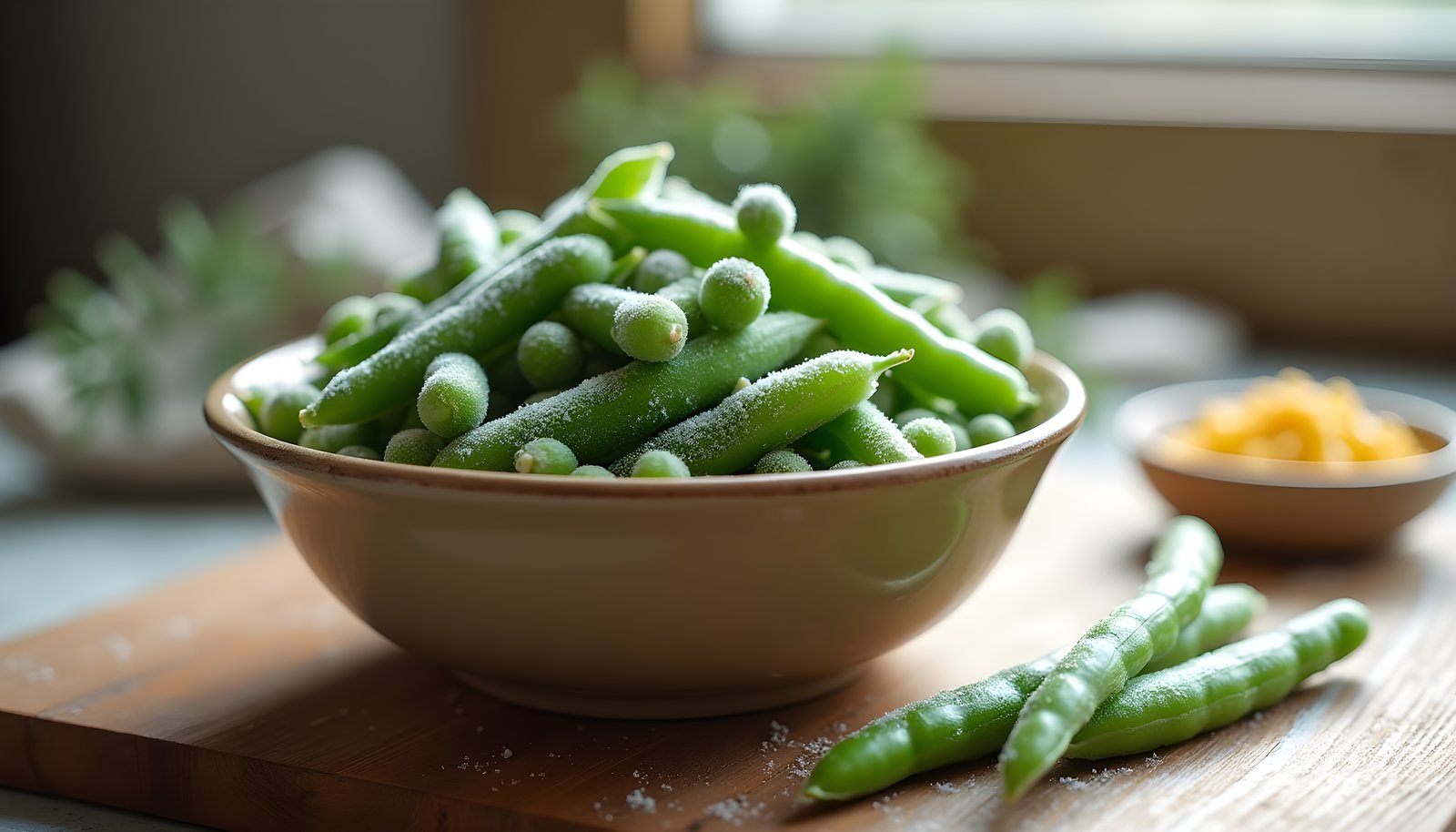
Most frozen vegetables are blanched first, meaning they’re dipped briefly in boiling water or steam. The UC Davis review explains that this step inactivates natural enzymes that could otherwise stay active in the frozen product.
Blanching is a heat step, so it’s fair to ask whether it costs any fiber. The review notes that heat can change how soluble fiber is and alter some of its physical properties, but the frozen corn, peas and beans in the Makhlouf study still came out with unchanged fiber totals.
Minerals hold up well too. The review reports that some minerals can be lost to the blanching water, but retention is generally high, at 78 to 91%.
Fruits, by contrast, usually aren’t blanched before freezing. That’s one reason frozen berries and mango cubes can go straight from the bag into a bowl.
Freezer storage nutrition: what fades over months
Fiber is the sturdy part of the picture. Vitamin C is the fragile part, and the freezer slows its decline without stopping it completely.
The first half of the UC Davis review gathered vitamin C losses for vegetables frozen at about -20°C for a full year:
| Vegetable | Vitamin C lost after 12 months frozen | Fiber (review’s overall finding) |
|---|---|---|
| Broccoli | About 10% | Minimal change for intact produce |
| Green peas | About 10% | Minimal change for intact produce |
| Green beans | About 20% | Minimal change for intact produce |
| Spinach | About 30% | Minimal change for intact produce |
| White asparagus | Minimal | No significant change after 10 months |
The vitamin C figures are on a dry weight basis. The authors concluded that frozen products lose fewer nutrients up front but can lose more during long storage, mainly through oxidation, a slow reaction with oxygen.
The one fiber outlier
Not every food behaves the same. Fiddlehead greens frozen for 10 months lost about 25% of their crude fiber by wet weight, and the researchers suggested that heat during processing may have broken down part of the cell wall carbohydrates.
Fiddleheads are an unusual wild green, and the review stressed that fiber stability depends on the food. For the everyday vegetables in most freezers, the data points to fiber that stays put.
Freezing bread changes more than you’d expect
Starchy foods add an interesting twist. In a 2008 study in the European Journal of Clinical Nutrition, Burton and Lightowler fed 10 healthy adults white bread prepared four ways and measured their blood sugar response over two hours.
| Homemade white bread | Blood sugar response vs fresh |
|---|---|
| Fresh | Baseline |
| Toasted | About 25% lower |
| Frozen, then defrosted | About 31% lower |
| Frozen, defrosted, then toasted | About 39% lower |
The commercial loaf they tested showed a similar pattern, with a drop of about 26% after freezing, defrosting and toasting. The percentages here are worked out from the study’s reported values.
Researchers have shown that cooked starch can reorganize into resistant starch as it cools, a form that resists digestion and behaves somewhat like fiber. The bread study measured blood sugar rather than fiber, so the grams of fiber on your bread label don’t change. What changes is how quickly your body turns that slice into glucose.
Curious how many grams your own day should hold? Our fiber calculator sets a number for you from a few quick details.
Frozen meals fiber content starts with the ingredients
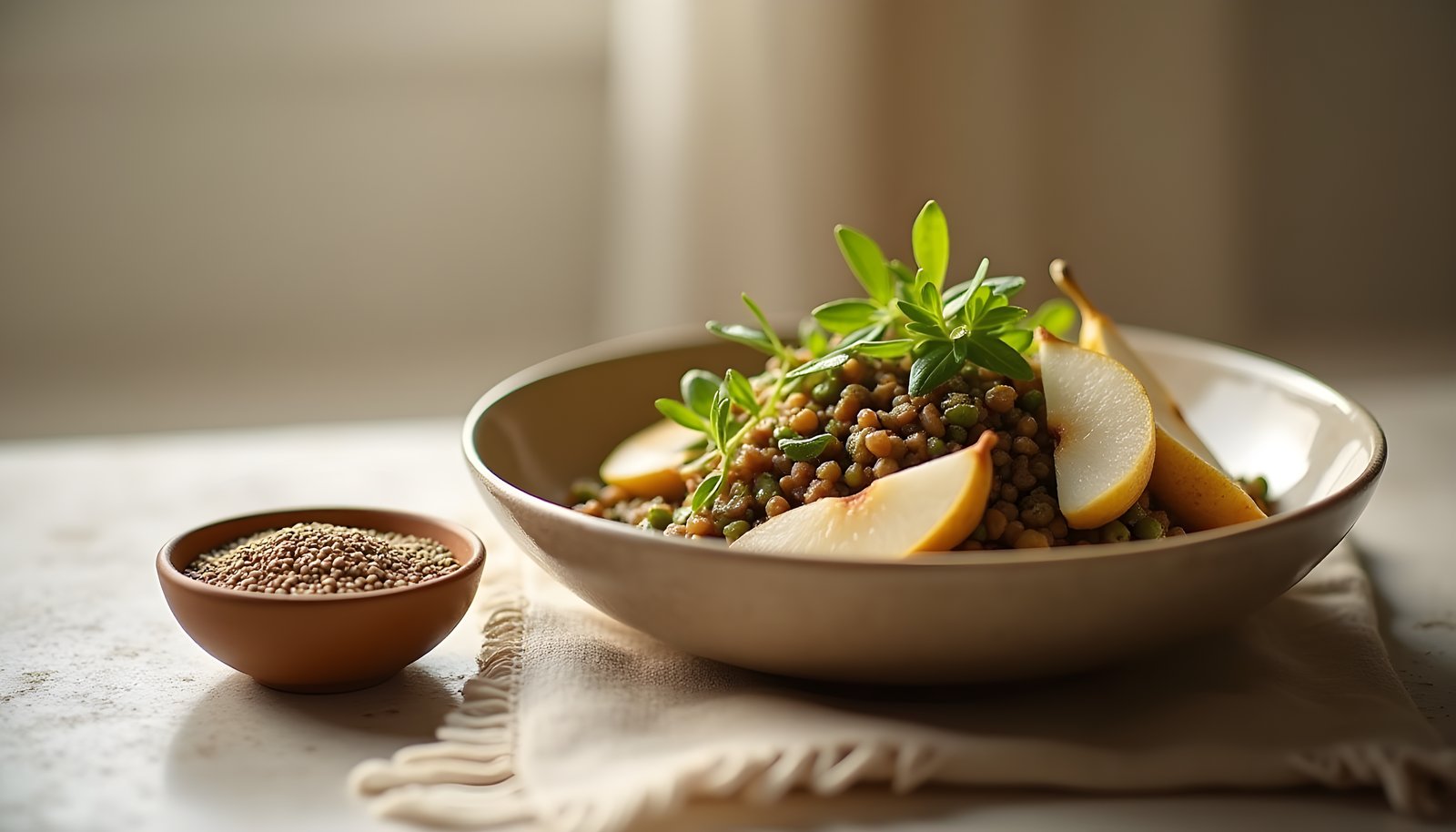
If freezing doesn’t change fiber, then a frozen dinner can only have as much fiber as its ingredients bring. A tray built on beans, lentils, whole grains and vegetables keeps all of it, while one built on refined pasta and cheese stays low no matter how well it was frozen.
The same review found that products with peels or outer layers removed had less fiber than their unprocessed versions. So the processing steps that come before freezing, like peeling potatoes for fries, matter far more than the freezer itself.
The Dietary Fiber line on the Nutrition Facts panel tells you what’s in the package. Freezing won’t add to that number, and it won’t take anything away.
Freezer habits that protect quality
Since fiber takes care of itself, the habits that matter are about texture, flavor and vitamins. NDSU’s food storage guidance covers the basics:
- Keep the freezer at 0°F (-18°C) or colder for long storage.
- Freeze in shallow containers so food freezes faster; food about 2 inches thick should freeze through in about two hours.
- Wrap food tightly or use airtight containers. Freezer burn, the grayish brown leathery spots, happens when air reaches the food’s surface.
- Thaw in the refrigerator, in cold water or in the microwave, never on the counter.
- Use older packages first, since quality suffers with lengthy freezer storage.
Freezer burn is a quality problem rather than a safety one, according to NDSU. It dries out the surface but doesn’t make food unsafe to eat.
Planning to batch cook beans, soups and grains for the freezer? Our recipe eBooks are full of high fiber dishes that freeze and reheat well.
How frozen food fits your daily fiber
Mayo Clinic suggests about 25 grams of fiber a day for women 50 and younger and 38 grams for men, with lower targets after 50. Frozen fruits, vegetables and beans count toward that total just like fresh ones.
Mayo also recommends raising fiber gradually and drinking plenty of water, since a sudden jump can bring gas and bloating. If a freezer stocked with beans and vegetables is new for you, add one extra serving a day and build from there.
If your stomach needs a gentler path to more fiber, our gut health guides lay out a slower, step-by-step plan.
What the research still needs to answer
The evidence on freezing and fiber is reassuring, but it’s also older than you might expect. The UC Davis authors noted that recent data on how processing affects dietary fiber is limited, and much of what they reviewed measured crude fiber rather than total dietary fiber.
Newer studies using modern dietary fiber methods, and looking at how frozen and thawed fiber behaves in the gut, would fill that gap. Until then, the best available data says your freezer is one of the safest places to keep fiber.
Freezing and fiber: what people want to know
Can vegetables lose fiber if they stay frozen for months?
Mostly no. In the studies reviewed by UC Davis researchers, white asparagus showed no significant fiber change after 10 months frozen, and only an unusual wild green, fiddleheads, lost about 25%.
Why is thawed fruit mushy if the fiber is still there?
Ice crystals form inside the cells, expand and break some cell walls open. The fiber stays, but the structure softens and releases water as it thaws.
Does blanching vegetables before freezing remove fiber?
Not in a meaningful way. Frozen corn, peas, green beans and yellow beans that were blanched showed no significant change in soluble, insoluble or total fiber.
Does freezing bread make it healthier?
It can lower the blood sugar response. In a 2008 study, homemade white bread that was frozen, defrosted and toasted raised blood sugar about 39% less than fresh bread, though its fiber grams didn’t change.
Is freezer-burned food still safe to eat?
Yes. NDSU explains that freezer burn is caused by air reaching the food’s surface and affects quality, not safety.
What temperature should my freezer be for long storage?
Set it to 0°F (-18°C) or colder. That temperature preserves food for extended periods, though quality slowly declines over time.
Do frozen vegetables count toward my daily fiber goal?
Yes. Frozen fruits, vegetables and beans keep their fiber, so they count toward the roughly 25 to 38 grams a day that Mayo Clinic suggests for adults.
Sources
- Rickman JC, Bruhn CM, Barrett DM. “Nutritional comparison of fresh, frozen, and canned fruits and vegetables II. Vitamin A and carotenoids, vitamin E, minerals and fiber.” Journal of the Science of Food and Agriculture. 2007. ucanr.edu
- Rickman JC, Barrett DM, Bruhn CM. “Nutritional comparison of fresh, frozen and canned fruits and vegetables. Part 1. Vitamins C and B and phenolic compounds.” Journal of the Science of Food and Agriculture. 2007. ucanr.edu
- Burton P, Lightowler HJ. “The impact of freezing and toasting on the glycaemic response of white bread.” European Journal of Clinical Nutrition. 2008. nature.com
- Garden-Robinson J, Lyonga AN. “Questions and Answers About Storing Food in the Freezer (FN1465).” NDSU Extension. 2025. ndsu.edu
- Sonia S, Witjaksono F, Ridwan R. “Effect of cooling of cooked white rice on resistant starch content and glycemic response.” Asia Pacific Journal of Clinical Nutrition. 2015. pubmed.ncbi.nlm.nih.gov
- Mayo Clinic Staff. “Dietary fiber: Essential for a healthy diet.” Mayo Clinic. 2024. mayoclinic.org