
In this article
- Leeks fiber, raw vs boiled
- Leek nutrition beyond the fiber
- Fructans: the leek carbohydrate worth knowing
- Leeks vs other allium vegetables
- The dark leek greens are worth keeping
- Building fiber foods around leeks
- A quick leek prep checklist
- What leeks fiber does for digestion
- Leeks, onions or scallions: a quick guide
- The edge case: leeks and a sensitive gut
- Common questions about leeks
- Sources
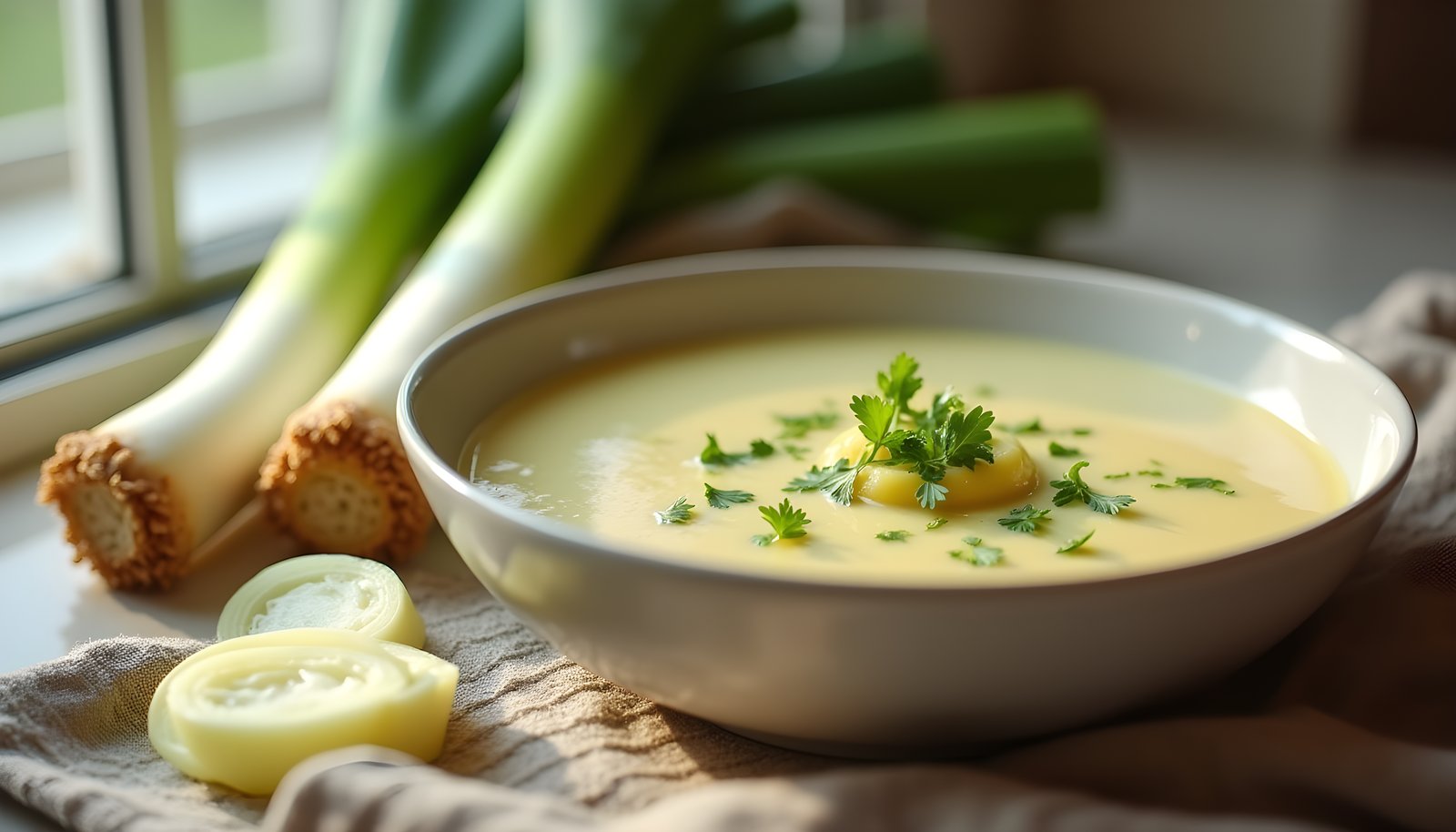
You trim the roots, slice off the dark green tops, rinse out the grit and slide a pale green pile into a pot of butter or oil. That pile, about one leek’s worth, holds roughly 1.6 grams of fiber if it’s raw, and a little less once it’s boiled.
So yes, leeks have fiber, but not a lot. What makes leeks fiber interesting is the type of carbohydrate that comes with it, and how leeks stack up against their allium relatives.
Leeks fiber, raw vs boiled
USDA FoodData Central lists the bulb and lower leaf of a raw leek at 1.8 grams of fiber per 100 grams and 61 calories. Boiled and drained, the same part comes in at 1.0 gram and 31 calories per 100 grams.
| Leeks (bulb and lower leaf) | Serving | Fiber | % DV (28 g) | Calories |
|---|---|---|---|---|
| Raw | 1 leek or 1 cup chopped (89 g) | 1.6 g | 6% | 54 |
| Raw | 100 g | 1.8 g | 6% | 61 |
| Boiled, drained | 1 leek (124 g) | 1.2 g | 4% | 38 |
| Boiled, drained | 100 g | 1.0 g | 4% | 31 |
USDA weighs a boiled leek at 124 grams and a raw one at 89 grams, so per leek the gap is smaller than the per 100 gram numbers suggest. A cooked leek still keeps about three quarters of the raw leek’s fiber.
A newer USDA Foundation record measured leeks with the green tops included and the root removed. It lists 3.0 grams of fiber per 100 grams, though it was analyzed differently from the older record, so the two aren’t a perfect match.
Either way, a typical portion lands between 1 and 2 grams. That’s useful, but it won’t carry a meal on its own.
Leek nutrition beyond the fiber
Using USDA’s raw record, one leek (89 g) also provides about:
- Vitamin K: 42 mcg, about 35% of the Daily Value
- Manganese: 0.43 mg, about 19% DV
- Folate: 57 mcg DFE, about 14% DV
- Vitamin C: 11 mg, about 12% DV
- Vitamin B6: 0.21 mg, about 12% DV
- Copper: 0.11 mg, about 12% DV
- Iron: 1.9 mg, about 10% DV
Boiling brings some of these down per leek. USDA’s boiled record shows about 32 mcg of vitamin K (26% DV) and 0.31 mg of manganese (14% DV) in one cooked leek.
A raw leek has about 12.6 grams of carbohydrate and 3.5 grams of sugar. Subtract the fiber and you get about 11 grams of net carbs. Per 100 grams that’s about 12.4 grams, higher than raw onion at about 7.6 grams.
Fructans: the leek carbohydrate worth knowing
Leeks belong to the allium family, alongside onions, garlic, shallots and scallions. Monash University’s FODMAP program lists leek among the vegetables particularly rich in fructans.
Fructans are chains of fructose sugar molecules joined together. They’re one of the FODMAPs, a group of carbohydrates that Monash’s diet program limits for people with irritable bowel syndrome.
For most people, fructans are simply part of what makes alliums a varied source of plant carbohydrates. For people with IBS, they’re the reason leeks may need to be tested in small portions.
Leeks vs other allium vegetables
Among the alliums, leeks sit in the middle for fiber. Here’s how USDA’s raw figures compare per 100 grams and per typical portion.
| Raw allium | Fiber per 100 g | Calories per 100 g | Typical portion | Fiber per portion |
|---|---|---|---|---|
| Scallions | 2.6 g | 32 | 1 cup chopped (100 g) | 2.6 g |
| Leeks | 1.8 g | 61 | 1 leek (89 g) | 1.6 g |
| Onion | 1.7 g | 40 | 1 medium (110 g) | 1.9 g |
Leeks carry slightly more fiber per gram than onions but have more calories per 100 grams. Scallions win on both counts: more fiber and fewer calories.
Cooked, the Dietary Guidelines list a cup of cooked onions at 2.9 grams of fiber and 92 calories. Alliums are flavor builders more than fiber builders, and that’s how they work best on a plate.
Where leeks land in a nutrient density ranking
A 2014 study in the CDC journal Preventing Chronic Disease scored 47 fruits and vegetables for nutrient density per 100 calories. Leeks ranked 40th with a score of 10.69, just over the cutoff of 10 needed to count as a powerhouse vegetable.
Scallions ranked 22nd with 27.35. Onions and garlic did not reach the cutoff at all, which puts leeks ahead of both in that analysis.
Fiber per calorie
Per 100 calories, raw leeks provide about 3.0 grams of fiber. Raw onions give about 4.3 grams and raw scallions about 8.1 grams.
Compare that with cooked broccoli, which the Dietary Guidelines list at 5.2 grams for 54 calories per cup, or roughly 9.6 grams per 100 calories. Leeks are a flavor ingredient first and a fiber source second.
The dark leek greens are worth keeping
Most recipes tell you to use only the white and pale green parts. The dark green tops are tougher, but they’re edible, and USDA’s record that includes them shows the higher fiber figure of 3.0 grams per 100 grams.
If you don’t want them in the main dish, slice them thin and simmer them longer, or add them to a pot of stock with other vegetable trimmings. Either way you keep more of the plant you paid for.
Building fiber foods around leeks
Since a leek brings 1 to 2 grams, the smart move is to pair it with fiber foods that do the heavy lifting. Picture a pot of potato leek soup made with two boiled leeks, two medium potatoes with the skins on and half a cup of white beans, split into two bowls.
The leeks supply about 2.5 grams in total. The Dietary Guidelines list a medium baked potato with skin at 3.9 grams and half a cup of white beans at 5.7 grams, so the pot reaches about 16 grams, roughly 8 grams per bowl.
| Fiber food to pair with leeks | Amount | Fiber (DGA) |
|---|---|---|
| Lentils, cooked | 1/2 cup | 7.8 g |
| Split peas, cooked | 1/2 cup | 8.2 g |
| White beans | 1/2 cup | 5.7 g |
| Potato, baked with skin | 1 medium | 3.9 g |
| Barley, cooked | 1/2 cup | 3.0 g |
Swap the white beans for split peas or lentils and the bowl climbs higher still. Half a cup of split peas alone adds 8.2 grams, more than five leeks’ worth of fiber.
Want more soups and stews built this way? Our recipe eBooks are full of easy, high fiber meals.
A quick leek prep checklist
- Trim off the roots and the toughest dark green tops
- Slice the leek lengthwise and rinse between the layers
- Slice the white and pale green parts into half moons
- Save the tops for stock if you don’t plan to eat them
- Pair the cooked leeks with beans, lentils, potatoes or whole grains
What leeks fiber does for digestion
The fiber in leeks works like fiber from other vegetables. Mayo Clinic explains that fiber increases the weight and size of stool and softens it, which makes it easier to pass and helps prevent constipation.
Mayo Clinic suggests about 21 to 25 grams of fiber a day for women and 30 to 38 grams for men. One raw leek covers about 6 to 8% of a woman’s target, so it’s a contributor rather than a cornerstone.
Mayo describes two types of fiber. Soluble fiber dissolves in water to form a gel-like material that can help lower blood cholesterol and glucose levels, and insoluble fiber helps material move through your digestive system. Vegetables supply both.
Mayo Clinic also notes that high fiber foods tend to be more filling, so you may eat less and stay satisfied longer. A leek on its own won’t do much there, but a leek and bean soup can.
Mayo also notes that adding fiber too quickly can cause gas, bloating and cramping. Build up gradually and drink plenty of water as you go.
Not sure where your own target sits? Our fiber calculator works it out in seconds.
Leeks, onions or scallions: a quick guide
If you want the most fiber per bite, scatter raw scallions generously. A cup of chopped scallions has about 2.6 grams.
If you want a mild, sweet base for soups, braises and gratins, use leeks. If you want the standard savory start to most dishes, a medium onion gives you about 1.9 grams.
And if you can use all three in one week, you get a little fiber from each and a lot of flavor across your meals.
The edge case: leeks and a sensitive gut
For people following a low FODMAP plan, leeks call for caution. Monash University places leek in the same fructan rich group as garlic, onion and spring onion.
If fructans bother you, a high fiber diet built around leek soup may cause more discomfort than it solves. In that case, lean on fiber sources that aren’t on Monash’s fructan list and test leeks in small portions.
If your gut needs a gentler plan for adding fiber, our guides walk you through it step by step.
Common questions about leeks
How much fiber is in one leek?
About 1.6 grams. USDA lists a raw leek (bulb and lower leaf, 89 g) at roughly 1.6 grams of fiber and 54 calories.
Do cooked leeks have less fiber?
Slightly less per leek. USDA lists a boiled leek at about 1.2 grams of fiber, compared with about 1.6 grams for a raw one.
Are leeks healthier than onions?
They’re close for fiber, with 1.8 grams per 100 grams versus 1.7 for onions. Leeks ranked above onions in a 2014 nutrient density study published by the CDC.
What vitamins are in leeks?
Leeks provide vitamin K, folate, vitamin C and vitamin B6. One raw leek supplies about 35% of the Daily Value for vitamin K.
Are leeks low FODMAP?
No. Monash University lists leek among the vegetables particularly rich in fructans, along with garlic, onion and spring onion.
How many calories are in leeks?
About 54 calories in a raw leek and about 38 in a boiled leek, based on USDA data.
Can you eat the green part of leeks?
Yes. A USDA record that includes the green tops lists about 3.0 grams of fiber per 100 grams of raw leek.
Sources
- USDA Agricultural Research Service. FoodData Central: SR Legacy Leeks, raw (169246); Leeks, cooked, boiled, drained, without salt (168426); Foundation Leeks, bulb and greens, root removed, raw (2727584); Onions, spring or scallions, raw (170005); Onions, raw (170000). 2019 to 2026. fdc.nal.usda.gov
- U.S. Department of Agriculture and U.S. Department of Health and Human Services. “Food Sources of Dietary Fiber.” Dietary Guidelines for Americans, 2020 to 2025. dietaryguidelines.gov
- U.S. Food and Drug Administration. “Daily Value on the Nutrition and Supplement Facts Labels.” 2024. fda.gov
- Monash University. “High and low FODMAP foods.” Monash FODMAP. monashfodmap.com
- Di Noia J. “Defining Powerhouse Fruits and Vegetables: A Nutrient Density Approach.” Preventing Chronic Disease. 2014. cdc.gov
- Mayo Clinic Staff. “Dietary fiber: Essential for a healthy diet.” Mayo Clinic. 2025. mayoclinic.org