
In this article
- Watercress fiber by the numbers
- Watercress nutrition: the real payoff
- Why watercress tops superfood greens rankings
- Watercress vs other leafy greens for fiber
- Raw or cooked watercress?
- Pairing watercress with fiber rich plants
- What watercress fiber does for your gut
- Watercress on a low calorie plate
- What the powerhouse research still needs to show
- Watercress questions people ask
- Sources
Watercress scored a perfect 100 in a CDC-published ranking of 47 nutrient dense fruits and vegetables, beating every other food on the list. Yet a cup of chopped watercress has only about 0.2 grams of fiber.
Both facts are true, and the gap between them explains a lot about how to use this peppery green. Watercress fiber is tiny, but its vitamin K and vitamin C are not, and it costs you almost no calories to eat.
Watercress fiber by the numbers
USDA FoodData Central lists raw watercress at 0.5 grams of fiber per 100 grams, with 11 calories and about 95 grams of water. A chopped cup weighs 34 grams.
| Watercress | Serving | Fiber | % DV (28 g) | Calories |
|---|---|---|---|---|
| Raw, chopped | 1 cup (34 g) | 0.2 g | 1% | 4 |
| Raw, chopped | 2 cups (68 g) | 0.3 g | 1% | 7 |
| Raw | 100 g | 0.5 g | 2% | 11 |
| Cooked (USDA survey record) | 1 cup (142 g) | 0.7 g | 3% | 51 |
Cooking concentrates the leaves, so a cooked cup holds more watercress and a bit more fiber. Even then it stays under a gram.
USDA’s cooked figure comes from its food survey database, which describes the dish only as cooked. Its calorie count may reflect how the dish is typically prepared, so treat the raw numbers as the cleaner baseline.
Watercress nutrition: the real payoff
If fiber is not the draw, the micronutrients are. Per 100 grams of raw watercress, USDA lists about:
- Vitamin K: 250 mcg, about 208% of the Daily Value
- Vitamin C: 43 mg, about 48% DV
- Vitamin A: 160 mcg RAE, about 18% DV
- Manganese: 0.24 mg, about 10% DV
- Calcium: 120 mg, about 9% DV
- Riboflavin: 0.12 mg, about 9% DV
- Potassium: 330 mg, about 7% DV
- Vitamin E: 1.0 mg, about 7% DV
Scaled down to one chopped cup, that’s roughly 85 mcg of vitamin K (71% DV) and 15 mg of vitamin C (16% DV), plus about 41 mg of calcium.
The NIH Office of Dietary Supplements explains that vitamin K helps blood clot and supports healthy bones. It lists green leafy vegetables among the best food sources, and watercress packs an unusually large dose into a small handful.
One nutrient is surprisingly low. USDA lists only about 9 mcg of folate per 100 grams of watercress, compared with 97 mcg in raw arugula, so watercress is not the leafy green to lean on for folate.
Why watercress tops superfood greens rankings
The 2014 study, published in the CDC journal Preventing Chronic Disease, scored foods on 17 nutrients, including fiber, potassium, calcium, iron and vitamins A, C and K. Each food’s score was its average percent Daily Value per 100 calories, with each nutrient capped at 100%.
Any food scoring 10 or above earned the label powerhouse fruit or vegetable. Watercress came first at 100, followed by Chinese cabbage, chard, beet greens and spinach.
| Rank | Food | Score |
|---|---|---|
| 1 | Watercress | 100.00 |
| 2 | Chinese cabbage | 91.99 |
| 3 | Chard | 89.27 |
| 4 | Beet greens | 87.08 |
| 5 | Spinach | 86.43 |
| 10 | Collard greens | 62.49 |
| 15 | Kale | 49.07 |
| 18 | Arugula | 37.65 |
The 100 calorie catch
Scoring per 100 calories rewards foods that are extremely low in calories. At 11 calories per 100 grams, reaching 100 calories of raw watercress would take about 900 grams, or roughly 27 chopped cups.
Nobody eats that much at once. The ranking tells you watercress is very nutrient dense for its calories, which is real and useful, but it doesn’t mean a normal serving supplies much fiber.
Want to see how much fiber your own day should hold? Our fiber calculator gives you a personal target in seconds.
Watercress vs other leafy greens for fiber
Among common leafy greens, watercress sits at the low end for fiber content. Here are USDA’s raw figures per 100 grams.
| Raw leafy green | Fiber per 100 g | Calories per 100 g |
|---|---|---|
| Beet greens | 3.7 g | 22 |
| Spinach | 2.2 g | 23 |
| Romaine | 2.1 g | 17 |
| Arugula | 1.6 g | 25 |
| Iceberg | 1.2 g | 14 |
| Watercress | 0.5 g | 11 |
Cooked greens tell the same story at a larger scale. The Dietary Guidelines list a cup of cooked spinach at 4.3 grams of fiber and cooked beet greens at 4.2 grams, roughly six times the 0.7 grams in USDA’s cooked watercress cup.
Fiber per calorie doesn’t rescue it either. Raw watercress offers about 4.5 grams of fiber per 100 calories, compared with about 9.6 grams for raw spinach and nearly 17 grams for raw beet greens.
So if fiber is your goal, pick spinach, beet greens or chard as the leafy base and use watercress as a vitamin K and flavor boost on top.
Raw or cooked watercress?
USDA’s records let you compare the two forms per 100 grams. Raw watercress lists 43 mg of vitamin C, while the cooked survey record lists about 31 mg, so the raw leaves come out ahead on vitamin C.
Vitamin K and calcium hold steady. The raw record shows 250 mcg of vitamin K and 120 mg of calcium per 100 grams, and the cooked record shows 263 mcg and 125 mg.
Per cup, cooked watercress wins on volume. One cooked cup (142 g) supplies about 373 mcg of vitamin K, roughly three times the Daily Value, along with 178 mg of calcium and 488 mg of potassium.
| Per cup | Raw, chopped (34 g) | Cooked (142 g) |
|---|---|---|
| Fiber | 0.2 g | 0.7 g |
| Vitamin K | 85 mcg (71% DV) | 373 mcg (311% DV) |
| Vitamin C | 15 mg (16% DV) | 44 mg (49% DV) |
| Calcium | 41 mg (3% DV) | 178 mg (14% DV) |
| Potassium | 112 mg (2% DV) | 488 mg (10% DV) |
Fiber stays small in both forms. Choose raw when you want a crisp, peppery garnish, and cooked when you want watercress to count as a real serving of greens.
Pairing watercress with fiber rich plants
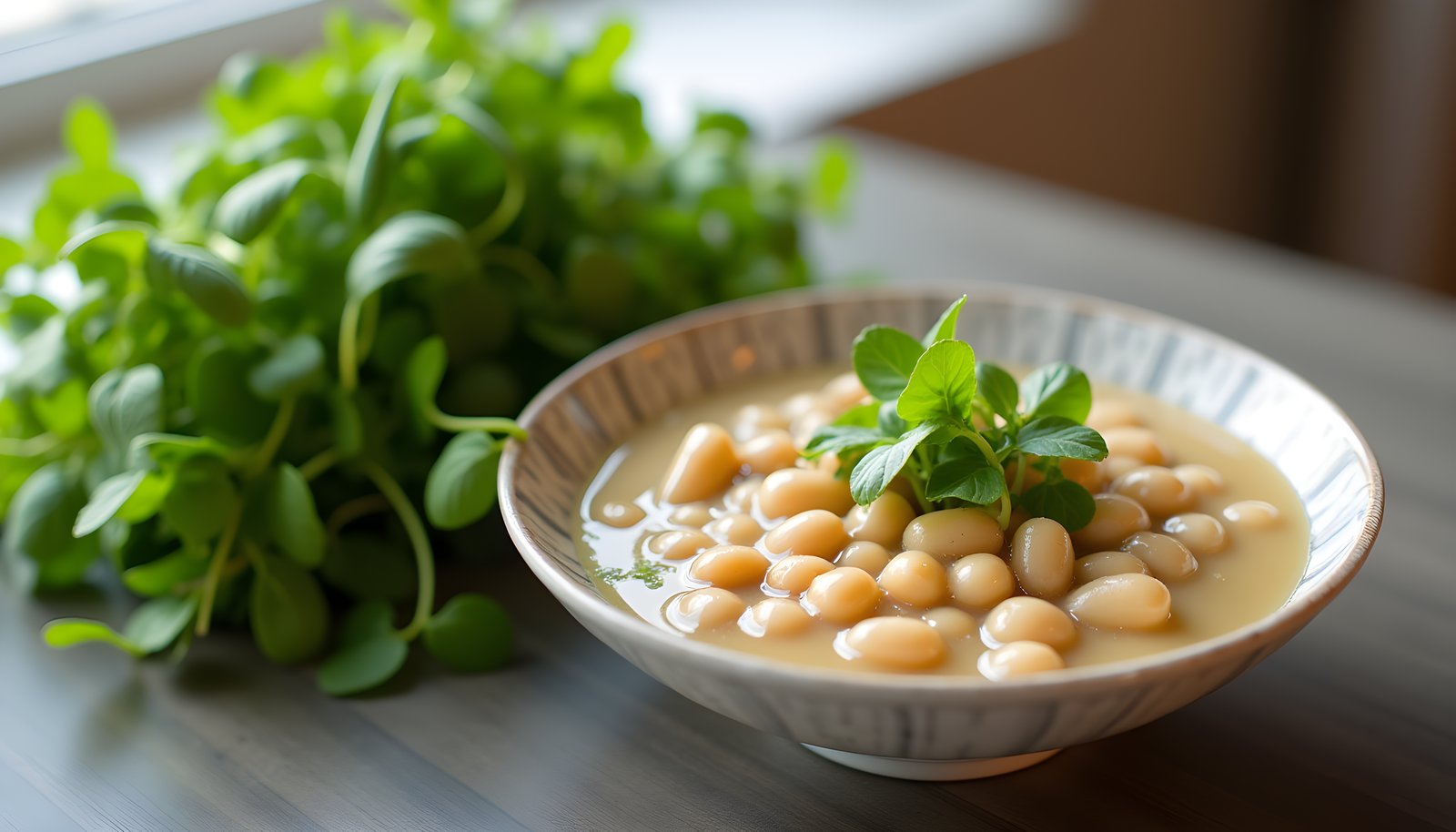
Watercress works best as the green note in a dish whose fiber comes from elsewhere. Picture a bowl of soup made with a cup of cooked watercress, half a cup of white beans and a medium baked potato with the skin.
Using the Dietary Guidelines figures, the beans add 5.7 grams and the potato 3.9 grams. With the watercress’s 0.7 grams, the bowl lands near 10.3 grams of fiber, while the greens still contribute about three times the Daily Value for vitamin K.
| Fiber rich plant to pair | Amount | Fiber (DGA) |
|---|---|---|
| Lentils, cooked | 1/2 cup | 7.8 g |
| Chickpeas | 1/2 cup | 6.3 g |
| White beans | 1/2 cup | 5.7 g |
| Avocado | 1/2 cup | 5.0 g |
| Potato, baked with skin | 1 medium | 3.9 g |
| Pear, with skin | 1/2 medium | 2.8 g |
Other easy ways to use it: scatter raw sprigs over a lentil salad, fold them into a chickpea wrap, or wilt a handful into bean soup just before serving.
Looking for more ways to build meals like this? Our recipe eBooks are full of easy, high fiber ideas.
What watercress fiber does for your gut
The small amount of fiber in watercress works the same way as fiber from other vegetables. Mayo Clinic explains that fiber adds weight and size to stool and softens it, which makes it easier to pass.
Because a serving holds so little, watercress won’t move your daily total much. Mayo Clinic suggests 21 to 25 grams a day for women and 30 to 38 grams for men, and a cup of watercress covers well under 1% of either.
That low fiber load does make it an easy green to add if your gut is sensitive. Mayo notes that increasing fiber too quickly can cause gas and bloating, and it recommends building up gradually while drinking plenty of water.
If your gut needs a steadier path to more fiber, our guides take you through it one step at a time.
Watercress on a low calorie plate
A cup of chopped raw watercress has about 4 calories and 0.4 grams of carbohydrate. It adds color, a peppery bite and a large share of vitamin K without changing your calorie or carb totals in any meaningful way.
Even two generous cups come in around 7 calories and still deliver about 142% of the Daily Value for vitamin K. That is a big dose of one vitamin for very few calories.
Mayo Clinic notes that high fiber foods tend to be more filling. Watercress alone is too light to do that job, which is another reason to pair it with beans, potatoes or whole grains.
What the powerhouse research still needs to show
The author of the 2014 ranking was clear about its limits. Scores were based on raw foods, did not include phytochemicals, and were only preliminarily validated.
Most important, the study did not test whether eating higher scoring vegetables leads to better health outcomes. That link remains to be studied, so for now the ranking is best read as a guide to nutrient density per calorie rather than proof that one green beats another for your health.
Until that research arrives, the practical takeaway is simple: enjoy watercress for its vitamins, and get your fiber from the beans, potatoes and cooked greens it pairs with.
Watercress questions people ask
How much fiber is in a cup of watercress?
Very little. A cup of chopped raw watercress weighs about 34 grams and has around 0.2 grams of fiber and 4 calories.
Is watercress the healthiest vegetable?
It ranked first in a 2014 CDC-published study of 47 fruits and vegetables, scoring 100 for nutrient density per 100 calories. That ranking reflects vitamins and minerals per calorie, not fiber per serving.
Does cooked watercress have more fiber?
Slightly. USDA lists about 0.7 grams of fiber in a cup of cooked watercress, because cooking packs more leaves into the cup.
What vitamins are in watercress?
Watercress is rich in vitamins K, C and A. 100 grams supplies about 208% of the Daily Value for vitamin K, 48% for vitamin C and 18% for vitamin A.
Is watercress better than spinach?
It depends on your goal. Raw spinach has about 2.2 grams of fiber per 100 grams versus 0.5 for watercress, while watercress has fewer calories, about 11 per 100 grams versus 23.
Is watercress good for weight loss?
It’s very low in calories, about 4 per cup. Its fiber is too low to make you feel full on its own, so pair it with beans or whole grains.
Which leafy greens have the most fiber?
Cooked greens lead. The Dietary Guidelines list cooked turnip greens at 5.0 grams per cup and cooked spinach at 4.3 grams.
Sources
- USDA Agricultural Research Service. FoodData Central: SR Legacy Watercress, raw (170068); FNDDS Watercress, cooked (2709640); Arugula, raw (169387); Beet greens, raw (170375); Spinach, raw (168462); Lettuce, cos or romaine, raw (169247); Lettuce, iceberg, raw (169248). 2019 to 2026. fdc.nal.usda.gov
- U.S. Department of Agriculture and U.S. Department of Health and Human Services. “Food Sources of Dietary Fiber.” Dietary Guidelines for Americans, 2020 to 2025. dietaryguidelines.gov
- U.S. Food and Drug Administration. “Daily Value on the Nutrition and Supplement Facts Labels.” 2024. fda.gov
- Di Noia J. “Defining Powerhouse Fruits and Vegetables: A Nutrient Density Approach.” Preventing Chronic Disease. 2014. cdc.gov
- National Institutes of Health Office of Dietary Supplements. “Vitamin K: Fact Sheet for Consumers.” 2021. ods.od.nih.gov
- Mayo Clinic Staff. “Dietary fiber: Essential for a healthy diet.” Mayo Clinic. 2025. mayoclinic.org