
In this article
- Swiss chard fiber, raw vs cooked
- Swiss chard nutrition: a lot of plant nutrients in one cup
- How Swiss chard compares with other leafy greens
- A chard and white bean skillet, counted
- Swiss chard on a low carb plate
- Leaves, stems and colors
- What Swiss chard fiber does for digestion
- When to reach for Swiss chard
- Cook one bunch this week
- Swiss chard questions people ask
- Sources
961 milligrams of potassium. That’s what USDA lists for a single cup of boiled Swiss chard, along with about 3.7 grams of fiber, for just 35 calories.
So yes, Swiss chard fiber is real, at around 13% of the Daily Value per cooked cup. But chard’s bigger story is how many plant nutrients it packs into that cup, from vitamin K to magnesium.
Swiss chard fiber, raw vs cooked
USDA FoodData Central lists raw Swiss chard at 1.6 grams of fiber per 100 grams and boiled chard at 2.1 grams. So the cooked greens carry a little more fiber in every bite.
| Swiss chard form | Serving | Fiber | % DV (28 g) | Calories |
|---|---|---|---|---|
| Raw | 1 large leaf (48 g) | 0.8 g | 3% | 9 |
| Boiled, chopped | 1/2 cup (88 g) | 1.8 g | 7% | 18 |
| Boiled, chopped | 1 cup (175 g) | 3.7 g | 13% | 35 |
| Raw | 100 g | 1.6 g | 6% | 19 |
| Boiled | 100 g | 2.1 g | 8% | 20 |
The Dietary Guidelines’ Food Sources of Dietary Fiber list matches USDA, putting a cup of cooked chard at 3.7 grams of fiber and 35 calories. Half a cup of cooked chard gives you about 1.9 grams on the same list.
Even raw, a single large leaf brings about 398 mcg of vitamin K, more than three times the Daily Value, according to USDA. That makes a few raw leaves in a salad a meaningful addition even if their fiber is small.
Raw chard is light on fiber per leaf because a leaf weighs so little. A big bunch shrinks dramatically in the pan, so the cooked cup is where the fiber adds up.
Swiss chard nutrition: a lot of plant nutrients in one cup
Chard covers a lot of nutritional ground in one serving. Based on USDA’s boiled record, one cup of chopped chard (175 g) provides about:
- Vitamin K: 573 mcg, about 478% of the Daily Value
- Vitamin A: 536 mcg RAE, about 60% DV
- Magnesium: 151 mg, about 36% DV
- Vitamin C: 31.5 mg, about 35% DV
- Copper: 0.29 mg, about 32% DV
- Manganese: 0.58 mg, about 25% DV
- Iron: 4.0 mg, about 22% DV
- Vitamin E: 3.3 mg, about 22% DV
- Potassium: 961 mg, about 20% DV
Vitamin K is the headline, as it is for most leafy greens. The NIH Office of Dietary Supplements explains that vitamin K is important for blood clotting and healthy bones, and it lists green leafy vegetables among the main food sources.
Magnesium is chard’s other big number. The NIH notes that magnesium is important for many processes in the body, including muscle and nerve function, and that it helps the body make protein, bone and DNA. It names green leafy vegetables like spinach as a key source.
Iron and vitamin E are worth a mention too. A cooked cup has about 4 mg of iron and 3.3 mg of vitamin E, each around 22% of the Daily Value, which is a generous amount for a vegetable side.
Potassium rounds out the list. At 961 mg per cooked cup, chard supplies about a fifth of the 4,700 mg Daily Value, from a side dish with only 35 calories.
A note on natural sodium
Chard also contains some sodium on its own. USDA’s unsalted boiled record lists about 313 mg per cup, roughly 14% of the 2,300 mg Daily Value, before you add any salt.
That doesn’t make chard a salty food, but it does mean you may want a lighter hand with the salt shaker when you cook it.
How Swiss chard compares with other leafy greens
Leafy greens fiber varies more than you might expect. Here’s how cooked chard lines up against other greens on the Dietary Guidelines list, cup for cup.
| Cooked greens (1 cup) | Fiber | Calories |
|---|---|---|
| Turnip greens | 5.0 g | 29 |
| Collard greens | 4.8 g | 63 |
| Kale | 4.7 g | 43 |
| Spinach | 4.3 g | 41 |
| Swiss chard | 3.7 g | 35 |
| Mustard greens | 2.8 g | 36 |
Chard sits in the middle of the group for fiber. Turnip greens, collards, kale and spinach all carry about 0.6 to 1.3 grams more per cup.
It still beats mustard greens by about a gram, and it’s one of the lowest calorie greens on the list. Per 100 calories, chard delivers about 10.6 grams of fiber, close to kale at 10.9 and spinach at 10.5.
Where chard pulls ahead is the mineral column. Its 151 mg of magnesium and 961 mg of potassium per cooked cup give it a strong case even when other greens win on fiber.
Mayo Clinic suggests about 21 to 25 grams of fiber a day for women and 30 to 38 grams for men. A cup of cooked chard covers about 15 to 18% of a woman’s target and 10 to 12% of a man’s.
Curious what your own daily fiber number looks like? Our fiber calculator gives you a personal target in seconds.
A chard and white bean skillet, counted
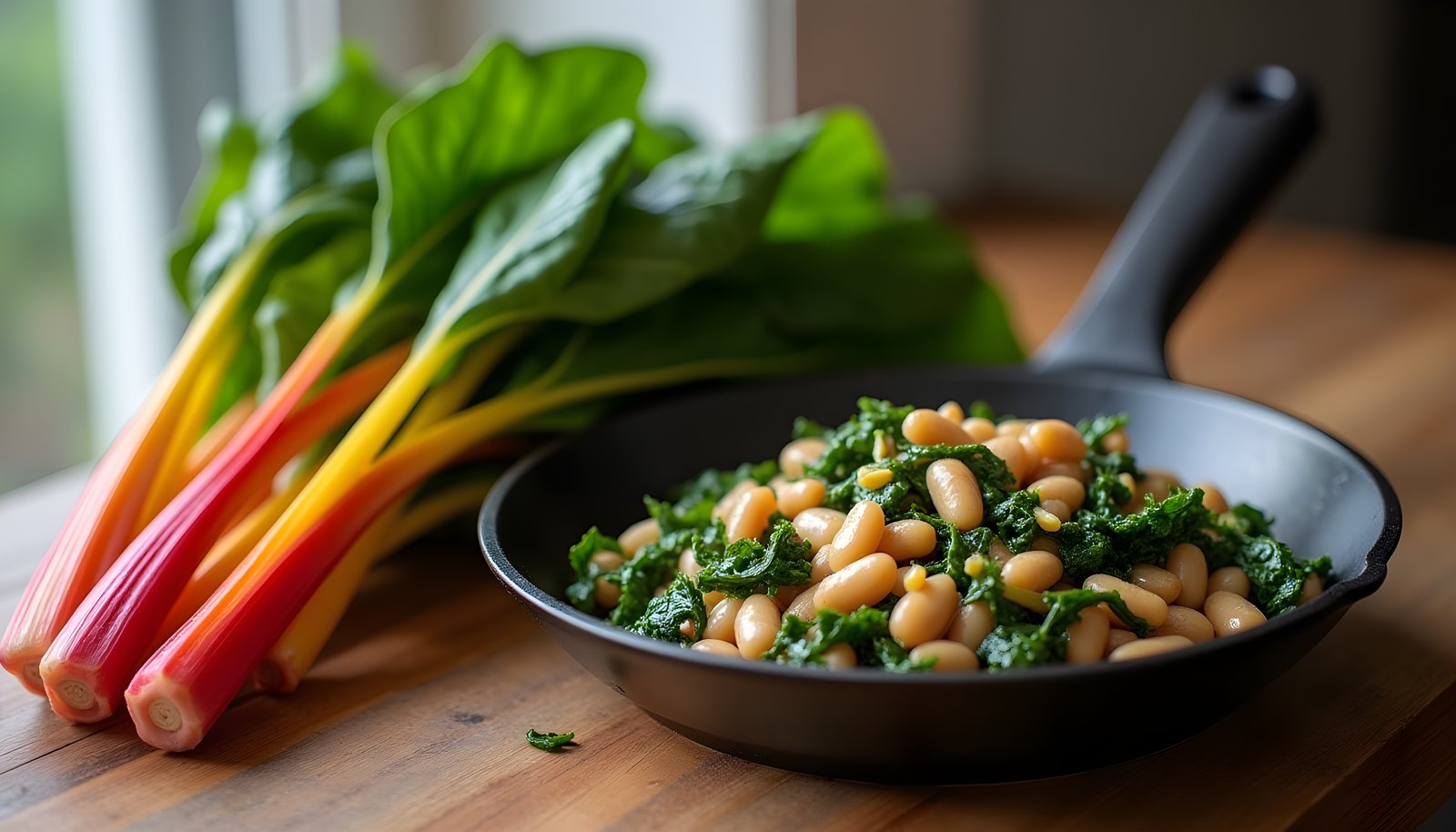
Say you wilt chard in a skillet with garlic and olive oil until you have about a cup of cooked greens. Stir in half a cup of cooked navy beans and finish with lemon.
The chard brings about 3.7 grams of fiber. The navy beans add about 9.6 grams, according to the Dietary Guidelines, bringing the skillet to roughly 13.3 grams of fiber.
Serve it over a cup of brown rice, which Mayo Clinic lists at about 3.5 grams, and the plate reaches nearly 17 grams. That’s well over half of a woman’s daily target from one simple dinner.
Prefer lentils? Half a cup of cooked lentils adds about 7.8 grams of fiber on the Dietary Guidelines list, so the chard and lentil version still reaches about 11.5 grams before the rice.
Swiss chard on a low carb plate
Chard fits easily into lower carb eating. A cup of boiled chard has about 7.2 grams of carbohydrate, and 3.7 grams of that is fiber, leaving roughly 3.5 grams of net carbs.
It also has under 2 grams of sugar per cup and about 3.3 grams of protein. Two cups of cooked chard alongside fish, chicken or eggs adds more than 7 grams of fiber while keeping net carbs around 7 grams.
Because it cooks down so much, chard is a practical way to add volume and nutrients to a low carb meal without much effort. A skillet of greens fills the plate and stretches the meal, and leftovers fold easily into omelets the next morning.
Leaves, stems and colors
Swiss chard comes with thick, crunchy stems in white, red, yellow or rainbow mixes. The stems are edible and take a few minutes longer to cook than the leaves, so you can slice them and start them in the pan first.
Using the whole plant means less waste and more food from each bunch. The colorful stems also make the dish look better on the plate, and they give a crisp contrast to the soft leaves.
Looking for more ways to use greens like chard in everyday meals? Our recipe eBooks are packed with easy, high fiber ideas.
What Swiss chard fiber does for digestion
Fiber from chard works like fiber from other vegetables. Mayo Clinic explains that fiber increases the weight and size of stool and softens it, which makes it easier to pass and helps prevent constipation.
Mayo Clinic also notes that high fiber foods tend to be more filling and are linked with healthier cholesterol and steadier blood sugar. A low calorie green with this much nutrition is an easy way to build toward those benefits.
If you’re increasing fiber from several foods at once, give your gut time to adjust. Mayo Clinic recommends adding fiber gradually over a few weeks and drinking plenty of water.
If digestion is a sticking point for you, our gut health guides walk you through a gentler approach step by step.
When to reach for Swiss chard
A simple way to decide where chard fits:
- For the most fiber from a green: pick turnip greens, collards or kale, which carry about a gram more per cup
- For magnesium and potassium: chard is a standout, with about 36% and 20% of the Daily Value per cooked cup
- For a quick side: chard wilts fast and works anywhere you’d use spinach
- For a full meal: pair it with beans, lentils or whole grains to push the fiber past 10 grams
Rotating your greens through the week is a simple way to get the best of each. Chard brings the magnesium and potassium, while collards, kale and turnip greens bring a little more fiber per cup.
Cook one bunch this week
Pick up a bunch of Swiss chard and cook the whole thing at once, stems and all. Keep the cooked greens in the fridge and fold a cup into eggs, soups, pasta or grain bowls over the next few days. Each cup adds about 3.7 grams of fiber and more than a third of your daily magnesium for only 35 calories.
Swiss chard questions people ask
Is Swiss chard high in fiber?
It’s a moderate source. A cup of boiled Swiss chard has about 3.7 grams of fiber, around 13% of the 28 gram Daily Value, for 35 calories.
Does cooked Swiss chard have more fiber than raw?
Per gram, yes. USDA lists boiled chard at 2.1 grams of fiber per 100 grams and raw chard at 1.6 grams.
Is Swiss chard better than spinach?
They’re close. Cooked spinach has a little more fiber at 4.3 grams per cup, while cooked chard has 3.7 grams and is a strong source of magnesium and potassium.
What vitamins are in Swiss chard?
Chard is rich in vitamin K, vitamin A and vitamin C. A cooked cup has about 478% of the Daily Value for vitamin K, 60% for vitamin A and 35% for vitamin C.
Is Swiss chard high in magnesium?
Yes. A cup of boiled chard has about 151 mg of magnesium, roughly 36% of the Daily Value, according to USDA.
Can you eat Swiss chard stems?
Yes. The stems are edible and slightly crunchier than the leaves, so they take a few extra minutes to cook.
How many calories are in Swiss chard?
About 35 calories in a cup of chopped boiled chard and about 9 in a large raw leaf.
Sources
- USDA Agricultural Research Service. FoodData Central: SR Legacy Chard, swiss, raw (169991); Chard, swiss, cooked, boiled, drained, without salt (170401). 2019. fdc.nal.usda.gov
- U.S. Department of Agriculture and U.S. Department of Health and Human Services. “Food Sources of Dietary Fiber.” Dietary Guidelines for Americans, 2020 to 2025. dietaryguidelines.gov
- U.S. Food and Drug Administration. “Daily Value on the Nutrition and Supplement Facts Labels.” 2024. fda.gov
- National Institutes of Health Office of Dietary Supplements. “Vitamin K: Fact Sheet for Consumers.” 2021. ods.od.nih.gov
- National Institutes of Health Office of Dietary Supplements. “Magnesium: Fact Sheet for Consumers.” 2021. ods.od.nih.gov
- Mayo Clinic Staff. “Dietary fiber: Essential for a healthy diet.” Mayo Clinic. 2025. mayoclinic.org