
In this article
- A mushroom that grows like wood
- Reishi mushroom fiber, measured in the lab
- Tea, extract or powder: what each form keeps
- How reishi compares with mushrooms you cook
- Reishi next to everyday fiber add ins
- Immune and digestion claims, and what’s been tested
- An evening routine, adjusted
- Clues on a reishi label
- Where reishi research may go next
- Reishi and fiber: your questions
- Sources
Say you brew a mug of reishi tea every evening, partly because you’ve read that mushrooms are full of fiber. On paper, you’re right: reishi mushroom fiber makes up about 64% of the dried mushroom in a 2024 lab analysis, a remarkably high share for any food.
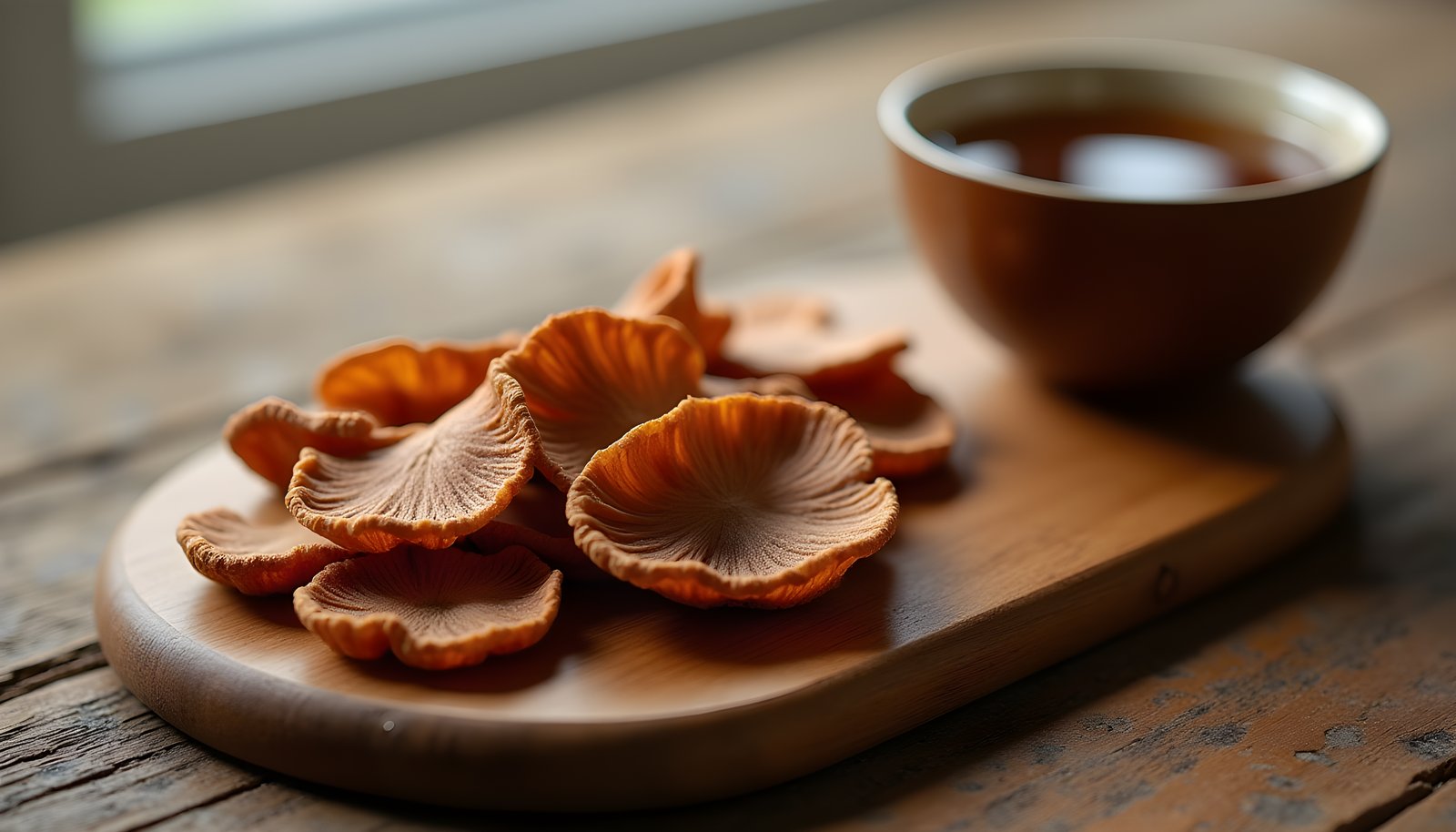
In the mug, it’s a different story. Reishi is woody and tough, so nearly everyone drinks it as tea or takes it as an extract, and the hot water pulls out only a small slice of that fiber.
A mushroom that grows like wood
Reishi, sold under the name Ganoderma lucidum, is a bracket fungus rather than a soft capped mushroom. The National Cancer Institute’s summary on medicinal mushrooms describes it as a woody polypore that grows on live trees, known as lingzhi in traditional Chinese medicine.
That same summary notes a naming wrinkle. The East Asian mushroom long called G. lucidum is now classified as Ganoderma sichuanense, though most research still uses the older name.
Unlike shiitake or oyster mushrooms, reishi isn’t something you slice into a stir fry. Its tough, corky flesh is the reason the fiber story plays out so differently from culinary mushrooms.
Reishi mushroom fiber, measured in the lab
A 2024 study in the journal Foods by Peng and colleagues compared dried fruiting bodies of G. lucidum with a close relative, G. leucocontextum. Here’s what they found for reishi:
| Dried reishi fruiting body | Amount per 100 g |
|---|---|
| Total dietary fiber | 64.2 g |
| Protein | 14.0 g |
| Fat | 2.0 g |
| Moisture | 9.6 g |
| Ash (minerals) | 1.2 g |
| Water soluble polysaccharides | about 1.4 g |
The related species came in at 58.9% fiber, so a very high fiber share seems typical for this group. For comparison, the dried shiitake listed in USDA FoodData Central carries 11.5 grams per 100 grams.
The bottom row matters most. The researchers measured 13.68 milligrams of water soluble polysaccharides per gram of reishi, which works out to roughly 1.4% of the mushroom.
Tea, extract or powder: what each form keeps
Most reishi fiber is locked in the mushroom’s rigid structure. Those insoluble parts don’t dissolve in hot water, so they stay with the spent slices when you strain your tea.
Harvard’s Nutrition Source describes insoluble fiber as the kind that doesn’t dissolve in water and helps food move through your digestive system. That’s exactly the portion a cup of tea leaves behind.
What does end up in the cup is a share of the water soluble polysaccharides, which the Foods study put at about 1.4% of the dried mushroom. Even if a few grams of reishi gave up all of it, the tea would hold only a small fraction of a gram.
| Reishi form | What you consume | Fiber it can deliver |
|---|---|---|
| Tea from slices | Hot water and dissolved compounds | Very little; the woody fiber is strained out |
| Hot water extract | Concentrated soluble fraction | Mostly polysaccharides, little insoluble fiber |
| Ground whole fruiting body | The entire dried mushroom | About 0.6 g per gram of powder |
| Mycelium powder | The fungus’s thread like network | Depends on the product; check the label |
Only finely ground whole reishi lets you swallow the fiber itself. At about 64% fiber, a 2 gram serving would carry roughly 1.3 grams, and a 1 gram serving about 0.6 grams.
Not sure what daily fiber number you’re working toward? Our fiber calculator gives you a personal target in a few seconds.
How reishi compares with mushrooms you cook
The USDA’s newer Foundation Foods data measures fiber in fresh culinary mushrooms. Unlike reishi, these are eaten in full servings, so their fiber actually lands on your plate:
| Mushroom | Amount | Fiber |
|---|---|---|
| Lion’s mane, raw | 100 g | 4.38 g |
| Shiitake, raw | 100 g | 4.17 g |
| Maitake, raw | 100 g | 3.07 g |
| King oyster, raw | 100 g | 3.01 g |
| White button, raw | 100 g | 1.72 g |
| Mushrooms, cooked (Dietary Guidelines) | 1 cup | 3.4 g |
| Reishi powder, whole ground (estimate) | 2 g | about 1.3 g |
| Reishi tea | 1 cup | a small fraction of a gram |
Those fresh numbers look smaller than reishi’s 64% only because fresh mushrooms are mostly water. USDA lists raw lion’s mane and shiitake at 88.6% water and white button at 91.8%, so the fiber is diluted, not missing.
A cup of cooked mushrooms gives you 3.4 grams of fiber, according to the Dietary Guidelines food source list. That’s more than double a generous spoonful of whole reishi powder and far more than a mug of tea.
Comparing reishi with other mushroom supplements and fiber products? Our comparison charts put the popular options side by side.
Reishi next to everyday fiber add ins
If you’re spooning reishi powder into a smoothie or oatmeal, it helps to see what else could go in that spoon. The add in values below come from the Dietary Guidelines food source list, and the percentages use the FDA’s 28 gram Daily Value:
| Add in | Amount | Fiber | % Daily Value |
|---|---|---|---|
| Reishi powder, whole ground (estimate) | 2 g | about 1.3 g | 5% |
| Flaxseed | 1 tablespoon | 2.8 g | 10% |
| Oat bran, cooked | 1/2 cup | 2.9 g | 10% |
| Chia seeds | 1 tablespoon | 4.1 g | 15% |
| Raspberries | 1 cup | 8.0 g | 29% |
Per gram, ground reishi is denser in fiber than chia. The difference is serving size: you’d eat a tablespoon of chia without thinking, while reishi powder is usually measured in a gram or two.
That makes reishi a small contributor even in its most fiber friendly form. It can sit alongside the bigger players, but it won’t replace them.
Immune and digestion claims, and what’s been tested
Reishi is mostly marketed for immune digestion support and general wellness, and its polysaccharides and triterpenes get most of the attention. The NCI summary lists triterpenoids, polysaccharides, lipids and proteins as its main compounds.
Human research is thin and mixed. In one open label study of lung cancer patients covered by the NCI, a water based reishi polysaccharide product taken at 1,800 milligrams three times a day for 12 weeks didn’t significantly change most immune measures.
In another, nonrandomized study, people taking 1.5 grams a day of a water soluble reishi mycelium extract for 12 months had fewer colorectal adenomas than an untreated group. The NCI is clear that the FDA hasn’t approved medicinal mushrooms as a treatment for cancer.
None of these studies tested reishi as a fiber source. Harvard notes that soluble fiber can help lower blood glucose and cholesterol, and reishi’s water soluble polysaccharides may count toward that side, but at these doses they add little to your daily fiber total.
If your real goal is steadier digestion, our gut health guides walk you through building more fiber into your meals without the discomfort.
An evening routine, adjusted
Go back to that nightly mug of reishi tea. On its own it adds almost nothing to your fiber count, and that’s fine if you enjoy the ritual.
Now pair it with a dinner that includes a cup of sautéed mushrooms and half a cup of lentils. Using the Dietary Guidelines values of 3.4 grams and 7.8 grams, that plate brings about 11.2 grams before you even count the rest of the meal.
The tea stays, and the fiber comes from food you were going to eat anyway. Harvard’s Nutrition Source puts adult needs at 25 to 35 grams a day and notes that most Americans get about 15, so a plate like this closes a big part of that gap.
Clues on a reishi label
- Look for the part used. “Fruiting body” means the mushroom itself, while “mycelium” is the fungus’s thread like network, which has a different makeup.
- Check for “extract” versus “powder.” Extracts concentrate soluble compounds; ground powder keeps the woody fiber.
- Find the fiber line. A small serving may round down to 0 or 1 gram on the Nutrition Facts panel, which matches the math above.
- Expect variation. The NCI notes that supplement ingredients can vary considerably from lot to lot, and label claims aren’t guaranteed.
Serving sizes on reishi products are often listed in milligrams or a single gram. Multiply that weight by about 0.64 for whole fruiting body powder to get a rough fiber estimate, and expect extracts to land well below it.
The FDA counts a food with 20% of the Daily Value per serving as a high source, which is 5.6 grams of fiber. No reishi serving comes close, so treat any fiber claim on the label as a bonus rather than the reason to buy.
Where reishi research may go next
Reishi’s fiber is real, but it’s packed into a form people rarely eat. Researchers are now comparing Ganoderma species side by side, as the 2024 Foods study did, which may help sort out which products deliver which compounds. In that study, the related species carried about twice the triterpenes of reishi, at 14.19 versus 7.08 milligrams per gram, while reishi held more fiber.
The species renaming and the wide differences between products both point the same way. Until studies match specific, well labeled products to real outcomes, the safest fiber plan is a plain one: let cooked mushrooms, beans, whole grains and fruit do the work, and treat reishi as a separate choice.
Reishi and fiber: your questions
Is reishi mushroom high in fiber?
Yes, by weight. Dried reishi was about 64% dietary fiber in a 2024 analysis, but most people consume it as tea or extract, which carries little of that fiber.
Does reishi tea have fiber?
Very little. The woody insoluble fiber stays in the strained slices, and only a small share of soluble polysaccharides dissolves into the water.
How much fiber is in reishi powder?
Whole ground reishi works out to about 0.6 grams of fiber per gram of powder. Extract powders hold far less because the insoluble fiber is removed.
Is reishi fiber soluble or insoluble?
Mostly insoluble. The Foods study measured water soluble polysaccharides at only about 1.4% of the dried mushroom, compared with 64% total fiber.
Do cooked mushrooms have more usable fiber than reishi?
Yes. A cup of cooked mushrooms has 3.4 grams of fiber, and you eat all of it, unlike reishi tea.
Can reishi support digestion?
There’s little direct evidence. Human studies have focused on immune markers and cancer related outcomes, not on reishi as a fiber source.
Is reishi mycelium the same as the mushroom?
No. Mycelium is the thread like network the fungus grows from, so its makeup can differ from the fruiting body that most fiber data describes.
Sources
- Peng G, Xiong C, Zeng X, Jin Y, Huang W. “Exploring Nutrient Profiles, Phytochemical Composition, and the Antiproliferative Activity of Ganoderma lucidum and Ganoderma leucocontextum: A Comprehensive Comparative Study.” Foods. 2024. mdpi-res.com
- PDQ Integrative, Alternative, and Complementary Therapies Editorial Board. “Medicinal Mushrooms (PDQ), Health Professional Version.” National Cancer Institute. 2024. www.cancer.gov
- U.S. Department of Agriculture, Agricultural Research Service. “Mushroom, lion’s mane (1999626); Mushrooms, shiitake (1999628); Mushrooms, white button (1999629); Mushroom, maitake (2003602); Mushroom, king oyster (2003599); Mushrooms, shiitake, dried (168436).” FoodData Central. 2019 to 2020. fdc.nal.usda.gov
- U.S. Department of Agriculture and U.S. Department of Health and Human Services. “Food Sources of Dietary Fiber.” Dietary Guidelines for Americans, 2020 to 2025. dietaryguidelines.gov
- U.S. Food and Drug Administration. “Daily Value on the Nutrition and Supplement Facts Labels.” 2024. www.fda.gov
- Harvard T.H. Chan School of Public Health. “Fiber.” The Nutrition Source. 2024. nutritionsource.hsph.harvard.edu